An X-Ray Face-on View of the Sgr B Molecular Clouds Observed with Suzaku
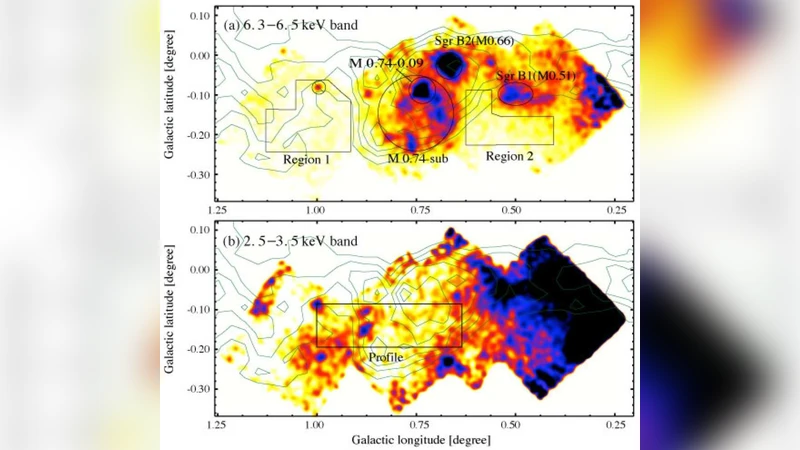
We present a new methodology to derive the positions of the Sgr B molecular clouds (MCs) along the line of sight, as an application study of the Galactic center diffuse X-rays (GCDX). The GCDX is composed of hot plasma emission of about 7 keV and 1 keV temperatures, and non-thermal continuum emission including the 6.4 keV line from neutral irons. The former, the Galactic center plasma emission (GCPE), is uniformly distributed over 1 degree in longitude, while the latter is clumpy emission produced by Thomson scattering and fluorescence from MCs irradiated by external X-rays (the X-ray reflection nebula emission: XRNE). We examined the Suzaku X-ray spectra of the GCPE and XRNE near to the Sgr B MC complex, and found that the spectra suffer from two different absorptions of N_H (Abs1) >10^23 H cm^-2 and N_H (Abs2) ~6 x 10^22 H cm^-2. Abs1 is proportional to the 6.4 keV-line flux, and hence is due to the MCs, while Abs2 is typical of interstellar absorption toward the Galactic center. Assuming that the GCPE plasma is spherically-extended around Sgr A* with a uniform density and the same angular distribution of the two temperature components, we quantitatively estimated the line-of-sight positions of the MCs from the flux ratio the GCPE spectrum suffered by Abs1 and that with no Abs1. The results suggest that the Sgr B MCs are located at the near side of Sgr A* in the GCPE.
💡 Research Summary
The authors present a novel technique for determining the line‑of‑sight positions of the Sagittarius B (Sgr B) molecular clouds (MCs) by exploiting Suzaku X‑ray observations of the Galactic‑center diffuse X‑ray emission (GCDX). GCDX consists of two distinct components: (1) the Galactic‑center plasma emission (GCPE), a hot thermal plasma with two temperature components (~7 keV and ~1 keV) that is spatially extended and roughly uniform over a one‑degree longitude range around Sgr A*, and (2) the X‑ray reflection nebula emission (XRNE), a non‑thermal continuum plus the neutral‑iron 6.4 keV fluorescence line produced when external hard X‑rays irradiate dense MCs.
Using Suzaku’s X‑ray Imaging Spectrometer (XIS), the authors extracted spectra from regions covering the Sgr B complex. Spectral fitting revealed two independent absorption columns: a very high column (N_H Abs1 > 10^23 cm⁻²) that scales directly with the 6.4 keV line flux, and a moderate column (N_H Abs2 ≈ 6 × 10^22 cm⁻²) consistent with the typical interstellar absorption toward the Galactic center. The authors interpret Abs1 as the intrinsic absorption of the MCs themselves, while Abs2 represents the foreground Galactic‑center absorption that affects all components.
The key assumption of the method is that the GCPE plasma is spherically symmetric about Sgr A*, has a uniform density, and that the two temperature components share the same angular distribution. Under this geometry, the fraction of GCPE emission that is attenuated by Abs1 depends on how much of the plasma lies behind the cloud along the line of sight. By comparing the observed GCPE spectrum (which includes the Abs1 attenuation) with a hypothetical GCPE spectrum that would be observed if the cloud were located behind the entire plasma (i.e., with no Abs1), the authors derive a quantitative measure of the cloud’s depth within the plasma.
Applying this framework to the Sgr B1, Sgr B2, and other sub‑structures, they find that the GCPE component behind each cloud is significantly reduced, indicating that the clouds reside on the near side of Sgr A* relative to the observer. The strongest absorption (Abs1 ≈ 1.5 × 10^23 cm⁻²) is associated with Sgr B2, suggesting it is either the most foreground cloud or the densest part of the complex. Some peripheral regions show lower Abs1 values, hinting at a possible placement deeper within or even behind the plasma.
This approach improves upon earlier distance estimates that relied solely on the 6.4 keV line intensity, which cannot disentangle foreground and background contributions. By directly measuring how much of the hot plasma emission is absorbed, the method yields an absolute line‑of‑sight position rather than a relative one. Moreover, the clear separation of the two absorption components provides insight into the layered structure of interstellar material toward the Galactic center.
The authors discuss broader implications: the technique can be applied to other molecular cloud complexes in the central molecular zone, allowing a three‑dimensional reconstruction of the GCPE and a better understanding of past high‑luminosity episodes of Sgr A* that illuminated the clouds. In addition, the method offers a diagnostic for probing the distribution of dense gas and its interaction with the pervasive hot plasma in galactic nuclei, potentially informing models of feedback, star formation, and the evolution of the central supermassive black hole environment.
Comments & Academic Discussion
Loading comments...
Leave a Comment