Bi-Hamiltonian representation, symmetries and integrals of mixed heavenly and Husain systems
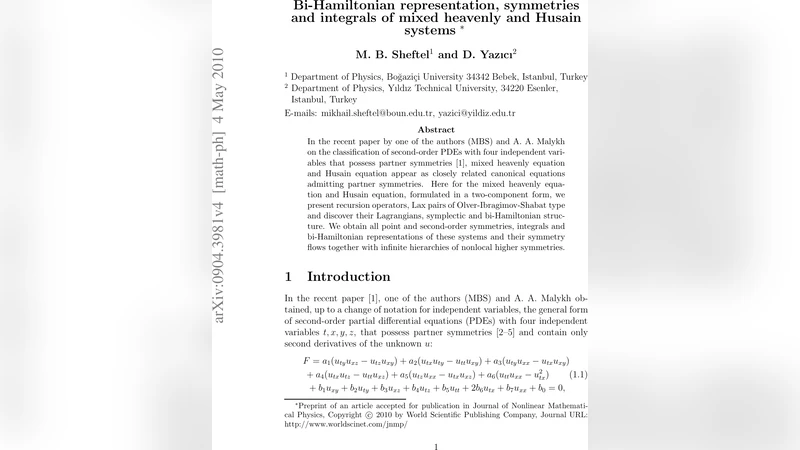
In the recent paper by one of the authors (MBS) and A. A. Malykh on the classification of second-order PDEs with four independent variables that possess partner symmetries (J. Phys. A: Math. Theor. Vol. 42 (2009) 395202 (20pp)), mixed heavenly equation and Husain equation appear as closely related canonical equations admitting partner symmetries. Here for the mixed heavenly equation and Husain equation, formulated in a two-component form, we present recursion operators, Lax pairs of Olver-Ibragimov-Shabat type and discover their Lagrangians, symplectic and bi-Hamiltonian structure. We obtain all point and second-order symmetries, integrals and bi-Hamiltonian representations of these systems and their symmetry flows together with infinite hierarchies of nonlocal higher symmetries.
💡 Research Summary
The paper investigates two prominent four‑dimensional second‑order partial differential equations—the mixed heavenly equation and the Husain equation—both of which were identified in the classification of PDEs admitting partner symmetries (Malykh & MBS, J. Phys. A 42 (2009) 395202). By reformulating each equation as a two‑component first‑order system with dependent variables (u) and (v), the authors bring the hidden geometric structures to the fore and are able to treat both models within a unified framework.
The first major achievement is the construction of Olver‑Ibragimov‑Shabat type Lax pairs for the two‑component systems. The Lax operators (L) and (M) consist of linear differential parts (spatial‑temporal derivatives) and nonlinear potential terms; their commutativity (
Comments & Academic Discussion
Loading comments...
Leave a Comment