Spectral Energy Distribution Fitting: Application to Lyman Alpha-Emitting Galaxies
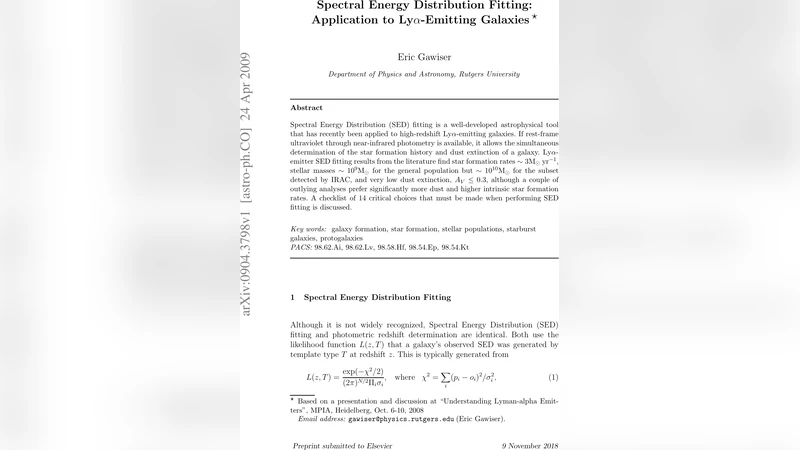
Spectral Energy Distribution (SED) fitting is a well-developed astrophysical tool that has recently been applied to high-redshift Lyman Alpha-emitting galaxies. If rest-frame ultraviolet through near-infrared photometry is available, it allows the simultaneous determination of the star formation history and dust extinction of a galaxy. Lyman Alpha-emitter SED fitting results from the literature find star formation rates ~3 M_sun/yr, stellar masses ~10^9 M_sun for the general population but ~10^10 M_sun for the subset detected by IRAC, and very low dust extinction, A_V < 0.3, although a couple of outlying analyses prefer significantly more dust and higher intrinsic star formation rates. A checklist of 14 critical choices that must be made when performing SED fitting is discussed.
💡 Research Summary
The paper provides a comprehensive review of how spectral energy distribution (SED) fitting has been applied to high‑redshift Lyman‑Alpha‑emitting galaxies (LAEs) and outlines the methodological choices that critically affect the derived physical parameters. The authors begin by emphasizing that LAEs are valuable tracers of early star formation but that Lyman‑α line measurements alone are hampered by resonant scattering and uncertain dust attenuation. By exploiting broadband photometry from the rest‑frame ultraviolet through the near‑infrared (including Spitzer/IRAC channels), SED fitting can simultaneously constrain star‑formation histories (SFHs), stellar masses, and internal dust extinction (A_V).
The methodological section details the components of a typical SED model: an initial mass function (usually Salpeter or Chabrier), stellar population synthesis libraries (e.g., Bruzual & Charlot 2003 or FSPS), a metallicity grid spanning ~0.2–1 Z⊙, and a set of dust attenuation curves (Calzetti, SMC, or Reddy). Star‑formation histories are represented by constant, exponentially declining, or burst‑like prescriptions. The authors stress that each of these choices introduces systematic shifts of order 0.2–0.3 dex in stellar mass and can alter inferred star‑formation rates (SFRs) by factors of two or more.
Observationally, the review highlights that most LAE samples are assembled from deep optical imaging (e.g., Subaru Suprime‑Cam) and HST optical/NIR data, while a minority have detections in the IRAC 3.6 µm and 4.5 µm bands. The inclusion of IRAC fluxes dramatically improves mass estimates because the rest‑frame optical light, which dominates the mass‑to‑light ratio, is directly probed. When IRAC data are available, typical LAE stellar masses rise from ~10⁹ M⊙ to ~10¹⁰ M⊙, and the inferred dust extinction can increase to A_V ≈ 0.5–1.0, depending on the attenuation law adopted.
The literature synthesis shows a consensus that the bulk of LAEs have modest SFRs of ~3 M⊙ yr⁻¹, low dust content (A_V < 0.3), and stellar masses around 10⁹ M⊙. However, a subset of IRAC‑detected LAEs appears more massive and possibly more obscured, leading some studies to report SFRs an order of magnitude higher. These divergent results are traced back to differences in model assumptions, treatment of non‑detections (upper limits), and the handling of photometric uncertainties.
A central contribution of the paper is a checklist of fourteen critical decisions that must be made when performing SED fitting on LAEs. The checklist includes: (1) choice of IMF, (2) metallicity range, (3) SFH parameterization, (4) dust attenuation curve, (5) treatment of nebular emission lines, (6) photometric error modeling, (7) filter transmission curve application, (8) line‑continuum separation, (9) fitting algorithm (χ² minimization vs. Bayesian inference), (10) prior distributions for parameters, (11) handling of upper limits, (12) inclusion of IRAC or longer‑wavelength data, (13) bias checks (e.g., Monte‑Carlo simulations), and (14) reproducibility practices such as code and data sharing. By following this checklist, researchers can reduce systematic biases and improve the comparability of results across different studies.
In the concluding remarks, the authors anticipate that forthcoming facilities—particularly the James Webb Space Telescope—will provide deeper, higher‑resolution NIRCam and MIRI photometry for LAEs. This will tighten constraints on stellar masses, enable more reliable dust attenuation measurements, and allow direct testing of the assumed SFH models. Ultimately, the paper argues that rigorous, transparent SED fitting, guided by the presented checklist, is essential for unlocking the full potential of LAEs as probes of galaxy formation in the early universe.
Comments & Academic Discussion
Loading comments...
Leave a Comment