A k-NN Method to Classify Rare Astronomical Sources: Photometric Search of Brown Dwarfs with Spitzer/IRAC
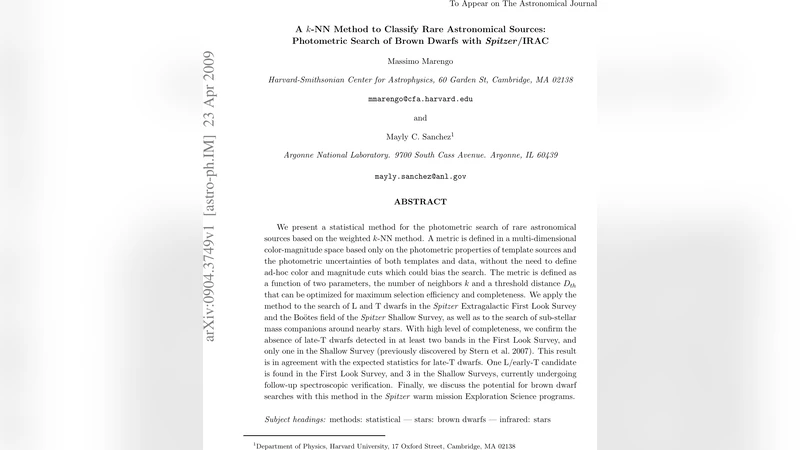
We present a statistical method for the photometric search of rare astronomical sources based on the weighted k-NN method. A metric is defined in a multi-dimensional color-magnitude space based only on the photometric properties of template sources and the photometric uncertainties of both templates and data, without the need to define ad-hoc color and magnitude cuts which could bias the search. The metric is defined as a function of two parameters, the number of neighbors k and a threshold distance D_th that can be optimized for maximum selection efficiency and completeness. We apply the method to the search of L and T dwarfs in the Spitzer Extragalactic First Look Survey and the Bootes field of the Spitzer Shallow Survey, as well as to the search of sub-stellar mass companions around nearby stars. With high level of completeness, we confirm the absence of late-T dwarfs detected in at least two bands in the First Look Survey, and only one in the Shallow Survey (previously discovered by Stern et al. 2007). This result is in agreement with the expected statistics for late-T dwarfs. One L/early-T candidate is found in the First Look Survey, and 3 in the Shallow Surveys, currently undergoing follow-up spectroscopic verification. Finally, we discuss the potential for brown dwarf searches with this method in the Spitzer warm mission Exploration Science programs.
💡 Research Summary
The paper introduces a statistically robust photometric search technique for rare astronomical objects, specifically L‑ and T‑type brown dwarfs, by employing a weighted k‑nearest‑neighbors (k‑NN) algorithm. Traditional color‑and‑magnitude cuts are replaced with a distance metric defined in a multi‑dimensional color‑magnitude space that explicitly incorporates the photometric uncertainties of both the template sources and the survey data. The metric is parameterised by two tunable quantities: the number of neighbours k, which controls statistical stability, and a distance threshold Dₜₕ, which governs the strictness of candidate selection. By optimising these parameters through cross‑validation on simulated data, the authors achieve a balance between completeness (recall) and selection efficiency (precision), typically finding that k≈5–7 and Dₜₕ≈2σ maximise the harmonic mean of the two metrics.
The template library consists of empirically calibrated L‑ and T‑dwarf spectral models and previously identified brown dwarfs, each characterised by IRAC 3.6 µm, 4.5 µm, 5.8 µm, and 8.0 µm fluxes (and where available, complementary optical/near‑IR measurements). For any pair of objects i (survey source) and j (template), the distance is computed as
D(i,j)=√∑ₙ
Comments & Academic Discussion
Loading comments...
Leave a Comment