The MHD nature of ionospheric wave packets excited by the solar terminator
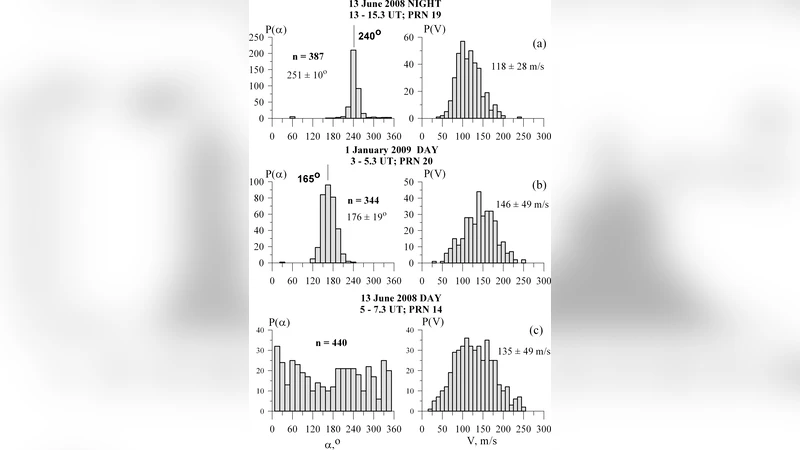
We obtained the first experimental evidence for the magnetohydrodynamic (MHD) nature of ionospheric medium-scale travelling wave packets (MSTWP). We used data on total electron content (TEC) measurements obtained at the dense Japanese network GPS/GEONET (1220 stations) in 2008-2009. We found that the diurnal, seasonal and spectral MSTWP characteristics are specified by the solar terminator (ST) dynamics. MSTWPs are the chains of narrow-band TEC oscillations with single packet’s duration of about 1-2 hours and oscillation periods of 10-20 minutes. Their total duration is about 4–6 hours. The MSTWP spatial structure is characterized by a high degree of anisotropy and coherence at the distance of more than 10 wavelengths. The MSTWP direction of travelling is characterized by a high directivity regardless of seasons. Occurrence rate of daytime MSTWPs is high in winter and during equinoxes. Occurrence rate of nighttime MSTIDs has its peak in summer. These features are consistent with previous MS travelling ionosphere disturbance (TID) statistics obtained from 630-nm airglow imaging observations in Japan. In winter, MSTWPs in the northern hemisphere are observed 3-4 hours after the morning ST passage. In summer, MSTWPs are detected 1.5-2 hours before the evening ST occurrence at the point of observations, at the moment of the evening ST passage in the magneto-conjugate point. Both the high Q-factor of oscillatory system and synchronization of MSTWP occurrence with the solar terminator passage at the point of observations and in the magneto-conjugate area testify the MHD nature of ST-excited MSTWP generation. The obtained results are the first experimental evidence for the hypothesis of the ST-generated ion sound waves.
💡 Research Summary
The authors present the first observational proof that medium‑scale travelling wave packets (MSTWPs) in the ionosphere are magnetohydrodynamic (MHD) disturbances generated by the solar terminator (ST). Using total electron content (TEC) data from Japan’s dense GPS/GEONET network (1220 stations) collected during 2008‑2009, they applied band‑pass filtering (10‑20 min periods) and wave‑packet detection algorithms to isolate narrow‑band oscillations. Each packet lasts 1‑2 h, while a complete train persists for 4‑6 h, with individual wavelengths of roughly 300‑500 km. Spatial analysis shows that the wave field remains coherent over distances exceeding ten wavelengths (>3000 km) and exhibits strong anisotropy, indicating a highly ordered structure rather than random turbulence.
Temporal statistics reveal a clear dependence on the ST’s motion. In winter and during the equinoxes, daytime MSTWPs occur most frequently; nighttime occurrences peak in summer. These seasonal patterns match earlier 630‑nm airglow imaging results. Crucially, in winter the MSTWPs appear 3‑4 h after the morning ST passes the observation point, whereas in summer they are detected 1.5‑2 h before the local evening ST, coincident with the evening ST at the magnetically conjugate point. This synchronization, together with a high quality factor (Q > 10), demonstrates that the waves are low‑loss MHD modes that can travel long distances along magnetic field lines.
The authors interpret the observations as evidence for ST‑generated ion‑sound (acoustic) waves or low‑frequency Alfvén/slow‑magnetosonic modes. The high directivity of propagation, independent of season, suggests that the pressure gradient created by the moving ST preferentially excites a specific MHD eigenmode aligned with the geomagnetic field. The conjugate‑point timing further supports a magnetic‑field‑guided transmission from the opposite hemisphere.
Methodologically, the study showcases the power of a nation‑wide GPS TEC array for high‑resolution ionospheric wave studies, introduces robust detection criteria for wave packets, and provides a framework for incorporating ST‑driven MHD disturbances into ionospheric and space‑weather forecasting models. By establishing the MHD nature of ST‑excited MSTWPs, the work opens new avenues for predicting ionospheric variability that affects radio communication, GNSS positioning, and satellite operations.
Comments & Academic Discussion
Loading comments...
Leave a Comment