On a class of second-order PDEs admitting partner symmetries
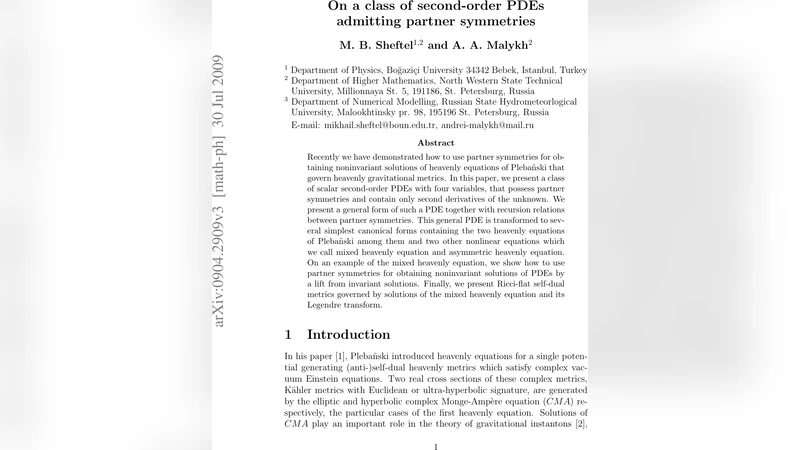
Recently we have demonstrated how to use partner symmetries for obtaining noninvariant solutions of heavenly equations of Plebanski that govern heavenly gravitational metrics. In this paper, we present a class of scalar second-order PDEs with four variables, that possess partner symmetries and contain only second derivatives of the unknown. We present a general form of such a PDE together with recursion relations between partner symmetries. This general PDE is transformed to several simplest canonical forms containing the two heavenly equations of Plebanski among them and two other nonlinear equations which we call mixed heavenly equation and asymmetric heavenly equation. On an example of the mixed heavenly equation, we show how to use partner symmetries for obtaining noninvariant solutions of PDEs by a lift from invariant solutions. Finally, we present Ricci-flat self-dual metrics governed by solutions of the mixed heavenly equation and its Legendre transform.
💡 Research Summary
The paper extends the recently introduced concept of partner symmetries – a special type of non‑local symmetry that maps one solution of a nonlinear PDE to another – from the well‑studied heavenly equations of Plebanski to a broader class of second‑order scalar partial differential equations in four independent variables. The authors first restrict attention to equations that involve only second derivatives of the unknown function (u(x^1,x^2,x^3,x^4)). Under this restriction the most general form that admits a partner symmetry can be written as a quadratic expression in the Hessian components, \
Comments & Academic Discussion
Loading comments...
Leave a Comment