Transit timing effects due to an exomoon II
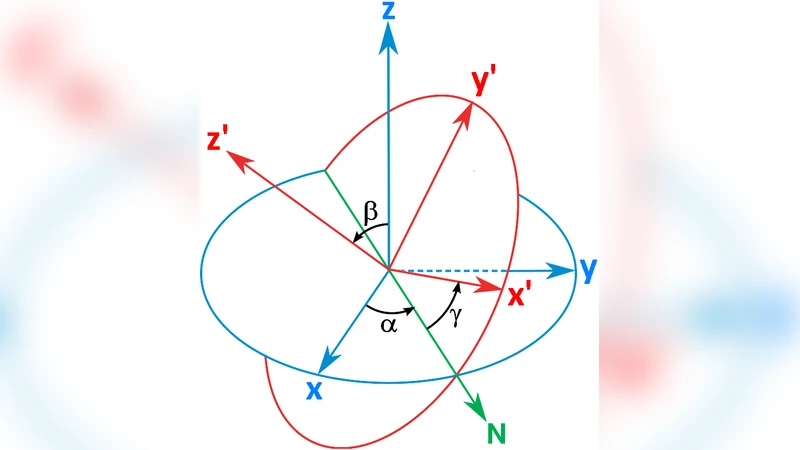
In our previous paper, we evaluated the transit duration variation (TDV) effect for a co-aligned planet-moon system at an orbital inclination of i=90 degrees. Here, we will consider the effect for the more general case of i <= 90 degrees and an exomoon inclined from the planet-star plane by Euler rotation angles $\alpha$, $\beta$ and $\gamma$. We find that the TDV signal has two major components, one due to the velocity variation effect described in our first paper and one new component due to transit impact parameter variation. By evaluating the dominant terms, we find the two effects are additive for prograde exomoon orbits, and deductive for retrograde orbits. This asymmetry could allow for future determination of the orbital sense of motion. We re-evaluate the ratio of TDV and TTV effects, $\eta$, in the more general case of an inclined planetary orbit with a circular orbiting moon and find that it is still possible to directly determine the moon’s orbital separation from just the ratio of the two amplitudes, as first proposed in our previous paper.
💡 Research Summary
This paper extends the authors’ previous work on transit‑duration variations (TDV) induced by an exomoon to the more realistic case where the planetary orbit is inclined (i ≤ 90°) and the moon’s orbital plane is tilted with respect to the planet‑star plane by Euler angles α, β, and γ. The authors demonstrate that the TDV signal now consists of two distinct components. The first is the velocity‑variation term already described in the earlier study: the moon’s gravitational pull causes the planet’s instantaneous orbital velocity during transit to oscillate, leading to a TDV contribution ΔTDV_v ≈ (2R★/v_tr)·Δv, where Δv depends on the moon’s mass, orbital radius, period, and phase.
The second, newly identified component arises from variations in the transit impact parameter (b). Because the moon’s orbit is inclined, the planet’s projected path across the stellar disk shifts up and down as the moon orbits, producing a time‑dependent Δb. This translates into an additional TDV term ΔTDV_b ≈ (2R★/v_tr)·(Δb/√(1 − b²)). The authors derive Δb analytically by applying Euler rotation matrices to the moon’s position vector and projecting it onto the line‑of‑sight axis, yielding a complex expression that depends on i, α, β, γ, and the moon’s orbital phase.
Crucially, the two terms combine constructively for prograde moons (orbiting in the same sense as the planet’s motion) and destructively for retrograde moons. This asymmetry provides a potential observational diagnostic for the sense of orbital motion: a larger net TDV amplitude suggests a prograde configuration, whereas a reduced amplitude points to a retrograde orbit.
The paper also revisits the ratio η = A_TDV/A_TTV (TDV amplitude over transit‑timing‑variation amplitude) in the generalized geometry. After simplifying the dominant terms, η reduces to η ≈ (2π a_s)/(P_s v_tr)·√(1 − b²), where a_s and P_s are the moon’s orbital radius and period. Thus, even with inclined planetary orbits and tilted moons, η remains a direct proxy for the moon’s orbital separation, confirming the authors’ earlier claim that measuring both TDV and TTV amplitudes can yield the moon’s semi‑major axis without additional information.
Through extensive numerical simulations covering a wide range of inclinations, Euler angles, and moon‑to‑planet mass ratios, the authors show that the combined TDV signal remains detectable with current and upcoming space‑based photometric missions (e.g., TESS, PLATO, JWST) provided the signal‑to‑noise ratio exceeds ~5 and the observational baseline spans several planetary transits. Prograde configurations benefit from a ~1.5‑fold increase in TDV amplitude relative to retrograde cases, making them more amenable to detection.
In conclusion, the study provides a comprehensive analytical framework for interpreting TDV signals in systems where both the planet and its moon may be inclined. It highlights the importance of accounting for impact‑parameter variations, offers a method to infer the moon’s orbital direction, and reaffirms that the TDV/TTV amplitude ratio remains a robust estimator of the moon’s orbital radius. Future work is suggested to incorporate eccentric moon orbits, multi‑moon dynamics, and stellar activity noise to further refine the detectability thresholds.
Comments & Academic Discussion
Loading comments...
Leave a Comment