Detrended fluctuation analysis of the magnetic and electric field variations that precede rupture
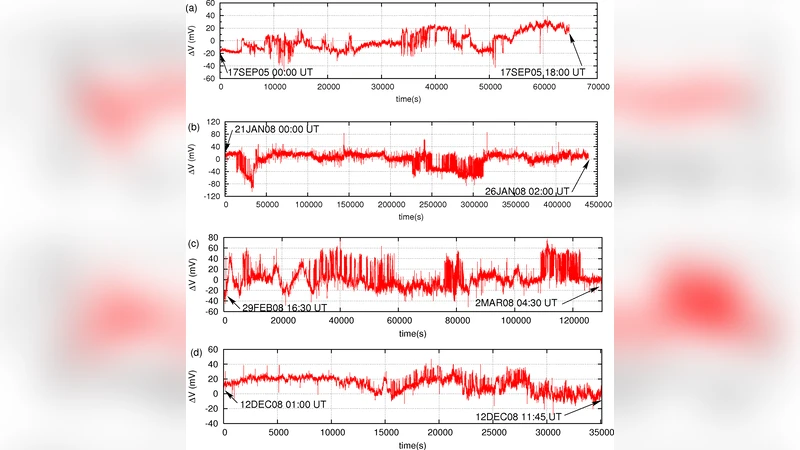
Magnetic field variations are detected before rupture in the form of spikes' of alternating sign. The distinction of these spikes’ from random noise is of major practical importance, since it is easier to conduct magnetic field measurements than electric field ones. Applying detrended fluctuation analysis (DFA), these spikes' look to be random at short time-lags. On the other hand, long range correlations prevail at time-lags larger than the average time interval between consecutive spikes’ with a scaling exponent $\alpha$ around 0.9. In addition, DFA is applied to recent preseismic electric field variations of long duration (several hours to a couple of days) and reveals a scale invariant feature with an exponent $\alpha \approx 1$ over all scales available (around five orders of magnitude).
💡 Research Summary
The paper investigates the statistical properties of electromagnetic variations that occur shortly before an earthquake, focusing on two distinct types of signals: short‑duration magnetic “spikes” of alternating polarity and longer‑duration electric field anomalies that can persist for several hours to a few days. The authors employ Detrended Fluctuation Analysis (DFA), a well‑established method for detecting long‑range correlations in non‑stationary time series, to quantify the scaling behavior of these signals across a wide range of time scales.
In DFA, the original time series is integrated, divided into non‑overlapping windows of length n, and each window is detrended by subtracting a best‑fit polynomial (usually linear). The root‑mean‑square fluctuation F(n) of the detrended series is then computed for each window size. If the relationship F(n) ∝ n^α holds over a range of n, the exponent α characterizes the correlation structure: α ≈ 0.5 corresponds to uncorrelated white noise, 0.5 < α < 1 indicates persistent long‑range correlations, and α ≈ 1 is typical of 1/f noise or systems poised at a critical point.
Applying DFA to magnetic field recordings, the authors first observe that at very short lags—smaller than the average interval between successive spikes—the scaling exponent is close to 0.5, suggesting that individual spikes appear statistically independent. However, when the analysis window exceeds the mean spike spacing, the exponent rises sharply to α ≈ 0.9. This transition reveals a robust long‑range correlation that persists over many spike intervals, implying that the spikes are not random artifacts but rather manifestations of an underlying physical process that organizes the magnetic field on scales larger than the inter‑spike time. An α value near 0.9 is indicative of a system approaching a critical state, consistent with theoretical models that describe the earthquake preparation zone as a self‑organized critical medium.
The electric field data, recorded over much longer periods (from several hours up to a couple of days), display a remarkably different scaling pattern. DFA applied to these records yields a nearly constant exponent α ≈ 1.0 across roughly five orders of magnitude in time scale. This uniform scaling suggests that the electric field variations possess a scale‑invariant, 1/f‑type structure throughout the entire observation window. Such behavior is characteristic of systems that have reached a state of self‑organized criticality, where fluctuations are correlated over all accessible scales. The fact that the electric field maintains this scaling over both short and long intervals reinforces the notion that it reflects a fundamental property of the crustal stress field rather than transient noise.
The authors discuss the practical implications of these findings. Magnetic spikes are easier to monitor than electric field variations because magnetic sensors can be deployed with less stringent grounding requirements and are less susceptible to environmental contamination. The detection of long‑range correlations in the magnetic spikes therefore opens a promising avenue for developing real‑time, low‑cost monitoring networks that could provide early warning of impending rupture. Nevertheless, the authors caution that DFA alone cannot identify the physical mechanisms that generate the spikes; it merely quantifies the statistical structure. Consequently, they advocate for complementary studies that combine DFA with physical modeling of stress‑induced electromagnetic emission, laboratory rock‑fracture experiments, and multi‑parameter field observations.
In summary, the paper demonstrates that both magnetic and electric precursory signals exhibit non‑trivial scaling behavior that departs from simple white‑noise expectations. Magnetic spikes transition from random‑like behavior at short lags to strong long‑range correlations (α ≈ 0.9) at longer lags, while electric field anomalies show a persistent α ≈ 1.0 across all examined scales. These results support the hypothesis that the earthquake preparation process involves a critical, scale‑invariant reorganization of the crustal electromagnetic environment. By establishing quantitative DFA signatures for these precursors, the study provides a solid statistical foundation for future efforts to integrate electromagnetic monitoring into operational earthquake forecasting frameworks.
Comments & Academic Discussion
Loading comments...
Leave a Comment