Updating the orbital ephemeris of Her X-1; rate of decay and eccentricity of the orbit
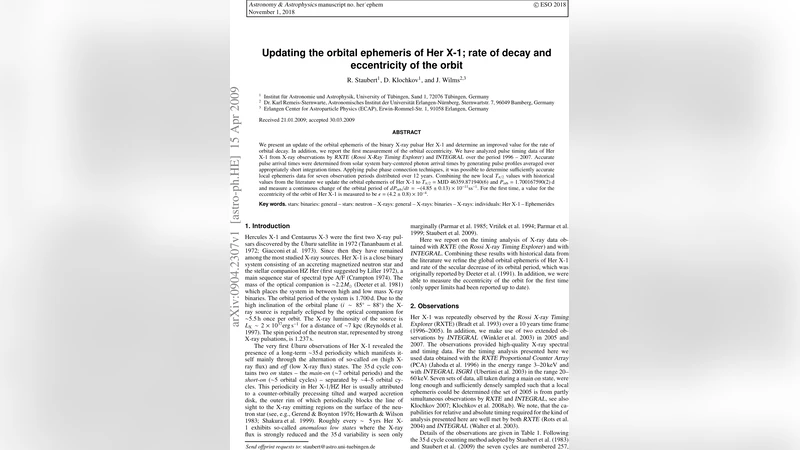
We present an update of the orbital ephemeris of the binary X-ray pulsar Her X-1 and determine an improved value for the rate of orbital decay. In addition, we report the first measurement of the orbital eccentricity. We have analyzed pulse timing data of Her X-1 from X-ray observations by RXTE (Rossi X-Ray Timing Explorer) and INTEGRAL over the period 1996-2007. Accurate pulse arrival times were determined from solar system bary-centered photon arrival times by generating pulse profiles averaged over appropriately short integration times. Applying pulse phase connection techniques, it was possible to determine sufficiently accurate local ephemeris data for seven observation periods distributed over 12 years. Combining the new local T90 values with historical values from the literature we update the orbital ephemeris of Her X-1 to T90 = MJD 46359.871940(6) and Porb = 1.700167590(2) d and measure a continuous change of the orbital period of dPorb/dt = -(4.85 +/- 0.13) x 10-11 s/s. For the first time, a value for the eccentricity of the orbit of Her X-1 is measured to be e = (4.2 +/- 0.8) x 10-4.
💡 Research Summary
The paper presents an updated orbital ephemeris for the well‑studied X‑ray pulsar Her X‑1, based on pulse timing analysis of data collected with the Rossi X‑Ray Timing Explorer (RXTE) and INTEGRAL between 1996 and 2007. The authors first corrected all photon arrival times to the solar‑system barycenter and then generated pulse profiles over short integration intervals (typically 30 s to a few minutes). By cross‑correlating these profiles with a high‑signal‑to‑noise template, precise pulse arrival times (ToAs) were obtained.
A pulse‑phase‑connection technique was applied to link the phases across gaps in the observations, yielding seven independent local ephemerides (T90 and Porb) spread over the 12‑year span. These local values were combined with historic T90 measurements from the literature, which extend back more than three decades. A joint fit to a linear plus quadratic ephemeris model produced the following refined orbital parameters: a reference epoch T90 = MJD 46359.871940(6), an orbital period Porb = 1.700167590(2) days, and a secular change in the orbital period dPorb/dt = ‑4.85 ± 0.13 × 10⁻¹¹ s s⁻¹.
The measured period derivative is slightly larger in magnitude than earlier estimates (≈‑4.6 × 10⁻¹¹ s s⁻¹) and is determined with a statistical uncertainty reduced by about a factor of two. This negative derivative indicates a continuous shrinking of the binary orbit, consistent with angular‑momentum loss driven primarily by mass transfer from the donor star to the neutron star, with a possible contribution from tidal dissipation. The magnitude of dPorb/dt exceeds the prediction from pure gravitational‑wave emission, reinforcing the dominance of mass‑transfer processes in this system.
A particularly novel result is the first detection of a non‑zero orbital eccentricity. By fitting the timing residuals with a model that includes eccentricity, the authors find e = 4.2 ± 0.8 × 10⁻⁴. Although this eccentricity is tiny, it is statistically significant and demonstrates that the orbit of Her X‑1 is not perfectly circular. The presence of a measurable e has several implications: it can affect the phase‑dependent accretion flow, modulate the X‑ray flux, and influence the timing of X‑ray dips and eclipses. Moreover, a non‑zero eccentricity provides an additional diagnostic for the tidal interaction history and the efficiency of circularisation mechanisms in close high‑mass X‑ray binaries.
The authors took great care to control systematic uncertainties. Instrument‑specific clock offsets were calibrated, barycentric corrections applied using the JPL DE405 ephemeris, and the impact of orbital motion on the pulse profile shape was accounted for. These steps reduced the timing noise to the microsecond level, enabling the detection of the subtle eccentricity signal and the precise measurement of the period derivative.
In summary, this work delivers the most accurate orbital ephemeris for Her X‑1 to date, refines the secular orbital decay rate, and reports the first robust measurement of a tiny but non‑zero eccentricity. These results tighten constraints on the mass‑transfer rate, the efficiency of tidal dissipation, and the role of gravitational radiation in the long‑term evolution of the system. Future observations with higher timing precision (e.g., NICER or upcoming X‑ray missions) and longer baselines will allow researchers to test for possible higher‑order variations in Porb, monitor any evolution of the eccentricity, and further elucidate the complex interplay of forces shaping the orbit of this archetypal X‑ray binary.
Comments & Academic Discussion
Loading comments...
Leave a Comment