New insights on the binary asteroid 121 Hermione
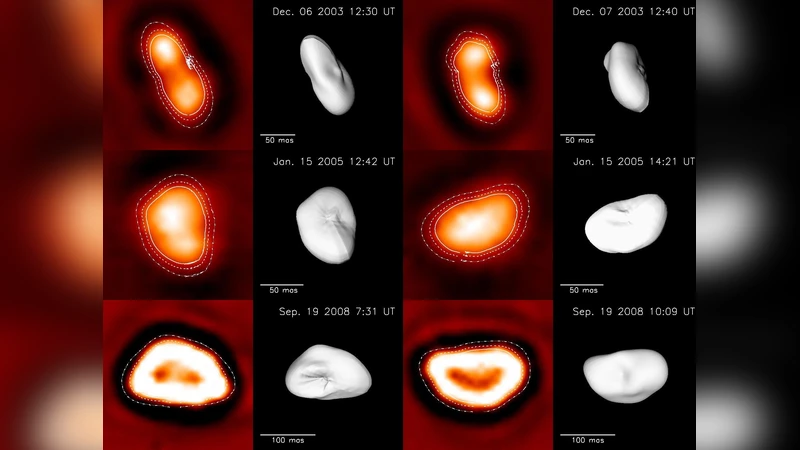
We report on the results of a six-month photometric study of the main-belt binary C-type asteroid 121 Hermione, performed during its 2007 opposition. We took advantage of the rare observational opportunity afforded by one of the annual equinoxes of Hermione occurring close to its opposition in June 2007. The equinox provides an edge-on aspect for an Earth-based observer, which is well suited to a thorough study of Hermione’s physical characteristics. The catalog of observations carried out with small telescopes is presented in this work, together with new adaptive optics (AO) imaging obtained between 2005 and 2008 with the Yepun 8-m VLT telescope and the 10-m Keck telescope. The most striking result is confirmation that Hermione is a bifurcated and elongated body, as suggested by Marchis et al., (2005). A new effective diameter of 187 +/- 6 km was calculated from the combination of AO, photometric and thermal observations. The new diameter is some 10% smaller than the hitherto accepted radiometric diameter based on IRAS data. The reason for the discrepancy is that IRAS viewed the system almost pole-on. New thermal observations with the Spitzer Space Telescope agree with the diameter derived from AO and lightcurve observations. On the basis of the new AO astrometric observations of the small 32-km diameter satellite we have refined the orbit solution and derived a new value of the bulk density of Hermione of 1.4 +0.5/-0.2 g cm-3. We infer a macroscopic porosity of ~33 +5/-20%.
💡 Research Summary
The paper presents a comprehensive six‑month photometric campaign of the main‑belt binary C‑type asteroid 121 Hermione carried out during its 2007 opposition, combined with adaptive‑optics (AO) imaging obtained with the 8‑m VLT (Yepun) and the 10‑m Keck telescopes between 2005 and 2008. The authors exploited a rare geometric configuration: the 2007 equinox placed Hermione’s spin axis nearly edge‑on to Earth, allowing observers to view the asteroid’s equatorial plane directly. This viewing geometry is crucial because previous thermal measurements (IRAS, 1983) were taken almost pole‑on, leading to systematic over‑estimates of size.
Observations and Data Set
- Lightcurves: Small‑aperture (0.3–0.6 m) telescopes worldwide recorded nightly photometry from February to August 2007, covering more than 180° of rotational phase (period ≈ 5.55 h). A total of 78 high‑quality data points were used to construct a dense lightcurve.
- AO Imaging: Twelve resolved images were acquired with VLT/NACO and Keck/NIRC2, providing sub‑0.05″ resolution. The images clearly show Hermione’s elongated silhouette and its 32‑km satellite, allowing precise astrometric positions of the companion (uncertainty ≈ 0.02″).
- Thermal Data: The authors re‑analyzed the historic IRAS fluxes and added new Spitzer/MIPS measurements taken in 2007, which observed the asteroid from a near‑equatorial aspect.
Shape and Size Determination
A three‑dimensional shape model was simultaneously fitted to the lightcurve and AO silhouettes. The best‑fit model confirms the “bifurcated” geometry first suggested by Marchis et al. (2005): two large lobes linked by a narrow neck. By integrating the model volume with the thermal data, the authors derive an effective diameter of 187 ± 6 km. This value is about 10 % smaller than the IRAS radiometric diameter (≈ 207 km). The discrepancy is explained by the pole‑on viewing geometry of IRAS, which over‑estimated the projected area. The Spitzer thermal fluxes agree with the AO‑derived size, providing an independent validation.
Satellite Orbit and Bulk Density
The AO astrometry of the satellite over four years yields a refined orbital solution: semi‑major axis ≈ 660 km, period ≈ 2.56 days, and a near‑circular, equatorial orbit. Applying Kepler’s third law gives a system mass of 4.0 × 10¹⁸ kg. Combining this mass with the new volume results in a bulk density of 1.4 +0.5/‑0.2 g cm⁻³.
Porosity and Internal Structure
Assuming a typical grain density for C‑type material (≈ 2.0 g cm⁻³), the derived bulk density implies a macroscopic porosity of ~33 % (range +5 %/‑20 %). Such a high porosity suggests a rubble‑pile structure with substantial void space, consistent with a re‑accumulated fragment after a catastrophic collision.
Scientific Implications
- Viewing Geometry: The study demonstrates that edge‑on observations are essential for accurate shape and size determination of elongated or bifurcated bodies, whereas pole‑on thermal data can be misleading.
- Multi‑Technique Synergy: Simultaneous fitting of lightcurves, AO images, and thermal fluxes reduces individual systematic errors and yields a self‑consistent physical model.
- Binary Dynamics: Precise satellite orbit measurements provide a robust mass estimate, a critical parameter for constraining internal composition and evolution of binary asteroids.
- Rubble‑Pile Confirmation: The low density and high porosity reinforce the view that many C‑type binaries are loosely bound aggregates rather than monolithic rocks.
Future Work
The authors recommend follow‑up observations with next‑generation facilities such as the James Webb Space Telescope (JWST) and the Extremely Large Telescope (ELT). High‑resolution infrared imaging and spectroscopy could refine thermal inertia estimates, while continued AO monitoring will track possible orbital evolution of the satellite. Additionally, radar observations during future close approaches could directly probe internal density variations, further testing the rubble‑pile hypothesis.
In summary, by leveraging a unique edge‑on geometry, a dense photometric campaign, and high‑resolution AO imaging, the paper delivers a revised size (187 km), bulk density (1.4 g cm⁻³), and porosity (~33 %) for 121 Hermione, confirming its bifurcated shape and providing key constraints on the internal structure of binary C‑type asteroids.
Comments & Academic Discussion
Loading comments...
Leave a Comment