A break in the gas and dust surface density of the disc around the T Tauri star IM Lup
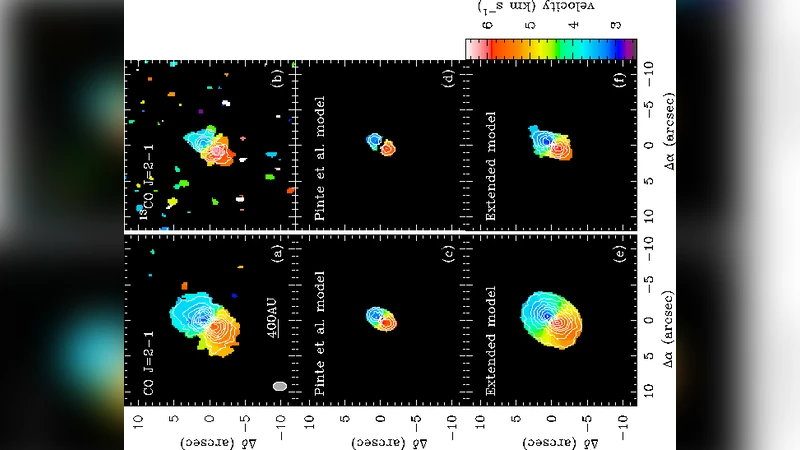
We study the distribution and physical properties of molecular gas in the disc around the T Tauri star IM Lup on scales close to 200 AU. We investigate how well the gas and dust distributions compare and work towards a unified disc model that can explain both gas and dust emission. 12CO, 13CO, and C18O J=2-1 line emission, as well as the dust continuum at 1.3 mm, is observed at 1.8" resolution towards IM Lup using the Submillimeter Array. A detailed disc model based on the dust emission is tested against these observations with the aid of a molecular excitation and radiative transfer code. Apparent discrepancies between the gas and dust distribution are investigated by adopting simple modifications to the existing model. The disc is seen at an inclination of 54+/-3 degrees and is in Keplerian rotation around a 0.8-1.6 Msun star. The outer disc radius traced by molecular gas emission is 900 AU, while the dust continuum emission and scattered light images limit the amount of dust present beyond 400 AU and are consistent with the existing model that assumes a 400 AU radius. Our observations require a drastic density decrease close to 400 AU with the vertical gas column density at 900 AU in the range of 5.d20 - 1.d22 cm-2. We derive a gas-to-dust mass ratio of 100 or higher in disc regions beyond 400 AU. Within 400 AU from the star our observations are consistent with a gas-to-dust ratio of 100 but other values are not ruled out.
💡 Research Summary
This study presents a high‑resolution (1.8″ ≈ 200 AU) Submillimeter Array (SMA) investigation of the gas and dust distribution in the circumstellar disc surrounding the T Tauri star IM Lup. The authors simultaneously observed the J = 2‑1 transitions of 12CO, 13CO, and C18O together with the 1.3 mm dust continuum, allowing a direct comparison of gas and solid components at the same spatial scale. The disc is inclined by 54 ± 3° and exhibits Keplerian rotation around a central star of mass 0.8–1.6 M☉. While CO emission extends to a radius of about 900 AU, the dust continuum and scattered‑light images show a sharp truncation near 400 AU, consistent with earlier dust‑only models that assumed a 400 AU outer radius.
When the existing dust‑based disc model is applied to the CO data, it under‑predicts the observed molecular line fluxes in the outer disc. To reconcile this discrepancy, the authors introduce a simple modification: a drastic reduction in the surface density of both gas and dust at ~400 AU. In the inner 400 AU the gas‑to‑dust mass ratio remains near the canonical value of 100, but beyond this radius the vertical gas column density drops to 5 × 10²⁰–1 × 10²² cm⁻², implying a gas‑to‑dust ratio of 100 or higher in the outer disc. Radiative‑transfer and molecular excitation calculations, assuming thermal equilibrium, reproduce the observed CO line profiles, channel maps, and intensity distributions with this altered density structure.
The analysis yields several key insights. First, the gas and dust are co‑spatial only within ~400 AU; outside this radius the dust mass is severely depleted while a tenuous gas component persists. Second, the steep density break suggests that processes such as dust growth, radial drift, or planet‑induced gaps have efficiently removed solid material from the outer disc, whereas the gas, being less susceptible to these mechanisms, remains detectable. Third, the relatively low CO column densities in the outer disc, despite the presence of gas, point to chemical effects—photodissociation by interstellar UV radiation, freeze‑out onto grains, or reduced excitation temperatures—that render CO optically thin.
These findings have important implications for disc evolution theories. The observed gas‑to‑dust ratio increase beyond 400 AU indicates that the outer disc may retain a more primordial composition, potentially serving as a reservoir for late‑stage planet formation or for replenishing inner regions via viscous spreading. Moreover, the necessity of a density break to match observations underscores the limitation of simple power‑law disc models and highlights the value of combined gas and dust diagnostics. The authors advocate for follow‑up high‑resolution ALMA observations to map additional molecular tracers, which would further constrain the chemical state, temperature structure, and dynamical processes shaping the outer regions of protoplanetary discs like that around IM Lup.
Comments & Academic Discussion
Loading comments...
Leave a Comment