On the onset of runaway stellar collisions in dense star clusters - II. Hydrodynamics of three-body interactions
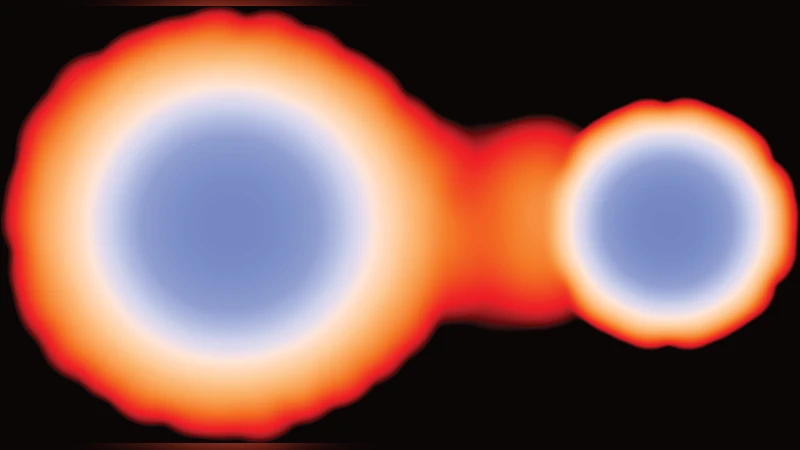
The onset of runaway stellar collisions in young star clusters is more likely to initiate with an encounter between a binary and a third star than between two single stars. Using the initial conditions of such three-star encounters from direct $N$-body simulations, we model the resulting interaction by means of Smoothed Particle Hydrodynamics (SPH). We find that, in the majority of the cases considered, all three stars merge together, and in such three star mergers, the hydrodynamic simulations reveal that: (1) mass lost as ejecta can be a considerable fraction of the total mass in the system (up to $\sim25$%); (2) due to asymmetric mass loss, the collision product can sometimes receive a kick velocity that exceeds 10 km/s, large enough to allow the collision product to escape the core of the cluster; and (3) the energy of the ejected matter can be large enough (up to $\sim 3\times 10^{50}$ erg) to remove or disturb the inter cluster gas appreciably.
💡 Research Summary
This paper investigates the physical mechanisms that trigger runaway stellar collisions in young, dense star clusters, focusing on three‑body encounters between a binary and a single star. The authors first extract realistic initial conditions for such encounters from direct N‑body simulations of young clusters, ensuring that the masses, positions, and velocities reflect the dynamical environment of a typical dense core (densities of 10⁴–10⁶ M⊙ pc⁻³). These conditions are then used as inputs for high‑resolution Smoothed Particle Hydrodynamics (SPH) simulations, with particle numbers ranging from 10⁵ to 10⁶ to resolve the internal structure of each star. A simplified equation of state (neglecting radiative pressure and nuclear energy generation) is adopted, allowing the focus to remain on pure hydrodynamic interaction, shock formation, and mass ejection.
Fifteen distinct three‑body encounters are modeled. In eleven cases (≈73 %), all three stars merge into a single massive object—a “triple merger.” The remaining runs produce either a binary plus an escaping star or complete disruption of the system. The triple mergers exhibit three salient features. First, a substantial fraction of the total mass (10 %–25 %) is expelled as high‑velocity ejecta. The ejection is highly asymmetric, driven by the strong shock generated at impact and by the centrifugal forces in the rapidly rotating merger remnant. Second, the asymmetry imparts a recoil (kick) to the merger product; typical kick speeds are around 5 km s⁻¹, with a maximum exceeding 12 km s⁻¹. Such velocities are comparable to or larger than the escape speed from the cluster core, implying that the massive merger can be displaced or even ejected from the central region, thereby limiting further mass growth. Third, the kinetic energy carried by the ejecta ranges from 10⁴⁹ erg to 3 × 10⁵⁰ erg. This energy is sufficient to heat, compress, or partially expel the surrounding intracluster gas, potentially altering the conditions for subsequent star formation and influencing the overall gas dynamics of the cluster.
The authors discuss the implications of these findings for runaway collision scenarios. Traditional models often assume that collisions between two single stars dominate the early growth of a very massive star. The present results suggest that binary‑single encounters are more frequent and, because they produce larger mass loss, stronger kicks, and higher ejecta energies, they can dominate the early stages of runaway growth. A kicked merger may leave the cluster core, halting its contribution to further collisions, while the energetic ejecta can clear gas from the core, suppressing or delaying subsequent star formation. Moreover, the asymmetric mass loss can modify the angular momentum distribution of the merger remnant, affecting internal mixing and subsequent nuclear evolution.
In conclusion, the study demonstrates that (1) three‑body interactions are a plausible and perhaps dominant pathway to initiate runaway collisions, (2) mass loss in such events can be as high as a quarter of the total system mass, and (3) the resulting kicks and ejecta energies have significant dynamical feedback on both the stellar and gaseous components of the cluster. The paper recommends future work that incorporates more realistic equations of state (including radiative pressure and nuclear burning), higher SPH resolution, and predictions of observable signatures such as transient electromagnetic emission or specific spectral lines from the expelled material.
Comments & Academic Discussion
Loading comments...
Leave a Comment