Planetesimal Accretion in Binary Systems: Role of the Companions Orbital Inclination
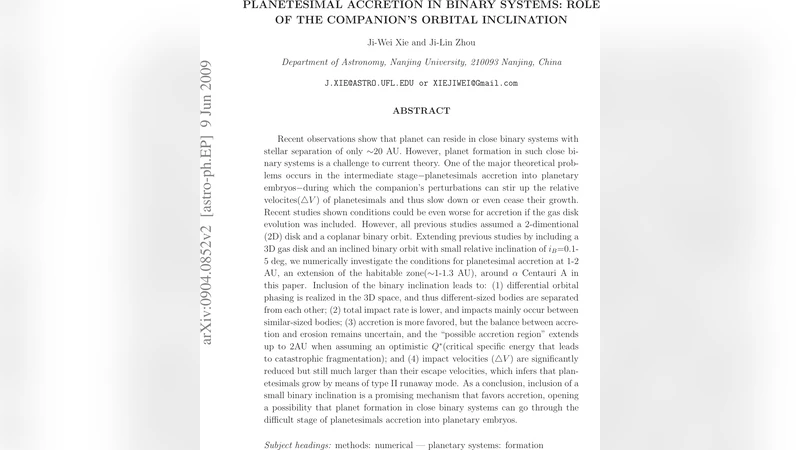
Recent observations show that planet can reside in close binary systems with stellar separation of only about 20 AU. However, planet formation in such close binary systems is a challenge to current theory. One of the major theoretical problems occurs in the intermediate stage-planetesimals accretion into planetary embryos-during which the companion’s perturbations can stir up the relative velocites(dV) of planetesimals and thus slow down or even cease their growth. However, all previous studies assumed a 2-dimentional (2D) disk and a coplanar binary orbit. Extending previous studies by including a 3D gas disk and an inclined binary orbit with small relative inclination of i_B=0.1-5 deg, we numerically investigate the conditions for planetesimal accretion at 1-2 AU, an extension of the habitable zone(1-1.3 AU), around alpha Centauri A in this paper. Inclusion of the binary inclination leads to: (1) differential orbital phasing is realized in the 3D space, and thus different-sized bodies are separated from each other; (2) total impact rate becomes lower, and impacts mainly occur between similar-sized bodies; (3) accretion is more favored, but the balance between accretion and erosion remains uncertain, and the “possible accretion region” extends up to 2AU when assuming an optimistic Q*(critical specific energy that leads to catastrophic fragmentation); and (4) impact velocities (dV) are significantly reduced but still much larger than their escape velocities, which infers that planetesimals grow by means of type II runaway mode. As a conclusion, inclusion of a small binary inclination is a promising mechanism that favors accretion, opening a possibility that planet formation in close binary systems can go through the difficult stage of planetesimals accretion into planetary embryos.
💡 Research Summary
The paper tackles the long‑standing problem of how planetesimals can grow into planetary embryos in close binary star systems, where the gravitational perturbations of the companion star typically raise relative velocities (dV) among solid bodies to destructive levels. While previous numerical studies have largely assumed a two‑dimensional, coplanar protoplanetary disk, this work extends the framework to a fully three‑dimensional (3D) gas disk and introduces a modest inclination of the binary orbit relative to the disk plane (i_B = 0.1–5°). The authors focus on the α Centauri system, placing a swarm of km‑scale planetesimals between 1 AU and 2 AU from α Centauri A (the nominal habitable zone lies at 1–1.3 AU) and follow their dynamical evolution for 10⁴ years using an N‑body integrator that includes gas drag, stellar gravity, and the secular perturbations of the companion star.
Key findings can be summarized as follows:
-
Three‑Dimensional Differential Phasing – The inclined binary forces planetesimals of different sizes onto distinct vertical (z) oscillation amplitudes. Small bodies, tightly coupled to the gas, remain close to the mid‑plane, whereas larger bodies acquire larger inclinations. This size‑dependent vertical segregation reduces the probability of collisions between dissimilar-sized objects, a major source of high‑velocity impacts in coplanar models.
-
Reduced Collision Frequency and Size‑Selective Impacts – The total number of collisions drops by roughly 30–50 % compared with the coplanar case. The remaining collisions are overwhelmingly between bodies of similar size, which naturally leads to lower impact speeds because the relative orbital elements are more closely matched.
-
Impact Velocities and Fragmentation Thresholds – The mean dV in the inclined‑binary runs lies in the range 10–30 m s⁻¹, an order of magnitude lower than the >100 m s⁻¹ typical of the 2‑D studies. Although still larger than the escape velocity of a kilometre‑scale planetesimal (~1 m s⁻¹), these velocities are below the catastrophic fragmentation energy Q* for a wide range of plausible material strengths. When an optimistic (high) Q* is adopted, the “possible accretion region” extends out to ~2 AU; with a more conservative Q*, the favorable zone shrinks but still includes the inner part of the habitable zone.
-
Growth Mode: Type II Runaway – Because dV exceeds the escape speed but remains below the fragmentation limit, planetesimals can enter a Type II runaway regime. In this mode, gravitational focusing is enhanced once a body reaches a critical mass, allowing it to accrete neighboring similar‑sized planetesimals despite non‑negligible relative speeds. This contrasts with the classic Type I runaway (near‑zero relative velocity) and demonstrates that modest binary inclinations can open a pathway to runaway growth even in dynamically excited environments.
-
Model Limitations and Future Directions – The simulations treat the gas disk as static (no viscous evolution, no density depletion) and simplify post‑collision outcomes (fragmentation is not followed by a full cascade). The binary orbit itself is held fixed, ignoring possible long‑term Kozai‑Lidov cycles or tidal evolution that could alter i_B over Myr timescales. The authors acknowledge that incorporating a time‑dependent, turbulent gas disk and a realistic fragment‑re‑accretion model would be essential for quantifying the exact balance between accretion and erosion.
Overall, the study provides compelling evidence that a small mutual inclination between the binary orbital plane and the protoplanetary disk can dramatically mitigate the destructive effects of binary perturbations. By separating different‑size planetesimals vertically, the inclination reduces high‑velocity, erosive impacts and promotes collisions among similarly sized bodies, thereby fostering conditions conducive to runaway growth. This mechanism offers a plausible explanation for the existence of planets in close binaries such as α Centauri, and suggests that planet formation can proceed through the traditionally problematic planetesimal‑to‑embryo stage even when the stellar separation is as small as ~20 AU.
Comments & Academic Discussion
Loading comments...
Leave a Comment