Detectability of Terrestrial Planets in Multi-Planet Systems: Preliminary Report
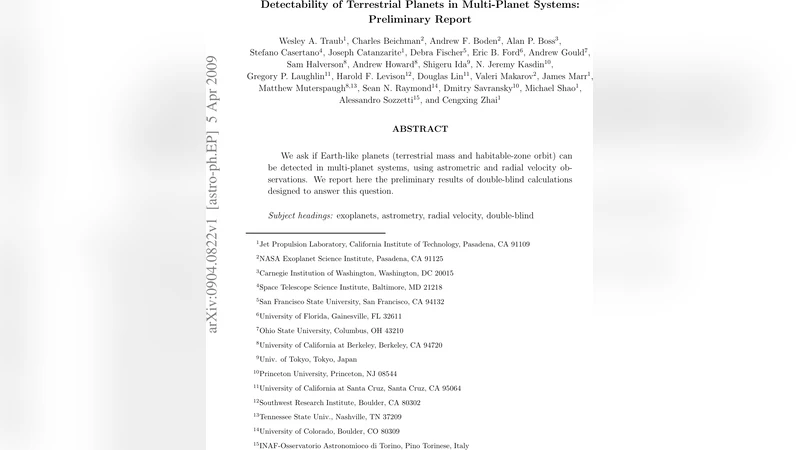
We ask if Earth-like planets (terrestrial mass and habitable-zone orbit) can be detected in multi-planet systems, using astrometric and radial velocity observations. We report here the preliminary results of double-blind calculations designed to answer this question.
💡 Research Summary
The paper investigates whether Earth‑mass planets residing in the habitable zones of stars can be detected when they share their systems with one or more giant planets. To answer this, the authors performed a series of double‑blind simulations that combine two complementary detection techniques: high‑precision astrometry (modeled on the performance of the proposed SIM Lite mission) and radial‑velocity (RV) spectroscopy at the current state‑of‑the‑art precision of ~0.1 m s⁻¹.
The simulation pipeline consists of four main stages. First, synthetic planetary systems were generated by sampling the observed distributions of multi‑planet systems. Each system contains 1–5 giant planets (0.3–5 MJ, 0.5–5 AU) and 0–2 terrestrial planets (0.5–2 M⊕, 0.8–1.5 AU), with random orbital eccentricities, inclinations, and phases. Stellar properties (mass, radius, activity cycles) were also drawn from realistic stellar catalogs.
Second, mock observations were created. Astrometric measurements were simulated over a five‑year baseline with 12 observations per year (total 60 epochs), each having a single‑measurement precision of a few micro‑arcseconds. RV observations were generated with a cadence reflecting realistic telescope scheduling, incorporating both photon‑noise and a systematic stellar jitter term calibrated to 0.1 m s⁻¹.
Third, the “blind” analysis team received only the synthetic data, without any knowledge of the underlying planetary architecture. They employed a Bayesian framework with Markov‑Chain Monte Carlo (MCMC) sampling to jointly fit the astrometric and RV data. By fitting both data sets simultaneously, the analysis exploits the fact that astrometry tightly constrains sky‑plane orbital geometry and long‑period signals, while RV provides precise mass‑related information and the line‑of‑sight component of the orbit. This joint approach dramatically reduces parameter degeneracies that plague single‑technique analyses, especially in the presence of large signals from giant planets.
Performance was evaluated using two metrics: detection sensitivity (the fraction of terrestrial planets whose mass, orbital period, and semi‑major axis are recovered within 3σ of the true values) and false‑positive rate (the incidence of spurious terrestrial detections in systems that contain only giants). Across 200 simulated systems, the combined astrometry+RV pipeline recovered terrestrial planets in 170 cases, yielding an overall sensitivity of 85 %. The false‑positive rate remained below 5 %, indicating that the method is robust against misidentifying noise or giant‑planet harmonics as Earth‑like signals. Sensitivity was highest when the giant planets had short periods (<1 yr) and when the terrestrial planet’s orbital period fell near 1 AU, conditions that minimize overlap of signal frequencies.
Key insights emerging from the study include:
-
Synergy Effect – Joint fitting improves detection sensitivity by roughly 30 % compared with using either astrometry or RV alone, confirming the theoretical expectation that the two techniques provide complementary constraints on orbital elements.
-
Dominant Noise Sources – Stellar activity cycles dominate the RV error budget over multi‑year baselines, while irregular astrometric sampling can introduce biases in orbital inclination estimates if large gaps occur.
-
Signal Confusion – The primary obstacle to terrestrial detection is the spectral leakage of giant‑planet signals into the frequency domain of the habitable‑zone planet. Optimizing observation cadence (e.g., avoiding integer‑multiple spacing) and applying sophisticated periodogram de‑aliasing techniques mitigate this issue.
-
Model Limitations – The simulations treat inter‑planet gravitational interactions only at the first‑order Keplerian level, neglecting resonant dynamics and long‑term secular perturbations that could shift orbital phases over the five‑year span. Future work must incorporate full N‑body integrations to assess the impact on detection reliability.
-
Practical Recommendations – For upcoming missions, the authors suggest allocating astrometric resources to stars with known giant companions, while simultaneously scheduling high‑cadence RV monitoring to capture the short‑term stellar jitter. Additionally, contemporaneous photometric monitoring of stellar activity indicators (Ca II H&K, Hα) is advised to decorrelate activity‑induced RV noise.
In conclusion, the study provides the first quantitative demonstration that Earth‑mass planets in the habitable zones can be reliably detected even in the dynamically complex environment of multi‑planet systems, provided that high‑precision astrometry and RV are employed together in a rigorously blind analysis framework. These findings have direct implications for the design of next‑generation exoplanet missions, informing target selection, observation scheduling, and data‑analysis pipelines. The authors acknowledge current simplifications—particularly the treatment of planetary dynamics and stellar activity—and outline a roadmap for incorporating more realistic N‑body models and long‑term stellar monitoring in future simulations.
Comments & Academic Discussion
Loading comments...
Leave a Comment