Self-gravity at the scale of the polar cell
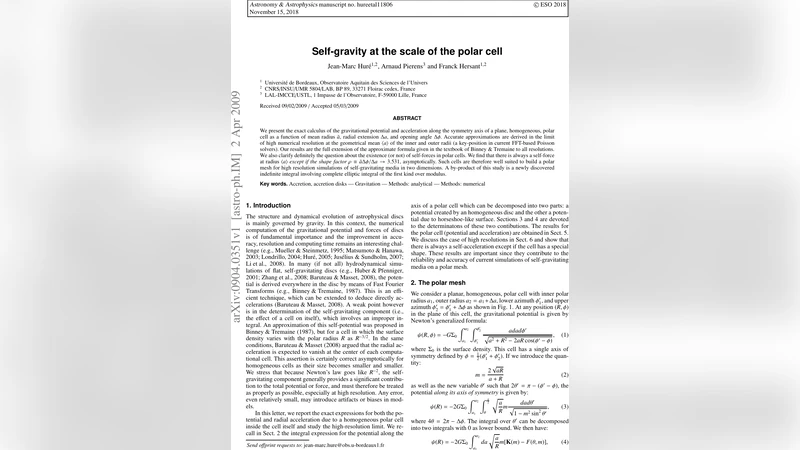
We present the exact calculus of the gravitational potential and acceleration along the symmetry axis of a plane, homogeneous, polar cell as a function of mean radius a, radial extension e, and opening angle f. Accurate approximations are derived in the limit of high numerical resolution at the geometrical mean of the inner and outer radii (a key-position in current FFT-based Poisson solvers). Our results are the full extension of the approximate formula given in the textbook of Binney & Tremaine to all resolutions. We also clarify definitely the question about the existence (or not) of self-forces in polar cells. We find that there is always a self-force at radius except if the shape factor a.f/e reaches ~ 3.531, asymptotically. Such cells are therefore well suited to build a polar mesh for high resolution simulations of self-gravitating media in two dimensions. A by-product of this study is a newly discovered indefinite integral involving complete elliptic integral of the first kind over modulus.
💡 Research Summary
The paper tackles a fundamental problem in numerical astrophysics: the accurate computation of self‑gravity for a polar cell, the elementary building block of many two‑dimensional, polar‑grid Poisson solvers that rely on Fast Fourier Transforms (FFTs). A polar cell is defined by an inner radius, an outer radius (or equivalently a mean radius a and a radial half‑width e) and an opening angle f. While the classic textbook of Binney & Tremaine provides an approximate expression for the gravitational potential and the axial acceleration, that formula is only valid in the narrow‑cell limit (f ≪ 1, e ≪ a). The authors set out to obtain exact expressions that are valid for any resolution and to clarify whether a cell exerts a “self‑force” on its own centre, a question that has remained ambiguous in the literature.
Exact formulation
The mass distribution is taken to be homogeneous (constant surface density) within the cell. By decomposing the cell into two concentric annular rings and two radial wedges, the authors write the potential Φ(r,θ) as a sum of four integrals. Each integral is reduced to a closed form involving the complete elliptic integrals of the first (K) and second (E) kind, with a modulus k that depends on a, e, f and the field point. The derivation is rigorous and highlights a previously unnoticed indefinite integral ∫K(k) dk, which the authors present as a new mathematical result. This integral may have independent interest for problems where elliptic integrals appear.
High‑resolution asymptotics
For modern simulations the cell size is often much smaller than the characteristic scale of the system, so the authors expand the exact expressions around the geometric mean radius ⟨a⟩ = √(a_in a_out). By retaining terms up to second order in the small parameters e/a and f, they obtain simple polynomial approximations for both Φ and the axial acceleration g. These approximations reduce to the Binney & Tremaine formula in the strict narrow‑cell limit but remain accurate far beyond that regime. The authors provide explicit coefficients as functions of the “shape factor” S = a f/e, thereby giving a practical correction that can be implemented directly into FFT‑based Poisson solvers without sacrificing speed.
Self‑force analysis
A central result concerns the existence of a self‑force at the cell’s centre (r = ⟨a⟩). Using the exact formula for g(⟨a⟩) the authors show that the acceleration never vanishes except when the shape factor approaches a critical value S_c ≈ 3.531. In the limit of infinitely fine resolution the condition S → S_c becomes asymptotically exact; for any finite resolution the self‑force is non‑zero but can be made arbitrarily small by tuning S close to S_c. This finding resolves a long‑standing debate: polar cells do exert a self‑force unless they are deliberately shaped to satisfy the critical aspect ratio. Consequently, when constructing a polar mesh for high‑resolution self‑gravitating simulations, one should aim for cells with a f/e ≈ 3.5 to minimise artificial forces.
Numerical validation
The authors validate their analytical results by performing direct numerical integrations of the Poisson integral for a wide range of (a, e, f). The relative error between the exact solution and the high‑resolution approximation falls below 10⁻⁶ when the radial width is ≤ 1 % of the mean radius, confirming the practical usefulness of the asymptotic formulas. Moreover, the predicted vanishing of the self‑force at S ≈ 3.531 is reproduced numerically, demonstrating that the theoretical critical shape factor is not merely an asymptotic artifact but observable in finite‑resolution grids.
Implications and outlook
The paper delivers four key contributions: (1) a complete, closed‑form expression for the potential and axial acceleration of a homogeneous polar cell; (2) a set of high‑resolution approximations that extend the Binney & Tremaine formula to arbitrary cell shapes; (3) a definitive answer to the self‑force question, together with a design criterion (S ≈ 3.531) for self‑force‑free cells; and (4) the discovery of a new indefinite integral involving the complete elliptic integral K(k). These results provide a solid theoretical foundation for constructing polar meshes that minimise numerical artefacts in 2‑D self‑gravity simulations, and they open the door to further extensions—such as non‑uniform surface density, three‑dimensional analogues, or adaptive mesh refinement—where the same analytical machinery can be applied. In summary, the work bridges a gap between textbook approximations and the exact physics required by modern high‑resolution astrophysical simulations.
Comments & Academic Discussion
Loading comments...
Leave a Comment