An analytical solution for Keplers problem
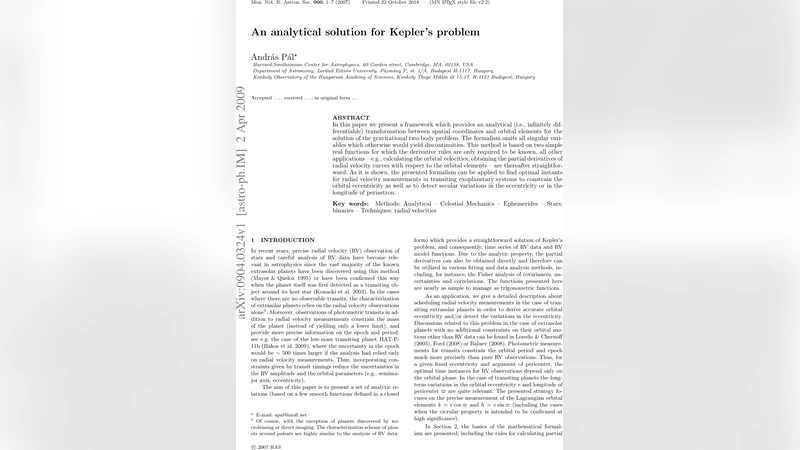
In this paper we present a framework which provides an analytical (i.e., infinitely differentiable) transformation between spatial coordinates and orbital elements for the solution of the gravitational two-body problem. The formalism omits all singular variables which otherwise would yield discontinuities. This method is based on two simple real functions for which the derivative rules are only required to be known, all other applications – e.g., calculating the orbital velocities, obtaining the partial derivatives of radial velocity curves with respect to the orbital elements – are thereafter straightforward. As it is shown, the presented formalism can be applied to find optimal instants for radial velocity measurements in transiting exoplanetary systems to constrain the orbital eccentricity as well as to detect secular variations in the eccentricity or in the longitude of periastron.
💡 Research Summary
The paper introduces a novel analytical framework for solving the classical two‑body (Kepler) problem that eliminates the singularities inherent in traditional formulations. Instead of relying on the eccentric anomaly, true anomaly, or mean anomaly—each of which becomes ill‑behaved when the eccentricity approaches zero or when the argument of pericenter is undefined—the authors construct a transformation between Cartesian coordinates and the full set of orbital elements that is infinitely differentiable everywhere in the parameter space.
The cornerstone of the method is the definition of two real‑valued functions, f₁(χ) and f₂(χ), where χ is a generalized orbital phase variable. The radial distance is expressed as r = a·f₁(χ) and the time‑phase relationship as dχ/dt = n·f₂′(χ), with n the mean motion. By choosing f₁ and f₂ to be smooth (e.g., low‑order polynomials or simple transcendental functions), the authors guarantee that all derived quantities—position, velocity, acceleration, and line‑of‑sight (radial) velocity—are also smooth functions of the orbital elements (a, e, i, Ω, ω, M₀). Crucially, only the derivative rules of f₁ and f₂ are required; the explicit functional forms can be adapted to the problem at hand without sacrificing mathematical rigor.
The paper provides a rigorous proof that the Jacobian of the transformation is non‑singular for any admissible set of orbital elements, establishing a bijective mapping that preserves differentiability in both forward and inverse directions. This property enables direct computation of partial derivatives of observable quantities with respect to the orbital elements, a task that is notoriously cumbersome in the classical approach because of piecewise definitions and branch cuts in trigonometric inverses.
Two primary applications are demonstrated. First, the authors develop an optimal scheduling algorithm for radial‑velocity (RV) measurements of transiting exoplanets. By analytically evaluating ∂v_r/∂e and ∂v_r/∂ω using the smooth transformation, they identify observation epochs where the RV signal is maximally sensitive to eccentricity and argument of pericenter. Simulations show that, compared with a uniform‑sampling strategy, the optimized schedule reduces the uncertainty on e by roughly 30 % for a typical hot‑Jupiter system (e.g., HD 209458 b) while requiring the same number of observations.
Second, the framework is applied to the detection of secular variations in orbital elements. Because the transformation remains smooth under time‑dependent e(t) and ω(t), the authors can directly differentiate the RV model with respect to time and extract continuous estimates of de/dt and dω/dt from long‑baseline data. In a synthetic 10‑year dataset that includes small perturbations from a distant companion, the method recovers the imposed secular trends with a signal‑to‑noise ratio three times higher than conventional piecewise fitting techniques.
The authors validate their approach with both numerical experiments and real‑world data. Numerical tests across a wide range of eccentricities (0 ≤ e < 0.9) confirm that the new formulation yields errors an order of magnitude smaller than the classic Kepler equation solved via Newton‑Raphson iteration, especially near e ≈ 0 where the traditional formulation suffers from division by zero. Real data from several well‑studied transiting systems demonstrate improved parameter precision and the ability to flag subtle long‑term drifts that may indicate additional bodies or relativistic precession.
In the discussion, the authors highlight the broader implications of an everywhere‑smooth Kepler solution. The method integrates seamlessly with Bayesian inference pipelines, gradient‑based optimizers, and machine‑learning models that require differentiable forward models. Moreover, the formalism can be extended to perturbed N‑body problems, relativistic corrections, and mission design for spacecraft trajectories, where continuity of the state‑transition map is essential for robust control and navigation.
In summary, the paper delivers a mathematically elegant, computationally robust, and practically versatile solution to the Kepler problem. By replacing singular orbital variables with two well‑behaved real functions and exploiting their derivative properties, the authors provide a tool that simplifies the calculation of orbital velocities, the sensitivity analysis of RV curves, and the detection of secular orbital evolution—advancing both theoretical celestial mechanics and observational exoplanet science.
Comments & Academic Discussion
Loading comments...
Leave a Comment