A semi-automatic procedure for abundance determination of A- and F-type stars
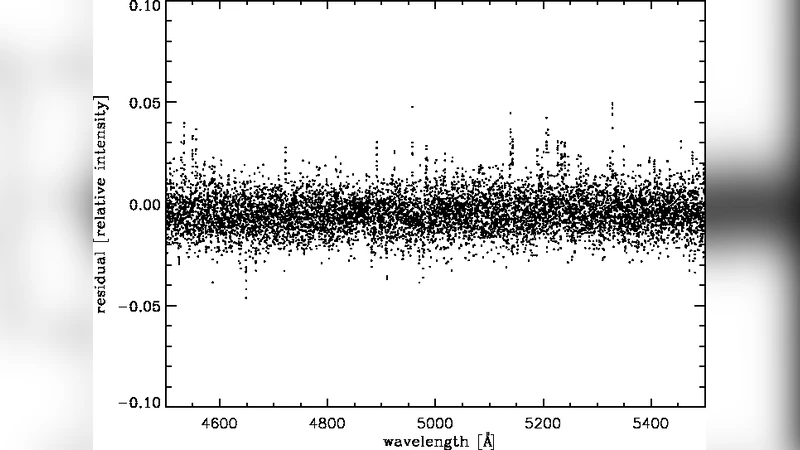
A variety of physical processes leading to different types of pulsations and chemical compositions is observed among A- and F-type stars. To investigate the underlying mechanisms responsible for these processes in stars with similar locations in the H-R diagram, an accurate abundance determination is needed, among others. Here, we describe a semi-automatic procedure developed to determine chemical abundances of various elements ranging from helium to mercury for this type of stars. We test our procedure on synthetic spectra, demonstrating that our procedure provides abundances consistent with the input values, even when the stellar parameters are offset by reasonable observational errors. For a fast-rotating star such as Vega, our analysis is consistent with those carried out with other plane-parallel model atmospheres. Simulations show that the offsets from the input abundances increase for stars with low inclination angle of about 4 degrees. For this inclination angle, we also show that the distribution of the iron abundance found in different regions is bimodal. Furthermore, the effect of rapid rotation can be seen in the peculiar behaviour of the H_beta line.
💡 Research Summary
The paper presents a semi‑automatic pipeline designed to determine the chemical abundances of A‑ and F‑type stars with high precision and efficiency. Recognizing that stars occupying similar positions on the Hertzsprung‑Russell diagram can exhibit markedly different pulsation behaviours and surface compositions, the authors argue that a reliable, reproducible abundance analysis is a prerequisite for disentangling the underlying physical mechanisms.
The methodology begins with the construction of a comprehensive line list covering elements from helium to mercury. Lines are selected from the NIST and VALD databases, prioritising those with minimal blending and strong sensitivity to temperature and pressure. Plane‑parallel LTE model atmospheres are computed with ATLAS9, and synthetic spectra are generated using SYNTHE. The semi‑automatic routine requires the user to supply initial estimates of effective temperature (T_eff), surface gravity (log g), projected rotational velocity (v sin i), and microturbulent velocity (ξ). For each element, the algorithm randomly selects at least five suitable lines, fits Gaussian or Voigt profiles, and minimizes the χ² difference between observed and synthetic fluxes. Lines that fall in low‑S/N regions, suffer severe blending, or are highly model‑dependent are automatically rejected. The final abundance for each element is obtained as a weighted average of the individual line results, with uncertainties derived from the χ² distribution and the propagation of parameter errors.
To assess robustness, the authors first test the pipeline on synthetic spectra where the input stellar parameters are deliberately perturbed by ±150 K in T_eff, ±0.2 dex in log g, and ±2 km s⁻¹ in v sin i. Despite these offsets, the recovered abundances deviate by less than 0.05 dex on average, demonstrating resilience to realistic observational uncertainties. The second test involves a fast‑rotating star, Vega (HD 172167), whose well‑studied parameters (T_eff ≈ 9600 K, v sin i ≈ 22 km s⁻¹,
Comments & Academic Discussion
Loading comments...
Leave a Comment