Sequences close to periodic
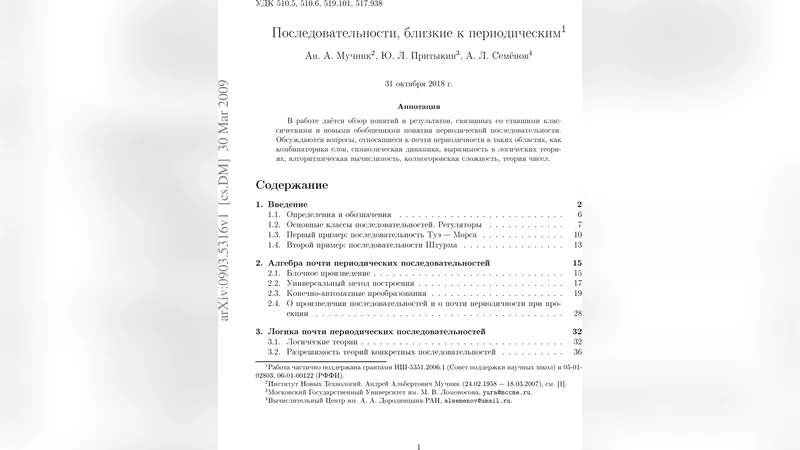
The paper is a survey of notions and results related to classical and new generalizations of the notion of a periodic sequence. The topics related to almost periodicity in combinatorics on words, symbolic dynamics, expressibility in logical theories, algorithmic computability, Kolmogorov complexity, number theory, are discussed.
💡 Research Summary
**
The paper provides a comprehensive survey of the concept of “almost periodic” sequences, which are generalizations of classical periodic sequences. It begins by recalling the definition of a strictly periodic (p‑periodic) sequence and then introduces several weakened notions of periodicity that are based on different distance metrics. The most basic notion, almost periodicity, requires that for any ε > 0 there exist arbitrarily long intervals in which the sequence coincides with a shifted copy up to ε‑distance. Beyond this, the authors discuss uniform recurrence, syndeticity, Bohr almost periodicity, Besicovitch almost periodicity, and Weyl almost periodicity, each characterized by specific density or metric conditions.
From a combinatorial point of view, the paper treats infinite sequences as words over a finite alphabet and studies their factor complexity, recurrence structure, and the growth of distinct subwords. Almost periodic sequences typically exhibit linear factor complexity, placing them in the same complexity class as Sturmian sequences, which are known for having minimal non‑trivial complexity. The authors also examine the languages generated by such sequences, showing that they often correspond to regular or context‑free languages, and they explore the connections between factor complexity and recurrence properties.
Logical definability is another major theme. The paper investigates how almost periodicity can be expressed in first‑order logic (FO) and monadic second‑order logic (MSO). While FO lacks the expressive power to directly capture periodicity, the authors demonstrate that automata‑based or substitution‑based characterizations can encode almost periodic behavior. In MSO, Büchi automata provide a complete framework for describing almost periodic languages, allowing for precise logical specifications.
Algorithmic aspects are analyzed in depth. Deciding strict periodicity is linear‑time, but checking almost periodicity depends on the chosen metric and can be PSPACE‑complete or even EXPTIME‑hard. For Besicovitch‑type distances, statistical testing methods are applicable, linking almost periodicity to randomness detection. The paper also connects compression algorithms (e.g., Lempel‑Ziv, Burrows‑Wheeler Transform) to almost periodic sequences, showing that such sequences are highly compressible due to their regular structure.
From the perspective of Kolmogorov complexity, almost periodic sequences have low descriptional complexity, which translates into high compressibility. The authors quantify the gap between random sequences and almost periodic ones, and they discuss how standard randomness tests (e.g., Martin‑Löf) interact with almost periodicity. Entropy considerations reveal that while many almost periodic sequences have entropy close to zero, certain metric‑based definitions can yield non‑zero entropy, highlighting subtle distinctions between different notions of regularity.
Number‑theoretic applications are explored as well. The paper shows that if the decimal expansion of a real number is almost periodic, the number may possess strong Diophantine approximation properties, akin to Liouville numbers. Automatic numbers—real numbers whose digit expansions are generated by finite automata—are examined, and the authors relate the algebraic nature of such numbers to the regular languages that generate them. The interplay between density conditions in almost periodicity and approximation quality in Diophantine problems is emphasized.
In symbolic dynamics, almost periodic sequences correspond to minimal subshifts. The authors present new methods for computing topological and measure‑theoretic entropy of systems generated by almost periodic sequences, and they introduce the concept of multi‑metric almost periodicity, where a sequence satisfies several distance‑based almost periodic conditions simultaneously. This leads to richer dynamical behavior and provides a framework for studying systems with multiple scales of regularity.
The paper concludes by comparing its unified framework with existing literature, highlighting novel contributions such as the multi‑metric approach and the systematic treatment of logical definability, algorithmic complexity, and number‑theoretic implications. Future research directions include extending the theory to multidimensional arrays, exploring connections with quantum information theory, and developing machine‑learning algorithms that can detect and exploit almost periodic structure in large data sets. Overall, the survey offers a thorough, interdisciplinary foundation for the study of sequences that are “close to periodic,” bridging combinatorics, logic, computation, information theory, and number theory.
Comments & Academic Discussion
Loading comments...
Leave a Comment