Sersic galaxy with Sersic halo models of early-type galaxies: a tool for N-body simulations
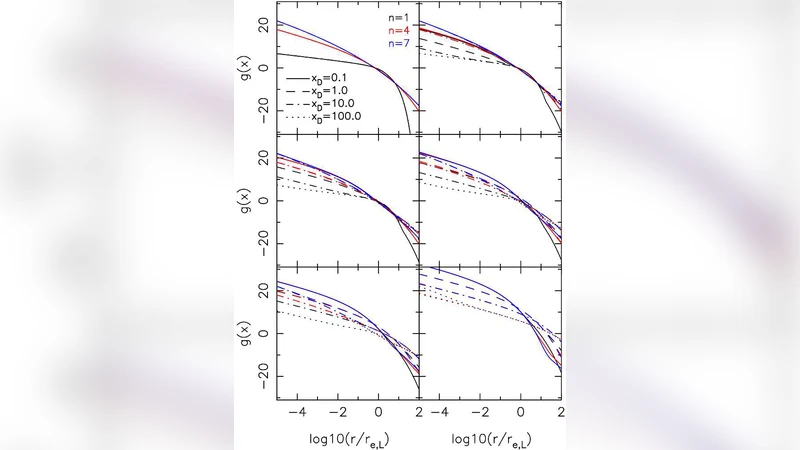
We present spherical, non-rotating, isotropic models of early-type galaxies with stellar and dark-matter components both described by deprojected Sersic density profiles, and prove that they represent physically admissible stable systems. Using empirical correlations and recent results of N-body simulations, all the free parameters of the models are expressed as functions of one single quantity: the total (B-band) luminosity of the stellar component. We analyze how to perform discrete N-body realizations of Sersic models. To this end, an optimal smoothing length is derived, defined as the softening parameter minimizing the error on the gravitational potential for the deprojected Sersic model. It is shown to depend on the Sersic index $n$ and on the number of particles of the N-body realization. A software code allowing the computations of the relevant quantities of one- and two-component Sersic models is provided. Both the code and the results of the present work are primarily intended as tools to perform N-body simulations of early-type galaxies, where the structural non-homology of these systems (i.e. the variation of the shape parameter along the galaxy sequence) might be taken into account.
💡 Research Summary
The paper introduces a comprehensive framework for constructing realistic, stable, spherical, non‑rotating, isotropic models of early‑type galaxies (ETGs) that include both stellar and dark‑matter components, each described by a deprojected Sérsic density profile. By exploiting well‑established empirical scaling relations (e.g., luminosity–size, mass‑to‑light ratio) and recent ΛCDM N‑body simulation results, the authors reduce the full set of model parameters (stellar mass, stellar scale radius, stellar Sérsic index, dark‑matter mass, dark‑matter scale radius, dark‑matter Sérsic index) to a single observable: the total B‑band luminosity of the stellar component (L_B).
The deprojection of the 2‑D Sérsic surface‑brightness law I(R) ∝ exp
Comments & Academic Discussion
Loading comments...
Leave a Comment