Protostellar collapse: rotation and disk formation
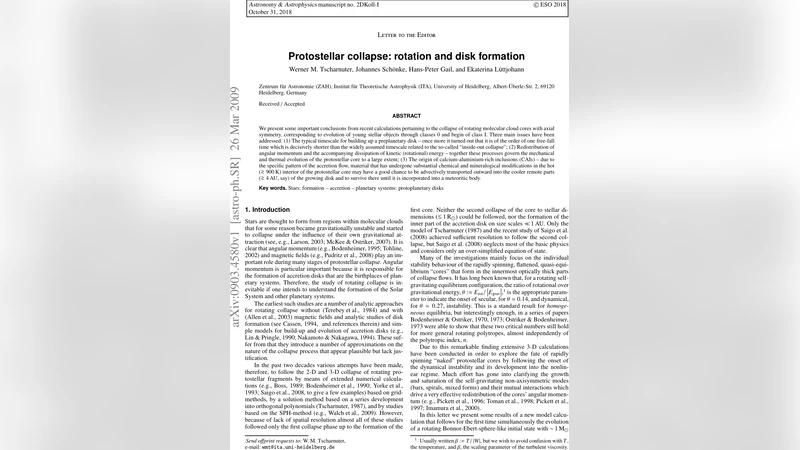
We present some important conclusions from recent calculations pertaining to the collapse of rotating molecular cloud cores with axial symmetry, corresponding to evolution of young stellar objects through classes 0 and begin of class I. Three main issues have been addressed: (1) The typical timescale for building up a preplanetary disk - once more it turned out that it is of the order of one free-fall time which is decisively shorter than the widely assumed timescale related to the so-called ‘inside-out collapse’; (2) Redistribution of angular momentum and the accompanying dissipation of kinetic (rotational) energy - together these processes govern the mechanical and thermal evolution of the protostellar core to a large extent; (3) The origin of calcium-aluminium-rich inclusions (CAIs) - due to the specific pattern of the accretion flow, material that has undergone substantial chemical and mineralogical modifications in the hot (exceeding 900 K) interior of the protostellar core may have a good chance to be advectively transported outward into the cooler remote parts (beyond 4 AU, say) of the growing disk and to survive there until it is incorporated into a meteoritic body.
💡 Research Summary
**
The paper presents a comprehensive numerical study of the collapse of rotating, axisymmetric molecular cloud cores and the consequent formation of a pre‑planetary (protoplanetary) disk during the early Class 0–I phases of young stellar objects. Three central issues are addressed: (1) the timescale for disk buildup, (2) the redistribution of angular momentum together with the dissipation of rotational kinetic energy, and (3) the origin of calcium‑aluminium‑rich inclusions (CAIs) in meteorites.
Rapid Disk Formation
Contrary to the classic “inside‑out collapse” picture, which predicts disk growth on timescales of tens to hundreds of thousands of years, the simulations show that a substantial disk (radii of several to tens of AU and masses up to ~0.1 M⊙) can be assembled within roughly one free‑fall time (t_ff ≈ 10³–10⁴ yr). The key driver is the centrifugal barrier: as the core collapses, material with sufficient specific angular momentum cannot fall directly onto the protostar and instead piles up in a rotationally supported structure. This process is extremely efficient; the disk mass rises sharply while the protostellar core mass grows more modestly.
Angular Momentum Transport and Energy Dissipation
Two mechanisms dominate the angular‑momentum budget. First, viscous (or magnetically mediated) diffusion spreads angular momentum outward, allowing the disk to expand. The authors adopt an α‑prescription with α≈10⁻³–10⁻², which yields outward angular‑momentum fluxes comparable to the inward mass accretion rate. Second, gravitational torques generated by spiral density waves and a toroidal accretion flow transport angular momentum radially and convert a large fraction (30–50 %) of the rotational kinetic energy into heat. This heating raises the temperature of the innermost region of the core above 900 K, a condition necessary for the formation of CAI precursor material.
Mechanism for CAI Production and Outward Transport
The high‑temperature inner core processes silicate material into CAI‑like condensates. The simulations reveal a “back‑flow” pattern: after being heated, material moves outward along the mid‑plane of the disk, carried by the same toroidal flow that transports angular momentum. This advective transport can carry a non‑negligible fraction (10–20 %) of the processed material to radii beyond 4 AU, where temperatures drop below the CAI stability limit, allowing the inclusions to survive. The authors argue that this internal production‑and‑outward‑mixing scenario offers a natural explanation for the presence of CAIs in meteorites without invoking a separate hot nebular region far from the Sun.
Parameter Sensitivity
A suite of models with varying core masses (1–3 M⊙) and rotational energy fractions (β = E_rot/E_grav = 0.001–0.05) demonstrates that higher β leads to larger, more massive disks and more efficient angular‑momentum transport. Low‑rotation cases (β < 10⁻³) produce only thin, low‑mass disks and delay disk formation, whereas β ≈ 0.04 yields disks extending beyond 30 AU within a single free‑fall time. This sensitivity aligns with observed diversity in disk sizes among Class 0/I objects.
Observational Implications and Future Work
The rapid disk‑formation timescale matches recent ALMA observations of sizable disks around very young protostars, challenging the notion that large disks must be a later evolutionary product. The back‑flow mechanism provides a plausible pathway for the isotopic anomalies observed in CAIs (e.g., ⁴⁶Ca/⁴⁰Ca ratios) by allowing material processed near the protostar to be incorporated into the outer disk where planetesimals later form. The authors suggest extending the study to full three‑dimensional magnetohydrodynamic simulations and coupling a detailed chemical network to quantify the exact composition of the outward‑transported solids.
In summary, the paper demonstrates that rotation fundamentally reshapes the collapse dynamics of molecular cloud cores, leading to (i) disk formation on a free‑fall timescale, (ii) vigorous angular‑momentum redistribution and rotational energy dissipation that control both the mechanical and thermal evolution of the system, and (iii) a robust internal pathway for producing and delivering CAI material to the outer disk. These findings refine our theoretical framework for star and planet formation and offer a coherent explanation for the early appearance of high‑temperature inclusions in primitive meteorites.
Comments & Academic Discussion
Loading comments...
Leave a Comment