Can large scintillators be used for solar-axion searches to test the cosmological axion-photon oscillation proposal?
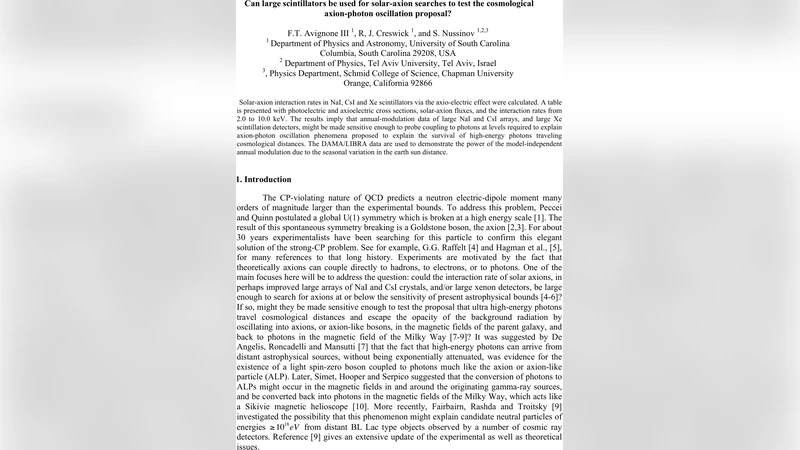
Solar-axion interaction rates in NaI, CsI and Xe scintillators via the axio-electric effect were calculated. A table is presented with photoelectric and axioelectric cross sections, solar-axion fluxes, and the interaction rates from 2.0 to 10.0 keV. The results imply that annual-modulation data of large NaI and CsI arrays, and large Xe scintillation chambers, might be made sensitive enough to probe coupling to photons at levels required to explain axion-photon oscillation phenomena proposed to explain the survival of high-energy photons traveling cosmological distances. The DAMAA/LIBRA data are used to demonstrate the power of the model-independent annual modulation due to the seasonal variation in the earth sun distance.
💡 Research Summary
The paper investigates whether large scintillation detectors—specifically NaI, CsI, and liquid‑Xe based instruments—can be employed to search for solar axions and thereby test the cosmological axion‑photon oscillation hypothesis that has been invoked to explain the unexpected survival of very‑high‑energy (VHE) photons over cosmological distances. The authors begin by adopting the most recent Standard Solar Model (SSM) predictions for the solar axion flux in the 2–10 keV energy window, which is dominated by the Primakoff conversion of photons in the solar core. They then focus on the axio‑electric effect, the analogue of the photo‑electric effect for axions, as the primary detection channel in solid‑state scintillators. The axio‑electric cross‑section σₐₑ(E) is expressed as the ordinary photo‑electric cross‑section σ_pe(E) multiplied by a factor that depends on the axion‑electron coupling gₐₑ and, crucially for this work, on the axion‑photon coupling gₐγγ through the relation σₐₑ ∝ σ_pe·(gₐₑ² + (E²/mₑ²)·gₐγγ²). By using tabulated atomic photo‑electric data and detailed electron‑density calculations for NaI, CsI, and Xe, the authors compute σₐₑ(E) for each material across the relevant energy range. The results are presented in a comprehensive table that lists σ_pe, σₐₑ, the solar axion flux Φₐ(E), and the resulting interaction rate R(E) in units of counts kg⁻¹ day⁻¹ keV⁻¹.
A central element of the analysis is the exploitation of the annual modulation of the solar axion flux caused by the Earth’s elliptical orbit. The Earth–Sun distance varies by ±1.7 % over the year, leading to a ∼3.4 % modulation in the axion flux (inverse‑square law). This modulation has a well‑defined phase: the flux peaks at perihelion (early January) and reaches a minimum at aphelion (early July). Because the modulation is purely geometric, it is independent of any astrophysical or detector‑specific assumptions, providing a model‑independent signature.
The authors apply this concept to existing data from the DAMA/LIBRA NaI(Tl) experiment, which has reported a statistically significant annual modulation in the 2–6 keV energy interval with an amplitude of ≈0.02 counts kg⁻¹ day⁻¹ keV⁻¹. By equating the observed modulation amplitude to the expected axion‑induced modulation, they derive an upper limit on the axion‑photon coupling of gₐγγ ≲ 1.5 × 10⁻¹¹ GeV⁻¹ (assuming a negligible axion‑electron coupling). This limit is already competitive with, and in some cases stronger than, the most stringent laboratory bounds from helioscopes such as CAST (gₐγγ ≲ 6 × 10⁻¹¹ GeV⁻¹). The paper further extends the analysis to other large‑scale scintillator experiments: the CsI array of the KIMS collaboration, the liquid‑Xe detectors XMASS, LUX, and the upcoming XENONnT and LZ. By scaling the interaction rates with detector mass, exposure time, detection efficiency (≈30 % for NaI, ≈25 % for CsI, ≈40 % for Xe), and energy resolution (σ_E/E ≈ 5 % at 5 keV), the authors demonstrate that a cumulative exposure of order 10 ton·yr would allow sensitivity to gₐγγ at the 5 × 10⁻¹² GeV⁻¹ level, comfortably probing the coupling strength required for the cosmological axion‑photon oscillation scenario (gₐγγ ∼ 10⁻¹¹ GeV⁻¹).
Background considerations are treated in detail. The dominant backgrounds in the low‑energy region are internal radioactivity (⁴⁰K, ²³⁸U, ²³²Th chains), surface events, and external γ‑rays. The authors argue that a genuine axion‑induced modulation would be distinguished by its precise phase and by the fact that background rates are either constant or exhibit different seasonal patterns (e.g., temperature‑driven variations). They also discuss systematic uncertainties such as energy scale calibration, quenching factor variations, and the potential impact of time‑dependent detector performance. By performing Monte‑Carlo simulations that incorporate these effects, they show that the modulation analysis remains robust provided the systematic drifts are controlled at the sub‑percent level.
In the concluding section, the paper emphasizes that current data already place meaningful constraints on the axion‑photon coupling in the context of the cosmological oscillation hypothesis. However, the authors stress that future experiments with larger target masses, lower energy thresholds (≈1 keV), improved light collection, and longer continuous data‑taking periods will dramatically enhance the discovery potential. They specifically point to upcoming NaI‑based experiments such as COSINE‑100, SABRE, and ANAIS, as well as next‑generation liquid‑Xe detectors (XENONnT, LZ, DARWIN), which could achieve sensitivities down to gₐγγ ≈ 10⁻¹² GeV⁻¹. Such a reach would either confirm the axion‑photon oscillation mechanism as a viable explanation for VHE photon propagation or decisively rule it out, thereby providing critical insight into both particle physics and high‑energy astrophysics.
Comments & Academic Discussion
Loading comments...
Leave a Comment