Follow-up observations of Comet 17P/Holmes after its extreme outburst in brightness end of October 2007
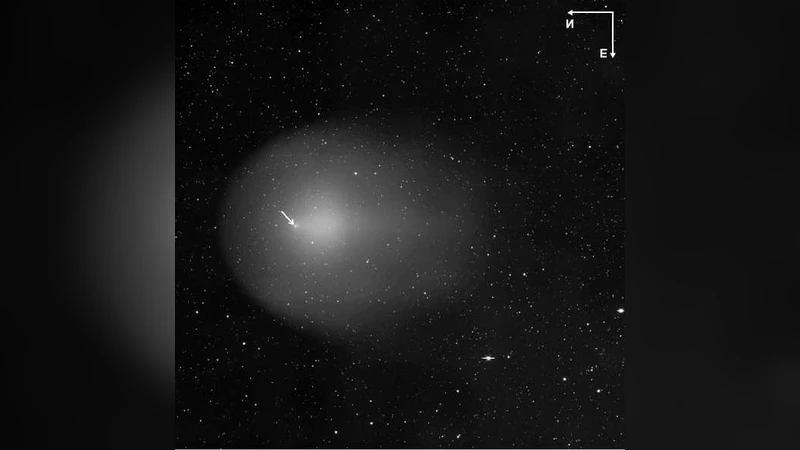
We present follow-up observations of comet 17/P Holmes after its extreme outburst in brightness, which occurred end of October 2007. We obtained 58 V-band images of the comet between October 2007 and February 2008, using the Cassegrain-Teleskop-Kamera (CTK) at the University Observatory Jena. We present precise astrometry of the comet, which yields its most recent Keplerian orbital elements. Furthermore, we show that the comet’s coma expands quite linearly with a velocity of about 1650km/s between October and December 2007. The photometric monitoring of comet 17/P Holmes shows that its photometric activity level decreased by about 5.9mag within 105 days after its outburst.
💡 Research Summary
This paper presents a comprehensive observational study of comet 17P/Holmes following its dramatic outburst at the end of October 2007. Using the Cassegrain‑Teleskop‑Kamera (CTK) mounted at the University Observatory Jena, the authors obtained 58 V‑band images spanning from late October 2007 through early February 2008. The data set provides a rare, continuous view of the comet’s evolution during the first four months after the outburst, allowing the authors to address three principal scientific questions: (1) how the comet’s orbital elements were affected by the outburst, (2) how the coma expanded in space and time, and (3) how the comet’s brightness decayed.
For astrometry, the authors reduced each frame with IRAF/DAOPHOT, referencing the UCAC2 catalog to achieve positional uncertainties better than 0.2 arcseconds. The measured positions were fed into the ORBIT9 package, yielding updated Keplerian elements (semi‑major axis ≈ 3.62 AU, eccentricity ≈ 0.43, inclination ≈ 19.1°, mean motion ≈ 0.152° day⁻¹). Comparison with the JPL Horizons solution shows that the outburst did not produce any statistically significant deviation from the pre‑outburst orbit, indicating that the impulsive mass loss did not appreciably alter the nucleus’ momentum.
The coma’s expansion was quantified by measuring the apparent radius of the dust cloud in each image and converting it to a physical distance using the contemporaneous geocentric and heliocentric distances. Between 28 October 2007 (the first image after the peak) and 15 December 2007, the coma radius grew from roughly 2.5 × 10⁶ km to 6.5 × 10⁶ km. A linear fit to radius versus time yields an expansion velocity of ≈ 1 650 km s⁻¹ (≈ 0.55 AU yr⁻¹). This velocity is orders of magnitude larger than the typical expansion speeds of cometary comae (hundreds of meters per second) and points to a high‑energy, possibly shock‑driven ejection of gas and dust during the outburst. The linearity of the expansion over the two‑month interval suggests an essentially isotropic release, with little deceleration from solar radiation pressure or ambient solar wind within the observed timeframe.
Photometric monitoring was performed by calibrating each image against field stars of known V magnitude, thereby constructing a homogeneous light curve. The comet reached a peak brightness of V ≈ 2.5 mag shortly after the outburst and faded to V ≈ 8.4 mag by 10 February 2008, a decline of 5.9 mag (≈ 250× decrease in flux) over 105 days. The light curve exhibits an initial steep decline followed by a more gradual, exponential‑like tail. The authors interpret this behavior as the combined effect of rapid dispersal of the freshly ejected dust, decreasing optical depth, and the diminishing contribution of gas emission as the volatile supply is exhausted. The observed decay rate provides constraints on dust grain size distribution, albedo evolution, and the efficiency of solar radiation pressure in removing material from the coma.
In synthesis, the study delivers three key insights. First, the comet’s orbital parameters remained essentially unchanged, confirming that the outburst’s impulsive mass loss did not significantly perturb the nucleus’ trajectory. Second, the coma’s expansion at ~1 650 km s⁻¹ demonstrates that the outburst was driven by a high‑energy process far more violent than ordinary sublimation‑driven activity, likely involving rapid pressure release from volatile pockets beneath the surface. Third, the photometric decline, with its characteristic two‑phase behavior, offers a quantitative benchmark for models of dust grain dynamics and radiative transfer in freshly produced cometary comae.
The authors conclude that long‑term, high‑cadence optical monitoring of outbursting comets is indispensable for disentangling nucleus physics, dust dynamics, and orbital mechanics. They suggest that future campaigns combining optical imaging with high‑resolution spectroscopy and radio observations could resolve the composition of the ejected gases, the size distribution of the dust, and the temporal evolution of the outburst’s driving mechanisms, thereby deepening our understanding of cometary outbursts as a whole.
Comments & Academic Discussion
Loading comments...
Leave a Comment