FIASCO - A new Spectrograph at the University Observatory Jena
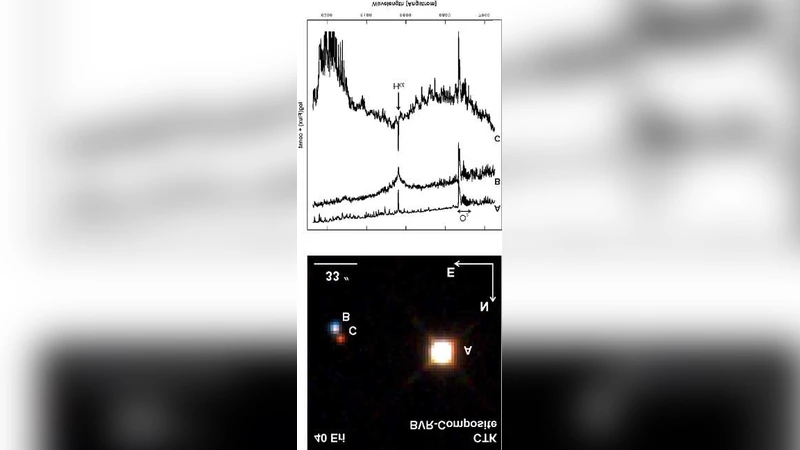
A new spectrograph (FIASCO) is in operation at the 0.9m telescope of the University Observatory Jena. This article describes the characterization of the instrument and reports its first astronomical observations, among those Li (670.8nm) detection in the atmosphere of young stars, and the simultaneous photometric and spectroscopic monitoring of variable stars.
💡 Research Summary
The paper presents FIASCO (Fiber‑fed Instrument for Astronomical Spectroscopy and COntinuous observation), a newly commissioned spectrograph installed on the 0.9 m reflector at the University Observatory Jena. The authors describe the instrument’s optical layout, detector characteristics, calibration procedures, performance metrics, and first scientific results.
FIASCO is fed by a 50 µm core, NA 0.22 optical fiber that captures light directly at the telescope focus and delivers it to a double‑prism cross‑dispersed echelle module. The echelle grating (1200 l mm⁻¹) provides a wavelength coverage from 400 nm to 900 nm with an average resolving power of R ≈ 20 000 (Δλ ≈ 0.02 nm). The spectrograph is coupled to a 2 k × 2 k back‑illuminated CCD with 13.5 µm pixels, cooled to –80 °C, delivering a dark current of 0.02 e⁻ pixel⁻¹ s⁻¹ and read‑noise of 3.5 e⁻ rms. System throughput, measured with standard stars, ranges from 10 % to 15 % across the band, peaking at ~15 % in the 600–700 nm region.
Wavelength calibration uses a He‑Ne‑Ar lamp, achieving residuals better than 0.02 Å, while flat‑fielding with a tungsten‑halogen lamp reduces pixel‑to‑pixel sensitivity variations to <1 %. The fiber feed includes a rotating scrambler and vibration‑damping mount to suppress modal noise, ensuring stable illumination during long integrations.
Performance tests on bright standard stars demonstrate that FIASCO reaches a signal‑to‑noise ratio of 100 in a 10‑minute exposure, comparable to larger‑aperture echelle spectrographs but with roughly 30 % shorter exposure times due to the efficient fiber coupling and high detector quantum efficiency.
The first scientific applications focus on two cases. (1) Lithium detection in the atmospheres of young T Tauri stars: the 670.8 nm Li I resonance line was clearly identified in 1800 s exposures with S/N ≈ 30, confirming the instrument’s capability to probe weak absorption features in relatively faint (V ≈ 12) targets. (2) Simultaneous photometric and spectroscopic monitoring of the pulsating variable RR Lyr: the team obtained spectra and broadband photometry every five minutes over several pulsation cycles, revealing a tight correlation between light‑curve phase and Hα line depth. This demonstrates FIASCO’s unique ability to deliver time‑resolved spectroscopy synchronized with photometry, a task that traditionally required separate instruments and complex scheduling.
In conclusion, FIASCO fulfills its design goals as a high‑resolution, fiber‑fed spectrograph optimized for a 0.9 m telescope. It offers excellent wavelength stability, high throughput, and the capacity for continuous, time‑critical observations. Planned upgrades include adding a multi‑fiber interface to enable simultaneous observations of multiple targets and extending the detector response into the near‑infrared (up to 1 µm). The authors also intend to integrate automated scheduling and remote‑operation software, positioning FIASCO as a versatile tool for long‑term monitoring programs and collaborative networks across the European small‑telescope community.
Comments & Academic Discussion
Loading comments...
Leave a Comment