Tidal dissipation in rotating fluid bodies: a simplified model
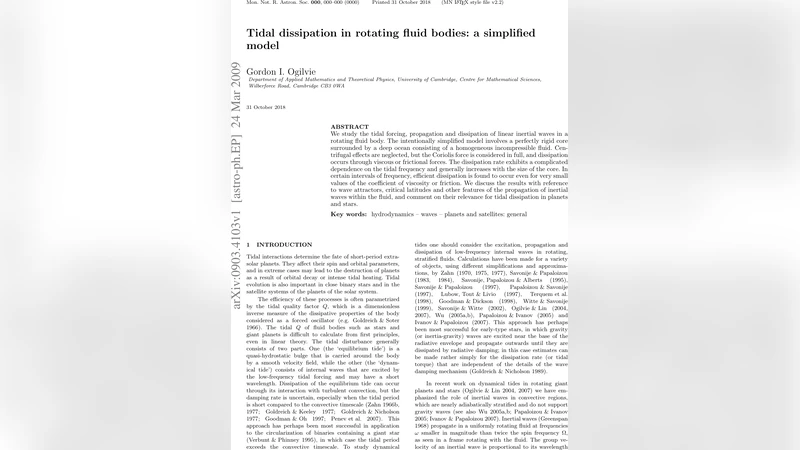
We study the tidal forcing, propagation and dissipation of linear inertial waves in a rotating fluid body. The intentionally simplified model involves a perfectly rigid core surrounded by a deep ocean consisting of a homogeneous incompressible fluid. Centrifugal effects are neglected, but the Coriolis force is considered in full, and dissipation occurs through viscous or frictional forces. The dissipation rate exhibits a complicated dependence on the tidal frequency and generally increases with the size of the core. In certain intervals of frequency, efficient dissipation is found to occur even for very small values of the coefficient of viscosity or friction. We discuss the results with reference to wave attractors, critical latitudes and other features of the propagation of inertial waves within the fluid, and comment on their relevance for tidal dissipation in planets and stars.
💡 Research Summary
The paper presents a systematic investigation of tidal forcing, propagation, and dissipation of linear inertial waves in a rotating fluid body using a deliberately simplified physical model. The model consists of a perfectly rigid spherical core surrounded by a deep ocean of homogeneous, incompressible fluid. Centrifugal deformation is ignored, but the Coriolis force is retained in full, ensuring that inertial waves exist only within the cone defined by angles between the rotation axis and the wavevector of 0°–90°. Dissipation is introduced through either a viscous term (characterized by a kinematic viscosity ν) or a linear friction term (characterized by a drag coefficient γ).
A key finding is that the dissipation rate D(ω) as a function of tidal frequency ω displays a highly non‑monotonic, “spiky” dependence. In certain narrow frequency intervals, D can become large even when ν or γ is vanishingly small. This counter‑intuitive behaviour is traced to the formation of wave attractors—geometric structures in which reflected inertial‑wave beams focus onto a limit cycle after successive reflections from the core‑ocean boundary and the outer surface. When an attractor exists, the wave energy is concentrated along a thin filament, and the local shear becomes extremely large; consequently, even a tiny viscous or frictional term can dissipate a substantial fraction of the tidal power.
The analysis also highlights the role of critical latitudes, i.e., latitudes where the wave characteristic is tangent to the spherical boundary. At these latitudes the group velocity vanishes in the direction normal to the surface, leading to a singular amplification of the wave amplitude. The combination of critical‑latitude singularities and attractor formation produces the observed peaks in D(ω).
Another systematic trend is the strong dependence of the overall dissipation level on the size of the rigid core. As the core radius Rc increases (relative to the total radius R), the fluid volume shrinks and the inner boundary area grows. This geometry forces inertial‑wave beams to encounter the core more frequently, enhancing the likelihood of attractor formation and increasing the total shear generated. Consequently, the mean dissipation rate rises roughly monotonically with Rc, and the peaks become more pronounced.
The authors compare viscous and frictional damping and find that, while both produce similar frequency‑dependent patterns, frictional damping yields a broader range of frequencies with appreciable dissipation because it does not require the development of very fine shear layers. Nevertheless, the essential physics—wave focusing, critical‑latitude amplification, and boundary‑induced reflection—remains the same for both mechanisms.
In the discussion, the relevance of these results to astrophysical bodies is examined. Giant planets, rapidly rotating low‑mass stars, and tidally interacting binary components often possess a dense central region (a solid core, a metallic hydrogen layer, or a convective core) surrounded by a deep fluid envelope. The simplified model captures the essential dynamics of inertial‑wave propagation in such configurations. The authors argue that, for realistic planetary interiors where the effective viscosity is extremely low, the presence of wave attractors could still lead to efficient tidal dissipation, potentially explaining observed orbital circularisation timescales and spin‑orbit synchronization rates that are otherwise difficult to reconcile with conventional equilibrium‑tide models.
Overall, the paper demonstrates that even in an idealised setting, the interaction of rotation, tidal forcing, and boundary geometry can produce highly efficient, frequency‑selective tidal dissipation through inertial‑wave dynamics. The findings provide a clear physical framework for interpreting tidal quality factors (Q) in rotating fluid bodies and suggest that future work incorporating stratification, magnetic fields, and realistic core elasticity will be essential to extend these insights to actual planets and stars.
Comments & Academic Discussion
Loading comments...
Leave a Comment