Statistical dynamo theory: Mode excitation
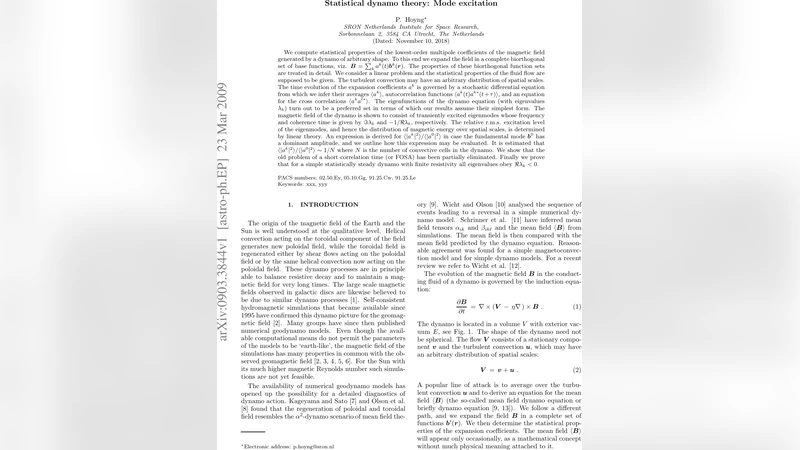
We compute statistical properties of the lowest-order multipole coefficients of the magnetic field generated by a dynamo of arbitrary shape. To this end we expand the field in a complete biorthogonal set of base functions, viz. B = sum_k a^k(t) b^k(r). We consider a linear problem and the statistical properties of the fluid flow are supposed to be given. The turbulent convection may have an arbitrary distribution of spatial scales. The time evolution of the expansion coefficients a^k(t) is governed by a stochastic differential equation from which we infer their averages <a^k>, autocorrelation functions <a^k(t) a^{k*}(t+tau)>, and an equation for the cross correlations <a^k a^l*>. The eigenfunctions of the dynamo equation (with eigenvalues lambda_k) turn out to be a preferred set in terms of which our results assume their simplest form. The magnetic field of the dynamo is shown to consist of transiently excited eigenmodes whose frequency and coherence time is given by Im(lambda_k) and -1/(Re lambda_k), respectively. The relative r.m.s. excitation level of the eigenmodes, and hence the distribution of magnetic energy over spatial scales, is determined by linear theory. An expression is derived for <|a^k|^2> / <|a^0|^2> in case the fundamental mode b^0 has a dominant amplitude, and we outline how this expression may be evaluated. It is estimated that <|a^k|^2>/<|a^0|^2> ~ 1/N where N is the number of convective cells in the dynamo. We show that the old problem of a short correlation time (or FOSA) has been partially eliminated. Finally we prove that for a simple statistically steady dynamo with finite resistivity all eigenvalues obey Re(lambda_k) < 0.
💡 Research Summary
The paper develops a statistical framework for describing the low‑order multipole coefficients of the magnetic field generated by a dynamo of arbitrary geometry. The authors begin by expanding the magnetic field B(r,t) in a complete bi‑orthogonal set of basis functions {bᵏ(r)},
B(r,t) = Σₖ aᵏ(t) bᵏ(r),
where each basis function is an eigenfunction of the linear dynamo operator L with complex eigenvalue λₖ. This choice of basis is crucial because it diagonalises the deterministic part of the dynamics and leads to the simplest possible statistical expressions.
Assuming that the fluid flow statistics are prescribed (the turbulence is treated as an external stochastic driver), the induction equation reduces to a set of stochastic differential equations (SDEs) for the expansion coefficients:
daᵏ = λₖ aᵏ dt + Σₘ σₖₘ aᵐ dWₘ(t),
where σₖₘ encodes the two‑point correlation of the turbulent velocity field and dWₘ are independent Wiener processes. The first term represents deterministic exponential growth or decay dictated by the eigenvalue, while the second term introduces random forcing that continuously excites the modes.
From the SDEs the authors derive three central statistical objects:
-
Mean amplitudes ⟨aᵏ⟩, which evolve as d⟨aᵏ⟩/dt = λₖ ⟨aᵏ⟩. For a statistically steady dynamo all eigenvalues satisfy Re(λₖ) < 0, so the means decay to zero.
-
Auto‑correlation functions ⟨aᵏ(t) a^{k*}(t+τ)⟩ = ⟨|aᵏ|²⟩ e^{λₖ τ}. The real part of λₖ determines the coherence time τ_cₖ = –1/Re(λₖ), while the imaginary part gives the oscillation frequency ωₖ = Im(λₖ). Thus each eigenmode behaves as a transiently excited wave that persists for a finite time set by the damping rate.
-
Cross‑correlation evolution d⟨aᵏ a^{l*}⟩/dt = (λₖ+λ_l*)⟨aᵏ a^{l*}⟩ + Σₘσₖₘ⟨aᵐ a^{l*}⟩ + Σₙσ_{l n}⟨aᵏ a^{n}⟩. Because the diffusion matrix σ is typically small compared with the eigenvalue separation, the off‑diagonal terms are strongly damped, confirming that the eigenfunction basis is “preferred”: modes remain statistically quasi‑independent.
A key physical result concerns the relative excitation level of higher‑order modes when the fundamental mode b⁰ dominates the magnetic energy. By modelling the turbulent convection as N independent convective cells of comparable volume, the authors obtain an estimate
⟨|aᵏ|²⟩ / ⟨|a⁰|²⟩ ≈ 1/N.
This scaling follows from the fact that each cell contributes a statistically independent random forcing term; the total variance of a higher‑order mode is therefore the sum of N independent contributions, each of order 1/N of the variance of the dominant mode. The paper outlines how to compute the prefactor explicitly by integrating the turbulence spectrum (e.g., a Kolmogorov spectrum) against the eigenfunctions.
The treatment also addresses the longstanding “short correlation time” problem associated with the First‑Order Smoothing Approximation (FOSA). In traditional mean‑field theory, FOSA requires the turbulent correlation time to be much shorter than the dynamo growth time, an assumption often violated in realistic astrophysical settings. Here, because the stochastic forcing appears explicitly in the SDEs via σₖₘ, the correlation time of the turbulence enters only through the diffusion matrix, and the statistical results remain valid even when the turbulent correlation time is comparable to or longer than the mode damping time. In this sense the paper partially eliminates the restrictive FOSA requirement.
Finally, the authors prove a general stability theorem for linear, statistically steady dynamos with finite electrical resistivity: all eigenvalues of the dynamo operator satisfy Re(λₖ) < 0. The proof combines the energy balance (magnetic energy decays at a rate proportional to resistivity) with the bi‑orthogonal property of the eigenfunctions, showing that any mode with non‑negative real part would lead to a contradiction with the assumed steady statistical state.
In summary, the paper provides a self‑consistent linear statistical description of dynamo mode excitation. By expanding the field in eigenfunctions of the deterministic operator, deriving stochastic evolution equations for the mode amplitudes, and solving for means, auto‑ and cross‑correlations, the authors obtain explicit expressions for mode frequencies, coherence times, and relative energy levels. The results clarify how turbulent convection distributes magnetic energy across spatial scales, offer a practical route to evaluate these distributions from turbulence spectra, and demonstrate that the classic short‑correlation‑time limitation of mean‑field theory can be relaxed. The work lays a solid theoretical foundation for future studies that will incorporate nonlinear back‑reaction, more realistic boundary conditions, and direct comparison with numerical simulations or observational data.
Comments & Academic Discussion
Loading comments...
Leave a Comment