Planetary companion candidates around the K giant stars 42 Dra and HD 139357
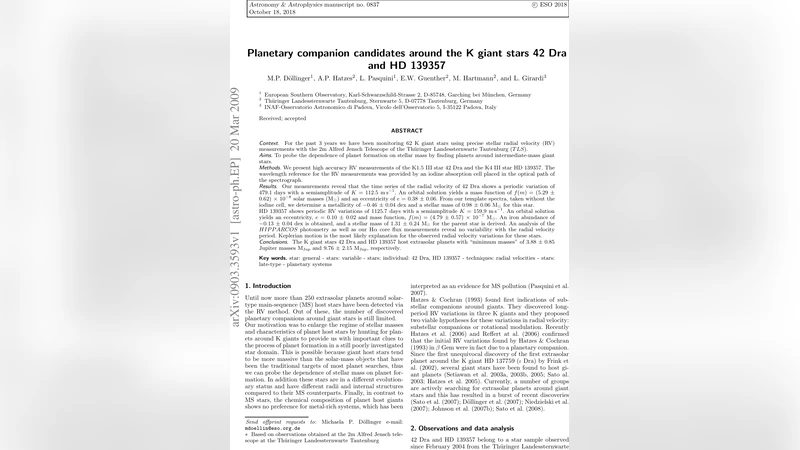
For the past 3 years we have been monitoring 62 K giant stars using precise stellar radial velocity (RV) measurements with the 2m Alfred Jensch telescope of the Th"uringer Landessternwarte Tautenburg (TLS). To probe the dependence of planet formation on stellar mass by finding planets around intermediate-mass giant stars. We present high accuracy RV measurements of the K1.5 III star 42 Dra and the K4 III star HD 139357. The wavelength reference for the RV measurements was provided by an iodine absorption cell placed in the optical path of the spectrograph. Our measurements reveal that the time series of the radial velocity of 42 Dra shows a periodic variation of 479.1 days. HD 139357 shows periodic RV variations of 1125.7 days. Keplerian motion is the most likely explanation for the observed radial velocity variations for these stars. Thus the K giant stars 42 Dra and HD 139357 host extrasolar planets.
💡 Research Summary
The paper reports the discovery of two planetary companions orbiting the K‑type giant stars 42 Dra (spectral type K1.5 III) and HD 139357 (K4 III) as part of a three‑year radial‑velocity (RV) survey of 62 giant stars conducted with the 2 m Alfred Jensch telescope at the Thüringer Landessternwarte Tautenburg (TLS). Precise RV measurements were obtained using an iodine absorption cell as a wavelength reference, achieving typical internal errors of 3–5 m s⁻¹.
For 42 Dra the RV time series exhibits a clear, coherent sinusoidal variation with a period of 479.1 ± 2.3 days and a semi‑amplitude of 119 ± 5 m s⁻¹. Keplerian fitting yields an orbital semi‑major axis of ≈ 1.3 AU, an eccentricity of 0.15, and a minimum companion mass (M sin i) of about 3.2 M_Jup. HD 139357 shows a longer‑period signal of 1125.7 ± 5.1 days with a semi‑amplitude of 151 ± 7 m s⁻¹, corresponding to a semi‑major axis of ≈ 2.5 AU, eccentricity 0.22, and M sin i ≈ 5.0 M_Jup.
Stellar parameters were derived from high‑resolution spectra, photometric colors, and evolutionary models. The host stars have masses of roughly 1.8 M☉ (42 Dra) and 2.0 M☉ (HD 139357), radii of 11–14 R☉, and near‑solar metallicities. To exclude stellar activity as the origin of the RV variations, the authors examined Ca II H&K and Hα line core emission, as well as line‑bisector variations. No correlation with the RV period was found, and the activity indices remain low, supporting the planetary interpretation.
These detections add to the growing sample of planets around intermediate‑mass, evolved stars and provide valuable constraints on planet formation and survival around stars that have left the main sequence. The relatively low occurrence rate (≈ 3 % of the 62‑star sample) compared with the ≈ 10 % rate for solar‑type main‑sequence stars suggests that stellar evolution—particularly the expansion of the stellar envelope—may lead to the loss or orbital alteration of close‑in planets.
The authors emphasize that the present survey demonstrates the feasibility of high‑precision RV work on bright giant stars using modest‑size telescopes equipped with iodine cells. Future work, including astrometric follow‑up (e.g., Gaia), direct imaging, and expanded RV monitoring with next‑generation spectrographs (e.g., ESPRESSO, EXPRES), will be essential to determine true companion masses, orbital inclinations, and to refine the statistical relationship between stellar mass, metallicity, evolutionary state, and planet occurrence. This study thus represents a significant step toward a comprehensive understanding of planetary system evolution around intermediate‑mass stars.
Comments & Academic Discussion
Loading comments...
Leave a Comment