Semi-passivity and synchronization of diffusively coupled neuronal oscillators
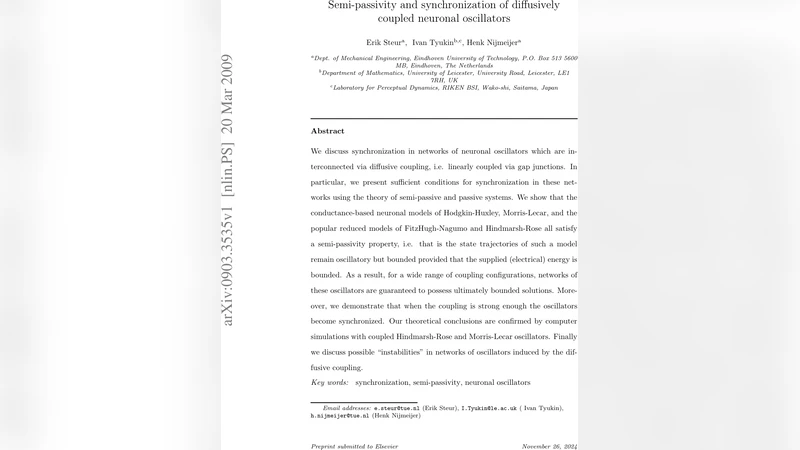
We discuss synchronization in networks of neuronal oscillators which are interconnected via diffusive coupling, i.e. linearly coupled via gap junctions. In particular, we present sufficient conditions for synchronization in these networks using the theory of semi-passive and passive systems. We show that the conductance-based neuronal models of Hodgkin-Huxley, Morris-Lecar, and the popular reduced models of FitzHugh-Nagumo and Hindmarsh-Rose all satisfy a semi-passivity property, i.e. that is the state trajectories of such a model remain oscillatory but bounded provided that the supplied (electrical) energy is bounded. As a result, for a wide range of coupling configurations, networks of these oscillators are guaranteed to possess ultimately bounded solutions. Moreover, we demonstrate that when the coupling is strong enough the oscillators become synchronized. Our theoretical conclusions are confirmed by computer simulations with coupled \HR and \ML oscillators. Finally we discuss possible “instabilities” in networks of oscillators induced by the diffusive coupling.
💡 Research Summary
The paper investigates synchronization in networks of neuronal oscillators that are coupled through electrical gap junctions, i.e., diffusive coupling. The authors adopt the concept of semi‑passivity—a relaxation of classical passivity—where a storage function V(x) satisfies the dissipation inequality (\dot V \le u^{\top}y) and guarantees that, for bounded input energy, the state trajectories remain ultimately bounded. They first prove that four widely used neuronal models—Hodgkin‑Huxley, Morris‑Lecar, FitzHugh‑Nagumo, and Hindmarsh‑Rose—each admit a suitable quadratic‑type storage function, thereby establishing their semi‑passive nature.
With each node described by (\dot x_i = f(x_i) - k\sum_{j}a_{ij}(x_i - x_j)), the network dynamics can be written compactly using the graph Laplacian L. Summing the individual storage functions yields a global dissipation inequality (\dot V_{\text{total}} \le -k, y^{\top} L y). Because the second smallest eigenvalue (\lambda_2) of L (the algebraic connectivity) is positive for any connected graph, the inequality becomes (\dot V_{\text{total}} \le -k\lambda_2|y|^2). Consequently, if the coupling gain k exceeds a threshold proportional to the non‑linear gain of the individual oscillators ((k > \gamma/\lambda_2)), the output differences decay exponentially, guaranteeing global synchronization. Even when the coupling is below this threshold, semi‑passivity ensures that all trajectories stay bounded, preventing blow‑up.
The authors also discuss a potential “diffusive instability” that can arise when k is excessively large. In that regime the coupling term dominates the intrinsic restoring dynamics, causing certain Laplacian modes to grow and leading to non‑physiological oscillations or loss of synchrony. They therefore propose design guidelines that balance coupling strength against network topology to stay within a safe stability region.
Numerical experiments with ten‑node networks of Hindmarsh‑Rose and Morris‑Lecar oscillators corroborate the theory. For coupling gains below the analytically derived bound, the oscillators exhibit bounded, desynchronized activity. When the gain surpasses the bound, the membrane potentials of all nodes converge to a common periodic orbit, confirming synchronization. Further increase of the gain produces the predicted diffusive instability, manifested as irregular, unbounded voltage excursions.
Overall, the study provides a unified energy‑based framework for analyzing both stability and synchronization of diffusively coupled neuronal models. By demonstrating that classic conductance‑based models are semi‑passive, the work extends passivity‑based control tools to a broad class of biologically realistic neural circuits, offering valuable insights for neuroscientists, computational modelers, and engineers designing electrically coupled neural hardware.
Comments & Academic Discussion
Loading comments...
Leave a Comment