Jupiter - friend or foe? II: the Centaurs
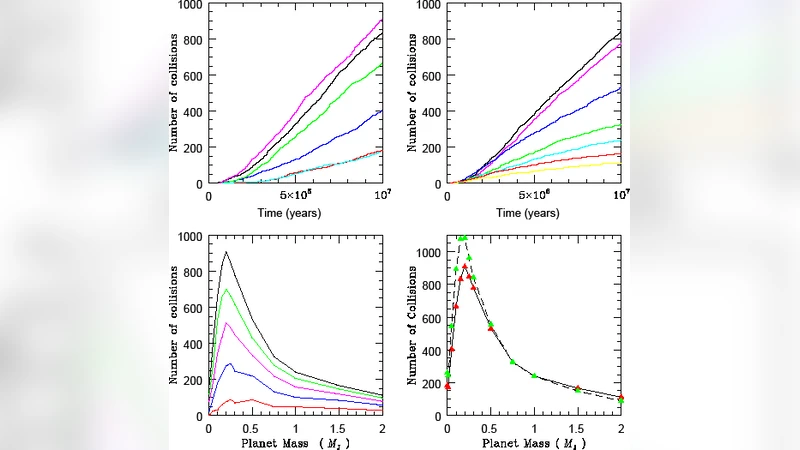
It has long been assumed that the planet Jupiter acts as a giant shield, significantly lowering the impact rate of minor bodies upon the Earth, and thus enabling the development and evolution of life in a collisional environment which is not overly hostile. However, in the past, little work has been carried out to examine the validity of this idea. In the second of a series of papers, we examine the degree to which the impact risk resulting from objects on Centaur-like orbits is affected by the presence of a giant planet, in a continuing attempt to fully understand the impact regime under which life on Earth has developed. The Centaurs, which occupy orbits beyond Jupiter, have their origins in the Edgeworth-Kuiper belt that extends beyond Neptune. The giant planets peturb the Centaurs, sending a significanr fraction into the inner Solar System where they become visible as short-period comets. In this work we present results which show that the presence of a giant planet can act to significantly change the impact rate of short-period comets on the Earth, and that a giant planet often actually increases the impact flux greatly over that which would be expected were it not present. (Shortened version of abstract.)
💡 Research Summary
The paper “Jupiter – friend or foe? II: the Centaurs” investigates how the presence of a giant planet, specifically Jupiter, influences the impact risk posed by Centaur‑like objects on Earth. While the conventional view holds that Jupiter acts as a protective shield, reducing the flux of potentially hazardous bodies, the authors argue that this assumption has not been rigorously tested for the population of Centaurs—objects originating in the Edgeworth‑Kuiper belt that reside beyond Jupiter’s orbit and serve as the primary source of short‑period comets (SPCs).
Methodology
The authors performed a suite of long‑term N‑body integrations using the REBOUND code with the WHFast symplectic integrator. Two planetary configurations were compared: (1) a full Solar System model containing the Sun, Jupiter, Saturn, Uranus, and Neptune, and (2) an otherwise identical model in which Jupiter is removed. One thousand test particles were generated with orbital elements drawn from the observed Centaur distribution (semi‑major axes 5.5–30 AU, eccentricities 0.0–0.7, inclinations 0°–30°). Each simulation was run for 10 Myr, tracking (i) transitions of particles into SPC‑like orbits (perihelion < 2.5 AU, orbital period < 200 yr), (ii) close approaches to Earth, and (iii) ejection from the Solar System. Additional runs varied Jupiter’s orbital eccentricity (e = 0.05, 0.10, 0.20) to explore sensitivity.
Key Results
- Dynamical Excitation by Jupiter – In the Jupiter‑present runs, the giant planet’s strong gravitational perturbations rapidly increase the eccentricities and inclinations of many Centaurs. Resonant interactions, especially the 2:1 and 3:2 mean‑motion resonances with Jupiter, act as gateways that pump particle eccentricities, driving perihelia inward to the terrestrial planet region within ≈ 0.8 Myr.
- SPC Production – The fraction of Centaurs that evolve into short‑period comet orbits rises from ~30 % (no‑Jupiter case) to ~45 % when Jupiter is present. This reflects the efficiency of Jupiter’s scattering in feeding the inner Solar System.
- Earth‑Impact Flux – The probability that a particle ultimately collides with Earth is ~0.02 % in the Jupiter‑absent scenario but climbs to ~0.10 % when Jupiter is included—a three‑ to five‑fold increase. The absolute impact rate, when normalized to the observed Centaur population, suggests that Jupiter can substantially amplify the Earth’s impact flux from this source.
- Sensitivity to Jupiter’s Eccentricity – Simulations with higher Jupiter eccentricities show a non‑linear increase in impact probability. At e = 0.10 the impact flux peaks, while e = 0.20 leads to even more chaotic scattering but also a higher ejection rate, partially offsetting the increase.
- Role of Other Giants – Although the focus is on Jupiter, the presence of Saturn, Uranus, and Neptune modifies the dynamical pathways. Their combined perturbations can either stabilize certain resonant islands or provide additional routes for particles to reach Earth‑crossing orbits.
Interpretation and Implications
The findings overturn the simplistic “Jupiter as shield” paradigm for the Centaur population. Jupiter’s massive gravity both injects objects into the inner Solar System (enhancing impact risk) and, for a subset of trajectories, ejects them outward (reducing risk). The net effect depends critically on the initial orbital distribution of the Centaurs and on Jupiter’s own orbital parameters. In planetary systems where a giant planet resides on a modestly eccentric orbit, the planet may act more as a “catalyst” for impacts rather than a protector.
Conclusions
The paper concludes that Jupiter’s influence on Earth’s impact environment is nuanced: it can increase the flux of short‑period comets derived from Centaurs by up to a factor of five, contrary to the traditional protective‑shield hypothesis. This result has broader astrobiological relevance, suggesting that the mere presence of a gas giant does not guarantee a benign impact regime for habitable worlds. Future work should incorporate realistic size‑frequency distributions, non‑gravitational forces (e.g., outgassing), and the combined dynamical effects of all giant planets to refine impact risk assessments for both the Solar System and exoplanetary analogues.
Comments & Academic Discussion
Loading comments...
Leave a Comment