Mapping low and high density clouds in astrophysical nebulae by imaging forbidden line emission
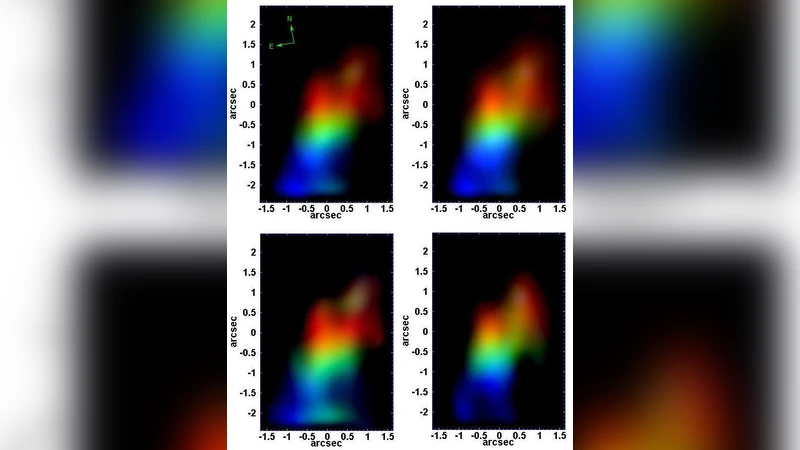
Emission line ratios have been essential for determining physical parameters such as gas temperature and density in astrophysical gaseous nebulae. With the advent of panoramic spectroscopic devices, images of regions with emission lines related to these physical parameters can, in principle, also be produced. We show that, with observations from modern instruments, it is possible to transform images taken from density sensitive forbidden lines into images of emission from high and low-density clouds by applying a transformation matrix. In order to achieve this, images of the pairs of density sensitive lines as well as the adjacent continuum have to be observed and combined. We have computed the critical densities for a series of pairs of lines in the infrared, optical, ultraviolet and X-rays bands, and calculated the pair line intensity ratios in the high and low-density limit using a 4 and 5 level atom approximation. In order to illustrate the method we applied it to GMOS-IFU data of two galactic nuclei. We conclude that this method provides new information of astrophysical interest, especially for mapping low and high-density clouds; for this reason we call it “the ld/hd imaging method”.
💡 Research Summary
The paper introduces a novel imaging technique that separates the emission from low‑density (LD) and high‑density (HD) gas clouds in astrophysical nebulae by exploiting the density‑sensitive nature of forbidden line pairs. Traditionally, electron temperature and density are derived from line‑ratio diagnostics applied to spectra extracted from long‑slit or integral‑field observations. With the advent of panoramic spectroscopic instruments (e.g., IFUs, wide‑field narrow‑band imagers) it becomes feasible to obtain spatially resolved images of individual forbidden lines across large fields of view. The authors demonstrate that, by acquiring images of a density‑sensitive line pair together with an adjacent continuum image, one can construct a linear transformation matrix that converts the raw line‑intensity maps into two distinct maps: one representing emission that originates predominantly in low‑density gas, the other in high‑density gas.
The theoretical foundation rests on a multi‑level atomic model (4‑ and 5‑level approximations) that provides the spontaneous decay rates (A‑values) and collisional de‑excitation coefficients for each transition. From these quantities the critical density n₍crit₎ = A/γ is calculated for a broad suite of lines spanning the infrared, optical, ultraviolet, and X‑ray regimes. In the low‑density limit (nₑ ≪ n₍crit₎) the line ratio approaches a value Rₗₒ set by the ratio of A‑values, whereas in the high‑density limit (nₑ ≫ n₍crit₎) collisional coupling forces the ratio to a different constant Rₕᵢ. By tabulating Rₗₒ, Rₕᵢ, and n₍crit₎ for each pair, the authors create a library that can be consulted for any target wavelength range.
Operationally, the method proceeds as follows: (1) obtain calibrated, astrometrically aligned images of the two forbidden lines (I₁, I₂) and an adjacent continuum (C); (2) subtract the appropriately scaled continuum from each line image using scaling factors α and β that account for filter transmission and underlying stellar/AGN continuum; (3) assemble the continuum‑subtracted line vector
Comments & Academic Discussion
Loading comments...
Leave a Comment