On the afterglow from the receding jet of gamma-ray burst
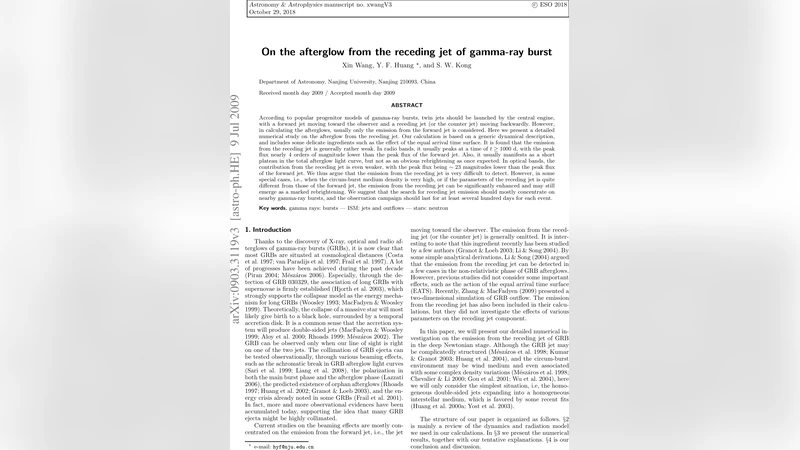
According to popular progenitor models of gamma-ray bursts, twin jets should be launched by the central engine, with a forward jet moving toward the observer and a receding jet (or the counter jet) moving backwardly. However, in calculating the afterglows, usually only the emission from the forward jet is considered. Here we present a detailed numerical study on the afterglow from the receding jet. Our calculation is based on a generic dynamical description, and includes some delicate ingredients such as the effect of the equal arrival time surface. It is found that the emission from the receding jet is generally rather weak. In radio bands, it usually peaks at a time of $t \geq 1000$ d, with the peak flux nearly 4 orders of magnitude lower than the peak flux of the forward jet. Also, it usually manifests as a short plateau in the total afterglow light curve, but not as an obvious rebrightening as once expected. In optical bands, the contribution from the receding jet is even weaker, with the peak flux being $\sim 8$ orders of magnitude lower than the peak flux of the forward jet. We thus argue that the emission from the receding jet is very difficult to detect. However, in some special cases, i.e., when the circum-burst medium density is very high, or if the parameters of the receding jet is quite different from those of the forward jet, the emission from the receding jet can be significantly enhanced and may still emerge as a marked rebrightening. We suggest that the search for receding jet emission should mostly concentrate on nearby gamma-ray bursts, and the observation campaign should last for at least several hundred days for each event.
💡 Research Summary
This paper investigates the afterglow emission from the receding (counter) jet of gamma‑ray bursts (GRBs), a component that is usually omitted in afterglow modeling. The authors adopt a generic dynamical framework originally proposed by Huang et al. (1999, 2000), which consists of four coupled differential equations describing the evolution of the jet radius, swept‑up mass, half‑opening angle, and bulk Lorentz factor. These equations reduce to the Blandford‑McKee self‑similar solution in the ultra‑relativistic phase and to the Sedov‑Taylor solution in the non‑relativistic regime, thus providing a unified description from early to late times.
The radiation model assumes that shock‑accelerated electrons follow a power‑law distribution in the comoving frame, modified to remain valid in the deep Newtonian phase by using (γ_e − 1) rather than γ_e. Minimum and maximum electron Lorentz factors are set by the usual microphysical parameters ξ_e (fraction of internal energy given to electrons) and ξ_B (magnetic‑field equipartition factor). Synchrotron emission is calculated with the standard formulae, and synchrotron self‑absorption (SSA) is incorporated through an optical‑depth integral and a reduction factor f(τ)=1−e^{−τ}. The observed flux is obtained by transforming the comoving emissivity with the Doppler factor D=
Comments & Academic Discussion
Loading comments...
Leave a Comment