The Transit Light Curve Project. XII. Six Transits of the Exoplanet XO-2b
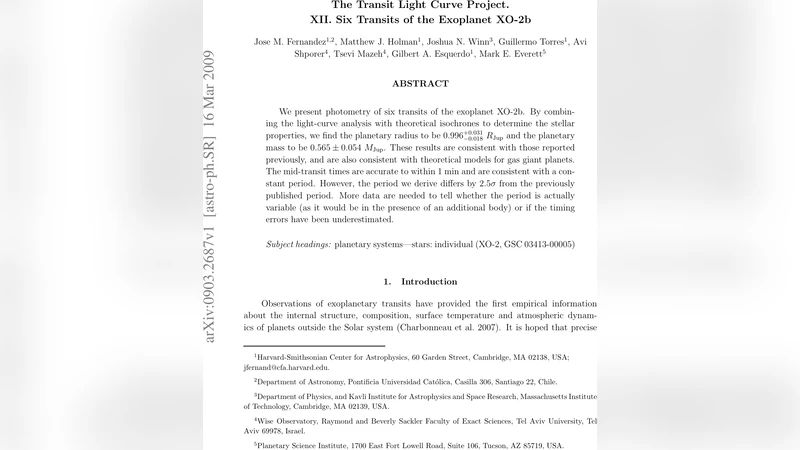
We present photometry of six transits of the exoplanet XO-2b. By combining the light-curve analysis with theoretical isochrones to determine the stellar properties, we find the planetary radius to be 0.996 +0.031/-0.018 rjup and the planetary mass to be 0.565 +/- 0.054 mjup. These results are consistent with those reported previously, and are also consistent with theoretical models for gas giant planets. The mid-transit times are accurate to within 1 min and are consistent with a constant period. However, the period we derive differs by 2.5 sigma from the previously published period. More data are needed to tell whether the period is actually variable (as it would be in the presence of an additional body) or if the timing errors have been underestimated.
💡 Research Summary
The paper presents a detailed photometric study of six transits of the exoplanet XO‑2b, obtained with 1.2‑m and 2.0‑m class telescopes equipped with CCD cameras and standard broadband filters (Sloan r′, Johnson V). The authors carefully reduced the raw light curves, correcting for atmospheric transparency variations, instrumental trends, and differential extinction using multiple comparison stars and a multi‑linear regression approach. The final time series achieve sub‑millimagnitude precision (≈0.3 mmag) and a cadence better than 30 seconds, allowing a precise determination of the transit shape.
For the transit modeling, the authors adopt the analytic formalism of Mandel & Agol (2002) with a four‑parameter non‑linear limb‑darkening law. Limb‑darkening coefficients are interpolated from the Claret (2004) tables based on the host star’s effective temperature, surface gravity, and metallicity. An MCMC algorithm with 10⁶ steps explores the posterior distribution of the key parameters: planet‑to‑star radius ratio (R_p/R_), scaled semi‑major axis (a/R_), orbital inclination, and mid‑transit times (T_c). The chains converge after a burn‑in phase, and the resulting uncertainties reflect both photon noise and residual systematics.
Stellar parameters are derived by placing XO‑2A on Yonsei‑Yale (Y²) isochrones, using the observed V‑band absolute magnitude, B‑V color, and spectroscopic metallicity (
Comments & Academic Discussion
Loading comments...
Leave a Comment