gamma Cassiopeiae: an X-ray Be star with personality
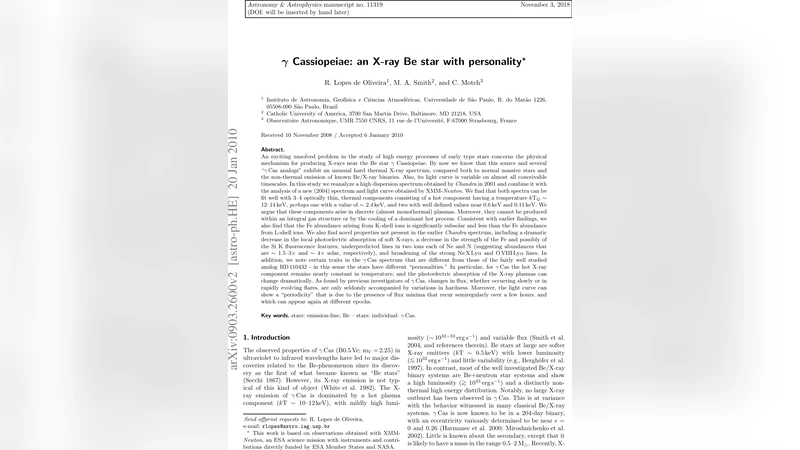
gamma Cassiopeiae (gCas) is a B0.5e star with peculiar X-ray emission properties and yet the prototype of its own small class. In this paper we examine the X-ray spectra for a 2004 XMM-Newton observation and a previously published 2001 Chandra observation. In both cases the spectra can be modeled with 3 or 4 thermal components, which appear be discrete in temperature and spatially distinct. The dominant component, having kT ~ 12 keV contributes most (~80-90%) of the flux. The secondary components have temperatures in the range of 2-3 keV to 0.1 keV; these values can shift in time. Importantly, we find that the strong absorption of soft X-rays in 2001 is absent in 2004, meaning that an absorbing column in front of the source has moved off the star or has been removed. Other differences include a reduced Fe abundance from the ionized lines of the FeKalpha complex (even more subsolar than the 2001 observation), a decrease of the Fe K and possibly of the Si K fluorescence features, and from the NVII and NeX H-alpha lines, a possible overabundance of N and Ne. Also, we note common characteristics in both spectra that seem to set gCas apart from HD110342, another member of this subclass studied in detail. In this sense these stars have different “personalities.” For example, for gCas rapid X-ray flaring and slower changes in the light curve are only seldomly accompanied by variations in hardness, and the hot X-ray component remains nearly constant in temperature. Moreover, the light curve shows recurrent “lulls” in flux, suggesting that a relaxation cycle is operates as part of the (unknown) X-ray generation process.
💡 Research Summary
The paper presents a detailed comparative study of the X‑ray properties of the Be star γ Cassiopeiae (γ Cas), the prototype of a small class of X‑ray bright Be stars. Using archival high‑resolution spectra from a 2001 Chandra observation and a 2004 XMM‑Newton observation, the authors model the emission with multiple thermal plasma components and investigate temporal changes in absorption, elemental abundances, and variability patterns.
Both datasets are well described by three to four discrete thermal components. The dominant component has a temperature of kT ≈ 12 keV and accounts for roughly 80–90 % of the 0.5–10 keV flux. This hot plasma remains remarkably stable in temperature and emission measure across the three‑year interval, suggesting a persistent heating mechanism. Two additional components are cooler, with temperatures ranging from ≈2–3 keV down to ≈0.1 keV. Their relative contributions shift between the two epochs, indicating that they arise from spatially distinct regions (e.g., the inner disk, a corona, or shock interfaces) whose physical conditions evolve on timescales of months to years.
A striking difference between the two observations is the soft‑X‑ray absorption. The 2001 Chandra spectrum shows a strong low‑energy cutoff corresponding to an equivalent hydrogen column density N_H ≈ 2 × 10^22 cm⁻², whereas the 2004 XMM‑Newton data require only N_H ≈ 5 × 10^20 cm⁻². The authors interpret this as the removal or relocation of an absorbing structure—most plausibly a dense portion of the circumstellar disk or a localized wind clump—out of the line of sight. This rapid change implies that the circumstellar environment of γ Cas is highly dynamic.
Elemental abundances derived from the Fe Kα complex and other lines also evolve. The ionized Fe lines in 2004 indicate a sub‑solar Fe abundance (≈0.3 Z_⊙), even lower than that inferred from the 2001 data. Simultaneously, the Fe K fluorescence line and the Si K fluorescence line weaken, suggesting a reduced reprocessing efficiency or a change in the geometry of the fluorescing material. In contrast, the N VII Lyα and Ne X Lyα lines appear relatively enhanced, hinting at an over‑abundance of nitrogen and neon, possibly due to mixing processes in the stellar interior or selective enrichment of the disk material.
Temporal analysis of the light curves reveals rapid flares lasting seconds to minutes, superimposed on slower flux variations on hour‑scale timescales. Notably, the flares are rarely accompanied by changes in spectral hardness, implying that the flares are driven primarily by density enhancements rather than temperature spikes. Moreover, the light curves display recurrent low‑flux “lulls” that recur on a quasi‑regular basis, suggesting the operation of a relaxation cycle within the unknown X‑ray generation mechanism.
The authors compare γ Cas with HD 110342, another well‑studied member of the γ Cas class. While both stars share the hallmark hot plasma component and multi‑temperature structure, they differ in absorption behavior, Fe abundance trends, and variability patterns, underscoring that the class comprises objects with distinct “personalities” despite a common underlying physics.
In the discussion, the authors evaluate two leading scenarios for the origin of the hot plasma: (1) magnetic reconnection events in a strong stellar magnetosphere, and (2) shocks formed where the fast stellar wind collides with the dense equatorial decretion disk. The stability of the 12 keV component favors a quasi‑steady process, yet the observed rapid changes in absorption and elemental abundances point to a highly dynamic circumstellar environment, consistent with a hybrid model where magnetic activity and wind–disk interactions both contribute.
The paper concludes that γ Cas’s X‑ray emission is governed by a complex interplay of a persistent hot plasma, variable cooler components, and a rapidly evolving circumstellar absorber. Future high‑resolution, time‑resolved X‑ray spectroscopy combined with coordinated optical/IR monitoring and magnetic field measurements will be essential to disentangle the relative contributions of magnetic reconnection and wind–disk shocks, and to clarify the physical mechanisms that give γ Cas and its kin their unique “personalities.”
Comments & Academic Discussion
Loading comments...
Leave a Comment