Statistical mechanics of budget-constrained auctions
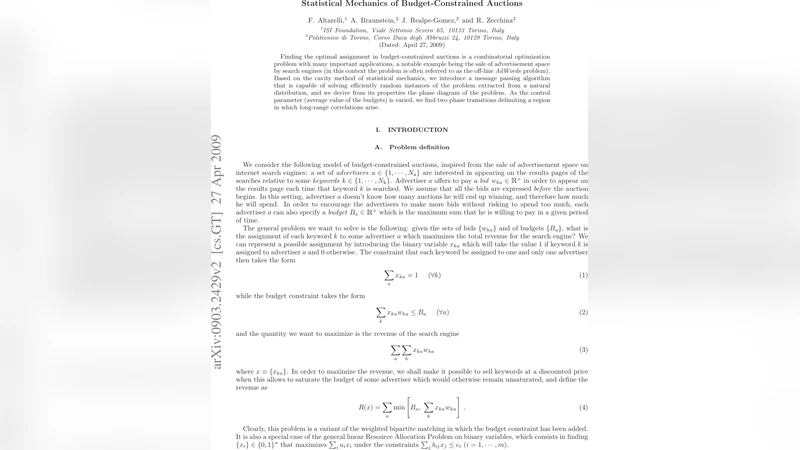
Finding the optimal assignment in budget-constrained auctions is a combinatorial optimization problem with many important applications, a notable example being the sale of advertisement space by search engines (in this context the problem is often referred to as the off-line AdWords problem). Based on the cavity method of statistical mechanics, we introduce a message passing algorithm that is capable of solving efficiently random instances of the problem extracted from a natural distribution, and we derive from its properties the phase diagram of the problem. As the control parameter (average value of the budgets) is varied, we find two phase transitions delimiting a region in which long-range correlations arise.
💡 Research Summary
The paper tackles the offline AdWords problem – a budget‑constrained auction in which a set of advertisers each has a limited budget and must be assigned to a set of keywords (or ad slots) so as to maximise total revenue while never exceeding any advertiser’s budget. Formally, with N advertisers, M keywords, binary variables x_{ij}∈{0,1} indicating whether advertiser i receives keyword j, bid values a_{ij} (revenue per click) and cost values c_{ij} (cost per click), the optimisation problem is: maximise Σ_{i,j} a_{ij} x_{ij} subject to Σ_j c_{ij} x_{ij} ≤ B_i for every i and Σ_i x_{ij}=1 for every j. This is a combinatorial NP‑hard problem; standard linear‑programming relaxations or greedy heuristics work only for modest instances.
The authors adopt a statistical‑mechanics viewpoint, mapping the problem onto a zero‑temperature spin‑glass model. Each binary decision x_{ij} becomes a spin, and the budget constraints are encoded as hard interactions in the Hamiltonian. They then apply the cavity method, which is the backbone of belief‑propagation (BP) on sparse factor graphs, to derive exact recursive equations for the marginal probabilities of each variable in the β→∞ limit (β being the inverse temperature).
Two families of cavity messages are introduced: η_{i→j}(x) – the probability that advertiser i would assign keyword j to state x if the edge (i,j) were removed, and \hat{η}_{j→i}(x) – the analogous probability from the keyword side. The update rules read, in compact form,
η_{i→j}(x) ∝ Σ_{ {x_{ik}}{k≠j} δ( Σ_k c{ik} x_{ik} ≤ B_i ) e^{β Σ_k a_{ik} x_{ik}} ∏{k≠j} \hat{η}{k→i}(x_{ik})
\hat{η}{j→i}(x) ∝ Σ{ {x_{kj}}{k≠i} δ( Σ_k x{kj}=1 ) e^{β a_{ij} x} ∏{k≠i} η{k→j}(x_{kj})
where δ enforces the hard constraints. In practice the authors work with log‑messages to avoid numerical overflow and reduce the state space to the two binary values. The algorithm iterates these equations over all edges until convergence; the marginal probability for each edge is then p_{ij}=η_{i→j}(1)·\hat{η}{j→i}(1) / (η{i→j}(0)·\hat{η}{j→i}(0)+η{i→j}(1)·\hat{η}_{j→i}(1)). A final assignment is obtained by selecting a maximum‑weight matching consistent with the highest marginals (or by a simple rounding scheme).
To evaluate performance, the authors generate random instances from a “natural” distribution: advertiser budgets B_i are drawn from a Gaussian N(μ,σ²), while bids a_{ij} and costs c_{ij} are independent uniform variables on
Comments & Academic Discussion
Loading comments...
Leave a Comment