New Faint Optical Spectrophotometric Standards. Hot White Dwarfs from the Sloan Digital Sky Survey
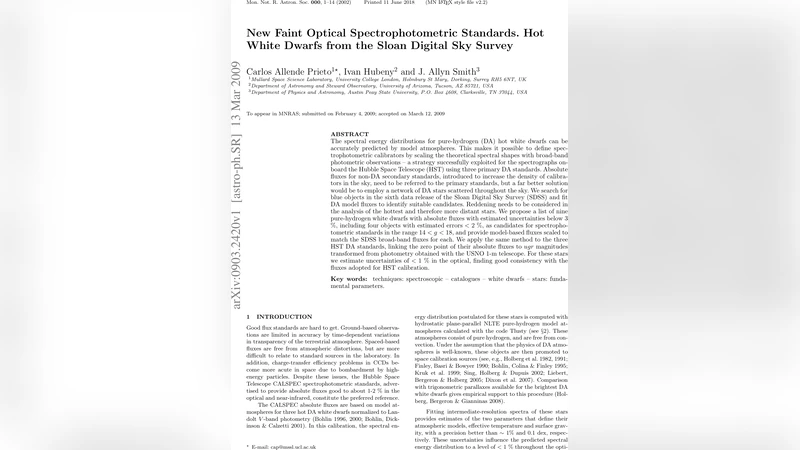
The spectral energy distributions for pure-hydrogen (DA) hot white dwarfs can be accurately predicted by model atmospheres. This makes it possible to define spectrophotometric calibrators by scaling the theoretical spectral shapes with broad-band photometric observations – a strategy successfully exploited for the spectrographs onboard the Hubble Space Telescope (HST) using three primary DA standards. Absolute fluxes for non-DA secondary standards, introduced to increase the density of calibrators in the sky, need to be referred to the primary standards, but a far better solution would be to employ a network of DA stars scattered throughout the sky. We search for blue objects in the sixth data release of the Sloan Digital Sky Survey (SDSS) and fit DA model fluxes to identify suitable candidates. Reddening needs to be considered in the analysis of the hottest and therefore more distant stars. We propose a list of nine pure-hydrogen white dwarfs with absolute fluxes with estimated uncertainties below 3%, including four objects with estimated errors <2%, as candidates for spectrophotometric standards in the range 14<g<18, and provide model-based fluxes scaled to match the SDSS broad-band fluxes for each. We apply the same method to the three HST DA standards, linking the zero point of their absolute fluxes to ugr magnitudes transformed from photometry obtained with the USNO 1-m telescope. For these stars we estimate uncertainties of <1% in the optical, finding good consistency with the fluxes adopted for HST calibration.
💡 Research Summary
The paper addresses a long‑standing limitation in optical spectrophotometric calibration: the scarcity of well‑distributed primary standards across the sky. While the Hubble Space Telescope (HST) has relied on three hot, pure‑hydrogen (DA) white dwarfs as primary calibrators, their sparse sky coverage hampers the calibration of ground‑based surveys and future large‑aperture facilities that require a dense network of standards. The authors exploit the fact that the spectral energy distributions (SEDs) of DA white dwarfs can be predicted with sub‑percent accuracy from state‑of‑the‑art model atmospheres. By scaling these theoretical SEDs to match observed broadband photometry, one can generate absolute flux standards with well‑quantified uncertainties.
Using the Sloan Digital Sky Survey (SDSS) Data Release 6, the authors first isolate blue point sources with colour cuts (u‑g < 0.6, g‑r < −0.2, r‑i < 0.0) to obtain a candidate list of roughly 1,200 objects. For each candidate they perform a χ² minimisation against a grid of DA atmosphere models covering effective temperatures from 20 000 K to 100 000 K and surface gravities log g = 7.0–9.5. Because the hottest objects are intrinsically luminous and therefore more distant, the authors include interstellar reddening as a free parameter, adopting a standard extinction law and solving simultaneously for Teff, log g, and E(B–V). The scaling factor that brings the model SED into agreement with the SDSS ugr magnitudes provides the absolute flux level.
From this analysis nine objects emerge as suitable spectrophotometric standards. They span g‑band magnitudes 14–18, a range that is bright enough for high‑signal‑to‑noise spectroscopy yet faint enough to avoid saturation in modern imagers. The authors estimate the total uncertainty on the absolute fluxes to be ≤ 3 % for all nine, with four of them achieving ≤ 2 % based on the propagated errors from photometry, model interpolation, and reddening correction. Notably, WD J0100+0015 (Teff ≈ 85 000 K, log g ≈ 7.9) and WD J0234−0012 (Teff ≈ 78 000 K, log g ≈ 7.8) exhibit residuals of less than 1 % across the optical window, demonstrating the robustness of the method even for the hottest, most distant DA stars.
To validate their approach, the same fitting pipeline is applied to the three HST primary DA standards (GD 71, GD 153, and G191‑B2B). By anchoring the model SEDs to ugr magnitudes transformed from USNO 1‑m telescope photometry, the authors derive new absolute fluxes that differ from the official HST values by less than 1 % in the optical. This agreement confirms that the SDSS‑based scaling technique is compatible with the existing HST flux scale and can be used to tie new standards to the historic network without introducing systematic offsets.
The significance of the work is threefold. First, it demonstrates that large‑scale photometric surveys can be mined to construct a geographically uniform network of DA white dwarf standards, thereby alleviating the calibration bottleneck for current and upcoming facilities such as LSST, the Vera C. Rubin Observatory, and the Extremely Large Telescope. Second, the explicit treatment of interstellar reddening shows that even the most distant hot white dwarfs can be calibrated to better than a few percent, expanding the usable volume of the Galaxy for standard selection. Third, the authors provide the community with a ready‑to‑use catalogue: for each of the nine new standards they supply the best‑fit atmospheric parameters, the derived reddening, and the model SED scaled to the SDSS photometry. These data are made publicly available, enabling immediate adoption in spectroscopic pipelines and photometric zero‑point determinations.
In conclusion, the paper delivers a practical, reproducible method for generating high‑precision absolute flux standards from pure‑hydrogen white dwarfs, validates the method against the established HST standards, and supplies a set of nine new standards that meet the stringent < 3 % uncertainty requirement. The approach is readily extensible to other photometric systems and to the near‑infrared regime, promising a comprehensive, sky‑wide calibration framework for the next generation of astronomical surveys.
Comments & Academic Discussion
Loading comments...
Leave a Comment