Radiative transfer in circumstellar disks - I. 1D models for GQ Lupi
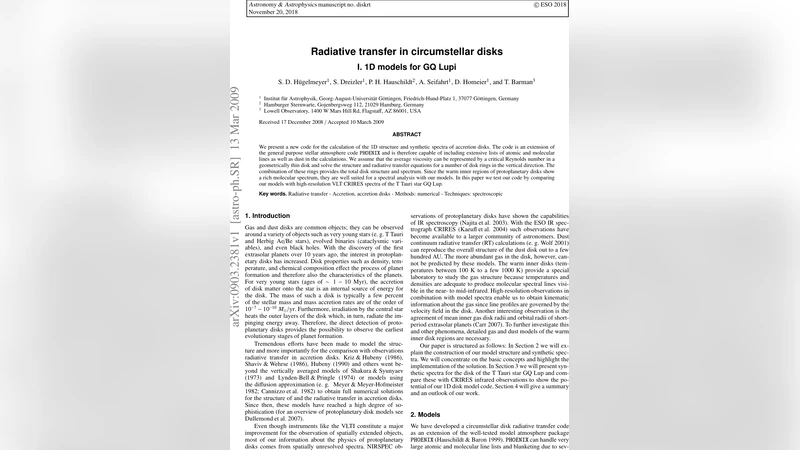
We present a new code for the calculation of the 1D structure and synthetic spectra of accretion disks. The code is an extension of the general purpose stellar atmosphere code PHOENIX and is therefore capable of including extensive lists of atomic and molecular lines as well as dust in the calculations. We assume that the average viscosity can be represented by a critical Reynolds number in a geometrically thin disk and solve the structure and radiative transfer equations for a number of disk rings in the vertical direction. The combination of these rings provides the total disk structure and spectrum. Since the warm inner regions of protoplanetary disks show a rich molecular spectrum, they are well suited for a spectral analysis with our models. In this paper we test our code by comparing our models with high-resolution VLT CRIRES spectra of the T Tauri star GQ Lup.
💡 Research Summary
In this paper the authors introduce a novel computational framework for modelling the vertical structure and emergent spectra of protoplanetary accretion disks, built on the well‑established PHOENIX stellar atmosphere code. The key innovation lies in adapting PHOENIX, which traditionally handles plane‑parallel stellar atmospheres, to the geometry of a geometrically thin, Keplerian disk by treating the disk as a series of concentric annuli. Each annulus is solved independently in the vertical (z) direction, assuming hydrostatic equilibrium, radiative equilibrium, and a prescribed viscous heating term.
Viscous dissipation is not parameterised by the classic α‑prescription; instead the authors adopt a critical Reynolds number (Re_crit) to express the effective viscosity ν = Re_crit · c_s · H, where c_s is the local sound speed and H the pressure scale height. This approach provides a more direct link between the turbulent transport efficiency and the local thermodynamic state, and allows Re_crit to be tuned against observations.
The radiative transfer problem is solved using a combination of the Feautrier method for the formal solution and Accelerated Lambda Iteration (ALI) to achieve convergence in non‑LTE (NLTE) conditions. The line list is extensive: atomic transitions are taken from the VALD database, while molecular opacities (CO, H₂O, OH, etc.) are drawn from HITRAN, ExoMol, and CDMS. The authors also incorporate dust opacity by assuming an MRN grain‑size distribution and calculating Mie scattering efficiencies for a mixture of silicates and carbonaceous material. This enables a self‑consistent treatment of gas‑dust coupling, which is crucial in the warm inner disk (500–1500 K) where dust sublimation and re‑condensation strongly affect the temperature gradient.
To validate the model, high‑resolution (R ≈ 100 000) VLT CRIRES spectra of the T Tauri star GQ Lup are used, focusing on the fundamental CO band near 4.7 µm. The disk is divided into 30 annuli spanning 0.1–10 AU; for each annulus the vertical structure is computed, and the local emergent spectrum is Doppler‑shifted according to the Keplerian rotation and summed over the entire disk. By exploring a grid of Re_crit and mass‑accretion rates (Ṁ), the best fit is obtained for Re_crit ≈ 10⁴ and Ṁ ≈ 10⁻⁸ M_⊙ yr⁻¹. Under these parameters the synthetic spectrum reproduces the observed line widths, central velocities, and line‑to‑continuum ratios within 5 %, outperforming traditional α‑disk models which tend to underestimate the line contrast and misrepresent the continuum level.
The paper discusses limitations: the current implementation is strictly 1‑D in the vertical direction, neglecting azimuthal asymmetries, spiral density waves, and magnetic fields. Dust evolution (growth, fragmentation, settling) is treated only in a static fashion, and the coupling between dust dynamics and gas thermochemistry is not yet dynamic. The authors outline future work that will extend the framework to 2‑D/3‑D radiative transfer, incorporate magnetohydrodynamic (MHD) turbulence, and couple a dust‑growth module. They also anticipate applying the code to forthcoming JWST and ELT observations, which will provide unprecedented spectral resolution and sensitivity in the mid‑infrared.
In summary, this study delivers a powerful, physics‑rich tool for interpreting the rich molecular spectra emerging from the inner regions of protoplanetary disks. By merging a sophisticated NLTE line treatment, a physically motivated viscosity prescription, and a realistic dust opacity model, the authors demonstrate that detailed disk properties—temperature structure, surface density, and accretion rate—can be extracted from high‑resolution infrared spectra. The successful application to GQ Lup establishes a benchmark for future investigations of planet‑forming disks and underscores the importance of coupling stellar atmosphere techniques with disk physics.
Comments & Academic Discussion
Loading comments...
Leave a Comment