On the possibility of detecting extrasolar planets atmospheres with the Rossiter-McLaughlin-effect
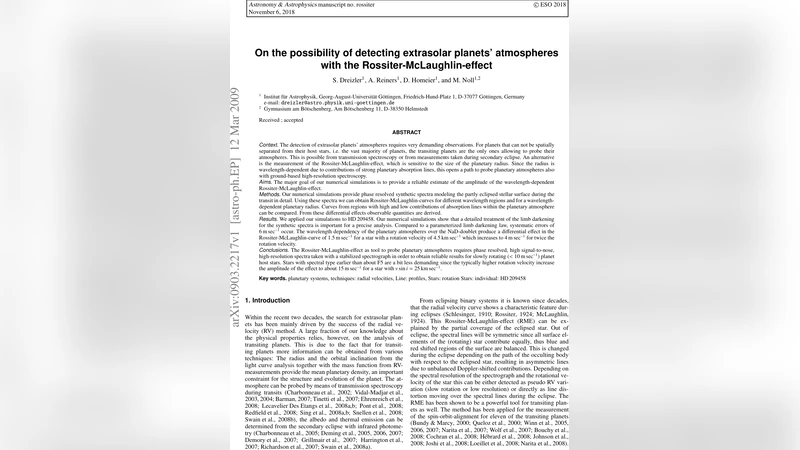
The detection of extrasolar planets’ atmospheres requires very demanding observations. For planets that can not be spatially separated from their host stars, i.e. the vast majority of planets, the transiting planets are the only ones allowing to probe their atmospheres. This is possible from transmission spectroscopy or from measurements taken during secondary eclipse. An alternative is the measurement of the Rossiter-McLaughlin-effect, which is sensitive to the size of the planetary radius. Since the radius is wavelength-dependent due to contributions of strong planetary absorption lines, this opens a path to probe planetary atmospheres also with ground-based high-resolution spectroscopy. The major goal of our numerical simulations is to provide a reliable estimate of the amplitude of the wavelength-dependent RM-effect. Our numerical simulations provide phase resolved synthetic spectra modeling the partly eclipsed stellar surface during the transit in detail. Using these spectra we can obtain RM-curves for different wavelength regions and for a wavelength-dependent planetary radius. Curves from regions with high and low contributions of absorption lines within the planetary atmosphere can be compared. From these differential effects observable quantities are derived. We applied our simulations to HD209458. Our numerical simulations show that a detailed treatment of the limb darkening for the synthetic spectra is important for a precise analysis. Compared to a parameterized limb darkening law, systematic errors of 6 m/sec occur. The wavelength dependency of the planetary atmospheres over the NaD-doublet produce a differential effect in the RM-curve of 1.5 m/sec for a star with a rotation velocity of 4.5 km/sec which increases to 4 m/sec for twice the rotation velocity.
💡 Research Summary
The paper investigates whether the Rossiter‑McLaughlin (RM) effect can be used to detect the atmospheres of transiting exoplanets, offering an alternative to traditional transmission spectroscopy that requires extremely high signal‑to‑noise ratios. The RM effect arises because a transiting planet blocks part of a rotating stellar disk, temporarily distorting the stellar line profile and producing an apparent radial‑velocity (RV) anomaly. If the planetary radius varies with wavelength—due to atmospheric absorption lines—then the depth of the stellar occultation, and consequently the amplitude of the RM anomaly, will also be wavelength‑dependent. By measuring this differential RM signal, one can infer atmospheric signatures without needing to resolve the planet spatially.
To quantify the expected signal, the authors develop a detailed numerical simulation pipeline. They construct a three‑dimensional model of the stellar surface, assigning to each surface element a high‑resolution synthetic spectrum derived from realistic stellar atmosphere models. Crucially, they implement a wavelength‑dependent limb‑darkening treatment directly from the model intensities rather than using a simple parametric law. This approach reduces systematic errors in the RM amplitude from several meters per second to the sub‑meter‑per‑second level.
The simulation proceeds as follows: for each time step during a transit, the portion of the stellar disk obscured by the planet is identified. The spectra of the unocculted surface elements are summed, yielding a phase‑resolved composite spectrum. Radial velocities are extracted from these spectra using cross‑correlation, producing an RM curve as a function of orbital phase. The authors then introduce a wavelength‑dependent planetary radius: in spectral regions dominated by strong atmospheric absorption (specifically the Na I D doublet at 5890 Å and 5896 Å) the effective radius is increased by about 1 % relative to continuum regions. By generating RM curves for both the “line” and “continuum” bands, they compute the differential RM amplitude.
Applying the model to the well‑studied system HD 209458 b, they find that for a host star with a projected rotational velocity of 4.5 km s⁻¹ the differential RM signal across the Na D lines is about 1.5 m s⁻¹. If the stellar rotation is doubled to ≈9 km s⁻¹, the signal grows to roughly 4 m s⁻¹. These amplitudes are within reach of current ultra‑stable, high‑resolution spectrographs such as HARPS, ESPRESSO, or the forthcoming ELT‑HIRES, provided that observations are conducted with sufficient temporal resolution (a few minutes per exposure) and that the data are co‑added over multiple transits to improve the signal‑to‑noise ratio.
The study highlights several key insights. First, the RM effect can serve as a direct probe of atmospheric absorption because it translates a wavelength‑dependent radius into a measurable RV shift, bypassing the need for absolute flux calibration required in transmission spectroscopy. Second, accurate limb‑darkening modeling is essential; neglecting its wavelength dependence can introduce systematic RV offsets of order 6 m s⁻¹, which would mask or mimic atmospheric signals. Third, the method benefits from host stars with relatively rapid rotation, as the RM amplitude scales with the stellar rotational velocity. Finally, the approach is inherently differential, allowing the comparison of “line” and “continuum” RM curves to isolate atmospheric contributions from instrumental or stellar activity noise.
In terms of observational strategy, the authors recommend targeting bright, fast‑rotating host stars, obtaining high‑cadence spectra throughout the entire transit (including ingress and egress), and focusing on spectral regions where strong planetary absorption lines are expected (e.g., Na I, K I, Hα). They also suggest that the synthetic RM models and the associated limb‑darkening tables be made publicly available to facilitate application to other systems.
In conclusion, the paper demonstrates through comprehensive simulations that wavelength‑dependent RM measurements can, in principle, detect exoplanetary atmospheres with current ground‑based facilities. By carefully accounting for limb darkening and stellar rotation, and by exploiting the differential nature of the signal, this technique offers a promising complement to traditional transmission spectroscopy, potentially extending atmospheric studies to planets that are otherwise inaccessible due to faintness or unfavorable orbital geometry.
Comments & Academic Discussion
Loading comments...
Leave a Comment