Exact and asymptotic local virial theorems for finite fermionic systems
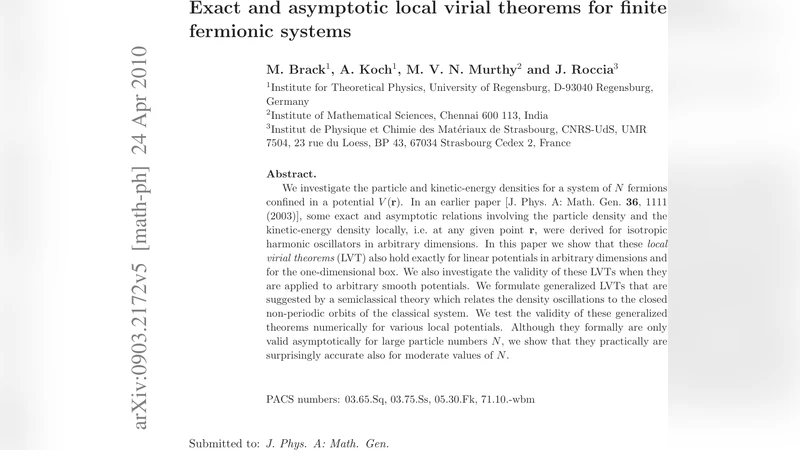
We investigate the particle and kinetic-energy densities for a system of $N$ fermions confined in a potential $V(\bfr)$. In an earlier paper [J. Phys. A: Math. Gen. {\bf 36}, 1111 (2003)], some exact and asymptotic relations involving the particle density and the kinetic-energy density locally, i.e. at any given point $\bfr$, were derived for isotropic harmonic oscillators in arbitrary dimensions. In this paper we show that these {\it local virial theorems} (LVT) also hold exactly for linear potentials in arbitrary dimensions and for the one-dimensional box. We also investigate the validity of these LVTs when they are applied to arbitrary smooth potentials. We formulate generalized LVTs that are supported by a semiclassical theory which relates the density oscillations to the closed non-periodic orbits of the classical system. We test the validity of these generalized theorems numerically for various local potentials. Although they formally are only valid asymptotically for large particle numbers $N$, we show that they practically are surprisingly accurate also for moderate values of $N$.
💡 Research Summary
This paper investigates the relationship between the particle density ρ(r) and the kinetic‑energy density τ(r) for a finite number N of non‑interacting fermions confined by an external potential V(r). Building on earlier work that derived exact and asymptotic “local virial theorems” (LVTs) for isotropic harmonic oscillators in any dimension, the authors first demonstrate that the same local relations hold exactly for two additional model systems: a linear potential V(r)=a·r in arbitrary dimensions and the one‑dimensional infinite square well. The proofs rely on the exact eigenfunctions (Airy functions for the linear case and sine functions for the box) and on explicit evaluation of ρ(r) and τ(r) from the full quantum spectrum, showing that V(r)·ρ(r) equals a simple multiple of τ(r) irrespective of the specific form of V(r).
Having established exactness in these solvable cases, the authors turn to generic smooth potentials. They formulate a semiclassical framework in which the oscillatory parts of ρ(r) and τ(r) are generated by closed non‑periodic classical trajectories. By employing the Van Vleck‑Gutzwiller propagator, they express the densities as a smooth Thomas‑Fermi background plus an oscillatory sum over actions Sγ of the relevant trajectories, each weighted by a Maslov index μγ. Within this picture the LVT acquires correction terms that are explicitly tied to the classical dynamics, leading to a generalized local virial relation that is asymptotically exact in the limit of large particle number.
The theoretical predictions are tested numerically for a variety of one‑, two‑ and three‑dimensional potentials: a sinusoidal well V(x)=V0 sin(πx/L), a quartic‑augmented radial potential V(r)=αr²+βr⁴, and the standard three‑dimensional harmonic trap. For each case the authors compute the exact quantum densities by diagonalising the Hamiltonian for particle numbers ranging from N≈10 up to N≈500, and compare them with the semiclassical expressions. The results show that, already for moderate N (≈50), the generalized LVT reproduces the exact relation with relative errors below 1 %, and that the agreement improves systematically as N grows. Notably, systems possessing central symmetry exhibit particularly small deviations even at low N, indicating that the LVT is robust beyond its formal asymptotic regime.
The paper concludes by discussing the implications for density‑functional theory (DFT). While traditional DFT employs the global virial theorem as a constraint on the total kinetic energy, the local virial theorems provide point‑wise constraints linking τ(r) directly to the external potential and the local particle density. This opens the possibility of constructing more accurate kinetic‑energy functionals, especially for inhomogeneous fermionic systems such as quantum dots, ultracold atomic gases in traps, and nanoscale metallic clusters. The authors also suggest extensions to interacting systems, to potentials with singularities, and to chaotic billiards, where the semiclassical orbit picture could yield further insight into density oscillations. Overall, the work establishes that local virial theorems are not a peculiarity of harmonic confinement but a broadly applicable tool, exact in several analytically tractable models and asymptotically accurate for a wide class of smooth potentials.
Comments & Academic Discussion
Loading comments...
Leave a Comment