High-precision photometry by telescope defocussing. I. The transiting planetary system WASP-5
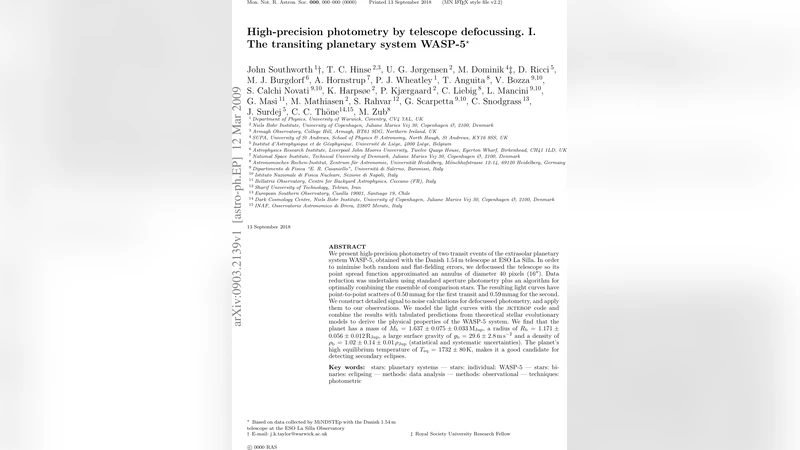
We present high-precision photometry of two transit events of the extrasolar planetary system WASP-5, obtained with the Danish 1.54m telescope at ESO La Silla. In order to minimise both random and flat-fielding errors, we defocussed the telescope so its point spread function approximated an annulus of diameter 40 pixels (16 arcsec). Data reduction was undertaken using standard aperture photometry plus an algorithm for optimally combining the ensemble of comparison stars. The resulting light curves have point-to-point scatters of 0.50 mmag for the first transit and 0.59 mmag for the second. We construct detailed signal to noise calculations for defocussed photometry, and apply them to our observations. We model the light curves with the JKTEBOP code and combine the results with tabulated predictions from theoretical stellar evolutionary models to derive the physical properties of the WASP-5 system. We find that the planet has a mass of M_b = 1.637 +/- 0.075 +/- 0.033 Mjup, a radius of R_b = 1.171 +/- 0.056 +/- 0.012 Rjup, a large surface gravity of g_b = 29.6 +/- 2.8 m/s2 and a density of rho_b = 1.02 +/- 0.14 +/- 0.01 rhojup (statistical and systematic uncertainties). The planet’s high equilibrium temperature of T_eq = 1732 +/- 80 K makes it a good candidate for detecting secondary eclipses.
💡 Research Summary
The paper presents a detailed demonstration of how telescope defocusing can be used to obtain ultra‑high‑precision transit photometry with a modest‑size (1.54 m) ground‑based telescope. The authors observed two transits of the hot‑Jupiter system WASP‑5 using the Danish telescope at ESO La Silla. By deliberately defocusing the optics so that the stellar point‑spread function (PSF) formed an annulus about 40 pixels (≈16 arcseconds) in diameter, the stellar flux was spread over thousands of detector pixels. This strategy reduces the impact of flat‑fielding errors, mitigates saturation, and makes the measurements less sensitive to short‑term atmospheric transparency variations and guiding jitter.
Data reduction combined conventional circular/elliptical aperture photometry with a novel algorithm that optimally weights an ensemble of comparison stars. The weighting scheme continuously evaluates the stability of each comparison and adjusts its contribution to the final differential light curve, thereby suppressing comparison‑star noise. The resulting light curves exhibit point‑to‑point scatter of 0.50 mmag for the first transit and 0.59 mmag for the second, a level of precision that rivals or exceeds that obtained with larger telescopes using focused imaging.
A comprehensive signal‑to‑noise (S/N) model was constructed, incorporating photon noise from the target, sky background, dark current, readout noise, and the increase in the number of illuminated pixels due to defocusing. By exploring this model, the authors identified the optimal combination of defocus radius and exposure time (≈120 s) that minimizes total noise for the given telescope and detector characteristics. The model predictions matched the observed performance, confirming that the chosen defocus parameters lie close to the theoretical optimum.
The transit light curves were modeled with the JKTEBOP code, which treats the star and planet as biaxial spheroids and includes limb‑darkening (both linear and non‑linear laws), possible third‑light contamination, and orbital eccentricity (fixed to zero for WASP‑5). Parameter uncertainties were quantified using both Markov Chain Monte Carlo (MCMC) simulations and a residual‑permutation (boot‑strap) method, providing robust statistical error estimates. To translate the photometric parameters into absolute physical properties, the authors combined the light‑curve results with spectroscopic constraints (stellar effective temperature, metallicity, radial‑velocity semi‑amplitude) and interpolated several state‑of‑the‑art stellar evolution models (Yonsei‑Yale, Padova, Dartmouth). The spread among model predictions was adopted as a systematic error term.
The final derived planetary parameters are: mass Mₚ = 1.637 ± 0.075 (stat) ± 0.033 (sys) M_Jup, radius Rₚ = 1.171 ± 0.056 (stat) ± 0.012 (sys) R_Jup, surface gravity gₚ = 29.6 ± 2.8 m s⁻², and mean density ρₚ = 1.02 ± 0.14 (stat) ± 0.01 (sys) ρ_Jup. The equilibrium temperature, assuming zero albedo and efficient redistribution, is T_eq = 1732 ± 80 K, placing WASP‑5 b among the hottest known transiting exoplanets and making it an attractive target for secondary‑eclipse and thermal‑emission studies.
Beyond the specific system, the paper emphasizes the broader utility of defocused photometry. By spreading light over many pixels, one can achieve photon‑limited precision even with relatively small apertures, provided that exposure times are long enough to average over scintillation and that the detector’s read‑noise remains sub‑dominant. The authors discuss limitations, such as increased risk of blending in crowded fields and the need for careful selection of defocus level to avoid excessive sky background. They suggest that the technique is especially valuable for follow‑up of transit candidates from wide‑field surveys, where rapid, high‑precision confirmation is required before allocating resources to space‑based or high‑resolution spectroscopic observations.
In summary, this work validates telescope defocusing as a cost‑effective, high‑precision method for ground‑based transit photometry, demonstrates its successful application to WASP‑5, and provides a framework—including S/N calculations, reduction pipelines, and modeling strategies—that can be adopted by other observers seeking millimagnitude or sub‑millimagnitude precision with modest facilities.
Comments & Academic Discussion
Loading comments...
Leave a Comment