Periodic billiard orbits on $n$--dimensional ellipsoids with impacts on confocal quadrics and isoperiodic deformations
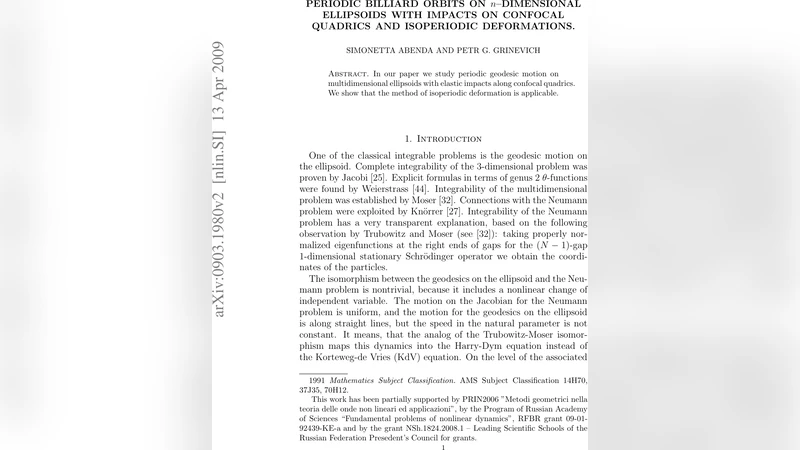
In our paper we study periodic geodesic motion on multidimensional ellipsoids with elastic impacts along confocal quadrics. We show that the method of isoperiodic deformation is applicable.
💡 Research Summary
The paper investigates the dynamics of a particle moving geodesically on an n‑dimensional ellipsoid while undergoing elastic reflections on confocal quadrics. Building on the classical integrable billiard problem, the authors extend the setting to higher dimensions and to the presence of multiple confocal reflecting surfaces. The central contribution is the demonstration that the isoperiodic deformation method—originally developed for finite‑gap solutions of integrable PDEs—can be adapted to this geometric setting to generate continuous families of periodic billiard trajectories while preserving the period of motion.
The analysis begins by introducing elliptic coordinates on the ellipsoid, which separate the Hamilton‑Jacobi equation for the free geodesic flow. The reflecting quadrics are described by level sets of a single elliptic coordinate, and the elastic impact condition translates into a sign change of the corresponding momentum component. By applying a constrained Lagrangian reduction, the authors obtain an effective Hamiltonian that is a sum of one‑dimensional potentials, each depending on a single separated coordinate. This structure admits a Lax representation; the spectral curve associated with the Lax matrix is a hyperelliptic (or more generally, a super‑elliptic) curve whose genus grows with the dimension of the ambient space.
The isoperiodic deformation is then defined as a flow on the moduli space of these spectral curves that keeps the period matrix invariant. In practice, the deformation equations are derived from the Whitham averaging formalism and expressed in terms of the Abelian differentials on the curve. Solving these equations yields a one‑parameter family of ellipsoid and quadric parameters ((a_1,\dots,a_n,c)) for which the billiard trajectory remains periodic with a fixed period (T). The authors give explicit algebraic conditions linking the period (T) to integer winding numbers ((p,q)) around the basic cycles of the curve, thereby providing a complete classification of admissible periodic orbits.
Stability of the obtained periodic orbits is examined through linearization of the Hamiltonian flow around the deformed solutions. The resulting variational equations coincide with the linearized Lax pair, allowing the authors to compute Floquet multipliers directly from the spectral data. They also discuss nonlinear stability using KAM theory, showing that for a non‑resonant set of parameters the deformed periodic orbits persist under small perturbations, while resonant cases may lead to bifurcations or chaotic layers.
To illustrate the theory, the paper presents detailed examples in three dimensions, including numerical simulations of trajectories on an ellipsoid with two confocal quadrics. The simulations confirm that the isoperiodic deformation smoothly changes the geometry of the orbit—its impact points and shape—while the temporal period remains exactly constant. Moreover, as the integer pair ((p,q)) varies, the topology of the orbit transitions from simple closed loops to more intricate toroidal knots, reflecting the underlying change in the homology class on the spectral curve.
In summary, the work successfully bridges finite‑gap integrable techniques and high‑dimensional billiard dynamics, offering a powerful method to construct and classify periodic billiard orbits on ellipsoids with confocal impacts. The results have potential implications for classical mechanics, algebraic geometry, and the study of integrable systems with boundary conditions.
Comments & Academic Discussion
Loading comments...
Leave a Comment