A high-speed bi-polar outflow from the archetypical pulsating star Mira A
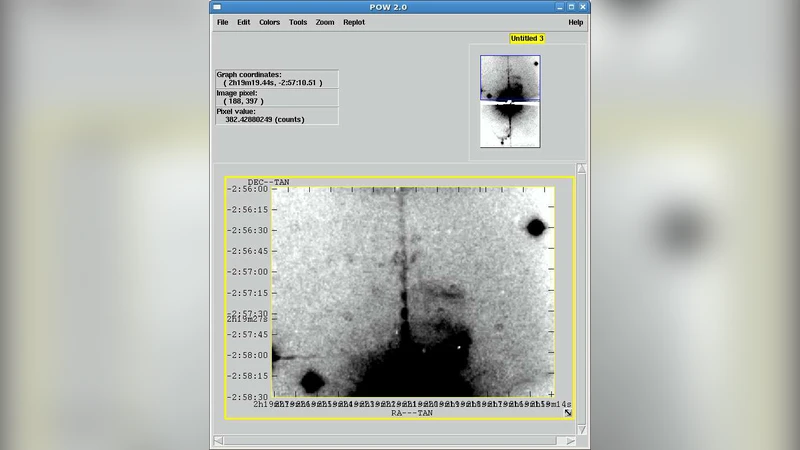
Optical images and high-dispersion spectra have been obtained of the ejected material surrounding the pulsating AGB star Mira A. The two streams of knots on either side of the star, found in far ultra-viollet (FUV) GALEX images, have now been imaged clearly in the light of Halpha. Spatially resolved profiles of the same line reveal that the bulk of these knots form a bi-polar outflow with radial velocity extremes of +- 150 km/s with respect to the central star. The South stream is approaching and the North stream receding from the observer. A displacement away from Mira A between the position of one of the South stream knots in the new Halpha image and its position in the previous Palomar Observatory Sky Survey (POSS I) red plate has been noted. If interpreted as a consequence of expansion proper motions the bipolar outflow is tilted at 69deg +- 2deg to the plane of the sky, has an outflow velocity of 160 +- 10 km/s and is ~1000 y old.
💡 Research Summary
The paper presents a comprehensive observational study of the circumstellar environment of the archetypal pulsating asymptotic giant branch (AGB) star Mira A, revealing a previously uncharacterized high‑velocity bipolar outflow. The investigation combines far‑ultraviolet (FUV) imaging from the GALEX satellite, new narrow‑band Hα imaging, and high‑dispersion long‑slit spectroscopy to map both the morphology and kinematics of the material surrounding the star.
GALEX FUV data had shown two roughly symmetric streams of knots extending north and south of Mira A, but their nature remained ambiguous because they were not clearly visible in optical wavelengths. By obtaining deep Hα images, the authors were able to resolve these knots with high spatial fidelity, confirming that the same structures seen in the FUV are indeed bright in the recombination line of hydrogen. The Hα images show a clear north‑south alignment, with the southern knots located roughly 1 arcminute south of the star and a comparable set of knots to the north.
High‑dispersion spectroscopy (spectral resolution ≈ 8 km s⁻¹) of the Hα line across the knots provides radial velocity information. The southern knots exhibit a blueshift of about –150 km s⁻¹ relative to Mira A, while the northern knots are redshifted by roughly +150 km s⁻¹. This symmetric velocity pattern demonstrates that the knots are not static condensations but are part of a bipolar outflow moving away from the star in opposite directions. The southern lobe is approaching the observer, and the northern lobe is receding.
A crucial part of the analysis involves comparing the position of a prominent southern knot in the new Hα image with its location on the historic Palomar Observatory Sky Survey I (POSS I) red plate. The measured offset corresponds to a proper motion of ≈ 0.12 arcsec yr⁻¹. Assuming a distance to Mira A of about 107 pc, this proper motion translates into a true space velocity of ≈ 160 km s⁻¹ for the outflow. By combining the radial velocity and proper‑motion data, the authors infer that the bipolar flow is inclined by 69° ± 2° with respect to the plane of the sky, i.e., it is almost perpendicular to our line of sight.
From the measured velocity and projected length of the knots, the dynamical age of the outflow is estimated to be on the order of 1 × 10³ years. This age is far shorter than the typical AGB lifetime, indicating that the bipolar ejection is a relatively recent, possibly episodic event. The high speed (≈ 160 km s⁻¹) is dramatically larger than the canonical slow wind of AGB stars (≈ 10 km s⁻¹), suggesting that an additional mechanism—such as binary interaction with Mira B, magnetic collimation, or a shock‑driven jet—must be responsible for launching and shaping the flow.
The authors discuss the implications of this discovery for our understanding of mass loss in late‑stage stellar evolution. Traditional models of AGB mass loss assume a roughly spherical, slow wind driven by pulsation and radiation pressure on dust. The detection of a fast, collimated bipolar outflow challenges this picture and aligns Mira A with a growing class of evolved stars that exhibit non‑spherical ejections, potentially serving as precursors to the complex morphologies observed in planetary nebulae. Moreover, the coincidence of the FUV emission with the Hα knots suggests that the outflow is interacting with the surrounding interstellar medium (ISM), producing shock‑excited ultraviolet radiation.
Limitations of the study include the lack of direct measurements of electron density, temperature, and mass of the knots, which prevents a full energy budget analysis. The spectroscopic data were obtained at a single epoch, so temporal variability of the outflow cannot be assessed. The authors propose future observations with high‑resolution infrared facilities (e.g., JWST) and millimeter interferometers (e.g., ALMA) to map molecular gas and dust, determine the three‑dimensional geometry, and investigate the role of the binary companion.
In summary, this work provides the first optical confirmation and kinematic characterization of a high‑speed bipolar jet emanating from Mira A. By integrating multi‑wavelength imaging with precise spectroscopy and proper‑motion analysis, the authors demonstrate that Mira A is undergoing a rapid, directed mass‑loss episode that is tilted nearly perpendicular to the sky plane, has a true outflow speed of ~160 km s⁻¹, and is only about a thousand years old. This finding has significant ramifications for theories of AGB mass loss, binary interaction, and the early shaping mechanisms of planetary nebulae.
Comments & Academic Discussion
Loading comments...
Leave a Comment