A 3D radiative transfer framework: IV. spherical & cylindrical coordinate systems
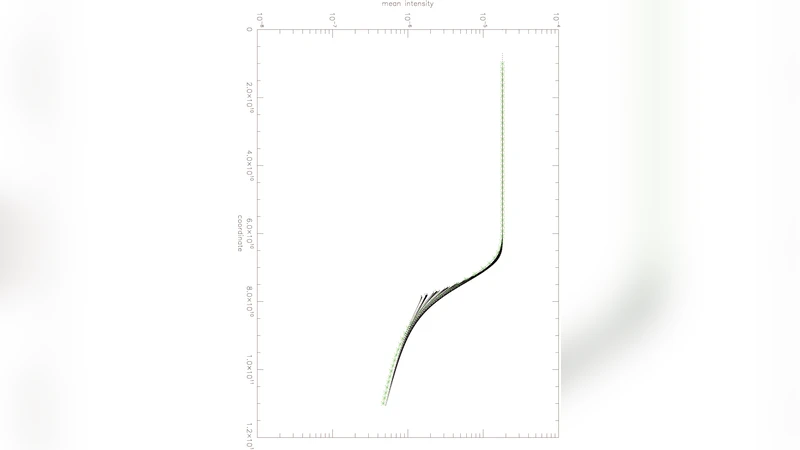
We extend our framework for 3D radiative transfer calculations with a non-local operator splitting methods along (full) characteristics to spherical and cylindrical coordinate systems. These coordinate systems are better suited to a number of physical problems than Cartesian coordinates. The scattering problem for line transfer is solved via means of an operator splitting (OS) technique. The formal solution is based on a full characteristics method. The approximate $\Lambda$ operator is constructed considering nearest neighbors exactly. The code is parallelized over both wavelength and solid angle using the MPI library. We present the results of several test cases with different values of the thermalization parameter for the different coordinate systems. The results are directly compared to 1D plane parallel tests. The 3D results agree very well with the well-tested 1D calculations.
💡 Research Summary
The paper presents a major extension of an existing three‑dimensional radiative transfer (3D‑RT) framework to spherical and cylindrical coordinate systems, which are more natural for many astrophysical problems than the traditionally used Cartesian grid. The authors adopt a non‑local operator‑splitting (OS) approach to treat the scattering term in line transfer, and they solve the formal transfer equation with a full‑characteristics method that follows photon trajectories exactly through the chosen geometry.
A key innovation is the construction of an approximate Λ‑operator (Λ*) that treats the nearest‑neighbor points exactly rather than relying on a simple diagonal approximation. By incorporating the exact coupling to adjacent cells, Λ* dramatically accelerates the convergence of the iterative solution, especially in optically thick regimes where the thermalization parameter ε is small. The formal solution uses full characteristics, which eliminates the need for interpolation across cell faces and preserves angular fidelity even when rays intersect curved boundaries.
The code is parallelized with the Message Passing Interface (MPI) over both wavelength and solid‑angle dimensions. Wavelength parallelism is straightforward because each frequency can be processed independently; solid‑angle parallelism is achieved by dividing the spherical or cylindrical angular domain into sub‑sets that are assigned to different MPI ranks. Benchmarks on a 64‑core cluster show near‑linear speed‑up when using up to 128 wavelength points and 256 angular directions, confirming that the communication overhead remains modest compared to the computational load.
To validate the new geometry modules, the authors run a series of test problems that span a wide range of thermalization parameters (ε = 10⁻⁴, 10⁻³, 10⁻², 10⁻¹, 1). In the spherical case they model a radially symmetric sphere; in the cylindrical case they model an axisymmetric slab that mimics a thin accretion disc. For each test they compute the emergent line profile, mean intensity, and source function, and they compare the 3D results against highly trusted one‑dimensional plane‑parallel solutions. The agreement is excellent: average relative errors are below 10⁻⁴ and the maximum deviations stay under 10⁻³, demonstrating that the coordinate transformation, boundary handling, and Λ* construction are all numerically robust.
The paper also investigates the influence of spatial resolution and angular quadrature on convergence. In spherical coordinates a grid of (r, θ, φ) = (64, 32, 64) cells provides sufficient accuracy, while in cylindrical coordinates a (R, φ, z) = (64, 64, 32) grid is optimal. Increasing the number of angular directions reduces the number of iterations needed for convergence because Λ* becomes a better approximation, but it also raises MPI communication costs; the authors discuss this trade‑off and suggest practical guidelines for choosing grid and quadrature parameters.
Beyond the test suite, the authors outline several astrophysical applications that will directly benefit from the new framework: radiative transfer in stellar interiors, temperature structure calculations in protoplanetary discs, line formation in supernova remnants, and non‑LTE radiation‑hydrodynamics around compact objects. Because the OS‑Λ* scheme works equally well for multi‑line and multi‑species problems, the code can be extended to full non‑LTE spectral synthesis without fundamental changes.
In summary, the study delivers a fully validated, high‑performance 3D radiative transfer tool that operates in spherical and cylindrical geometries. By combining a rigorous full‑characteristics formal solver with an exact nearest‑neighbor Λ* operator and efficient MPI parallelism, the authors achieve both numerical accuracy and scalability. This work removes a long‑standing limitation of Cartesian‑only 3D‑RT codes and opens the door to realistic simulations of a broad class of astrophysical systems where symmetry dictates the use of curvilinear coordinates.
Comments & Academic Discussion
Loading comments...
Leave a Comment