Radial mixing in the outer Milky Way disk caused by an orbiting satellite
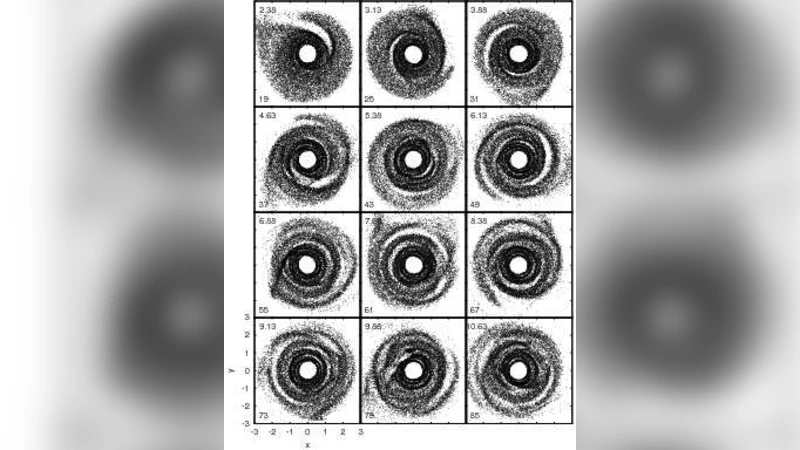
Using test particle simulations we examine the structure of the outer Galactic disk as it is perturbed by a satellite in a tight eccentric orbit about the Galaxy. A satellite of mass a few times 10^9 Msol can heat the outer Galactic disk, excite spiral structure and a warp and induce streams in the velocity distribution. We examine particle eccentricity versus the change in mean radius between initial and current orbits. Correlations between these quantities are reduced after a few satellite pericenter passages. Stars born in the outer galaxy can be moved in radius from their birth positions and be placed in low eccentricity orbits inside their birth radii. We propose that mergers and perturbations from satellite galaxies and subhalos can induce radial mixing in the stellar metallicity distribution.
💡 Research Summary
The paper investigates how a massive satellite on a tight, eccentric orbit can dynamically perturb the outer Milky Way disk and induce radial mixing of stars. Using collision‑free test‑particle simulations with roughly one million particles, the authors model a satellite of mass a few × 10⁹ M☉ on an orbit with eccentricity ≈ 0.5 and pericenter distance ≈ 15 kpc. The satellite’s first pericentric passage rapidly heats the disk, doubling the vertical velocity dispersion and generating a warp that resembles observed outer‑disk warps. Simultaneously, the satellite’s gravitational pull launches large‑scale spiral density waves with correlation lengths of 5–8 kpc, producing long‑lived spiral arms that redistribute angular momentum across the disk.
A key diagnostic is the relationship between particle eccentricity (e) and the change in mean orbital radius (ΔR) between the initial and final states. After one or two pericenter passages, the initial tight correlation between e and ΔR is largely erased, indicating that stars originally formed at large radii can be moved inward onto low‑eccentricity (e < 0.1) orbits. This “radial mixing” operates independently of the classic “churning” mechanism driven by internal spiral arms, providing an external pathway for mixing metallicity gradients. The authors find that satellites with masses below ~3 × 10⁹ M☉ produce only modest heating and mixing, whereas satellites above ~5 × 10⁹ M☉ generate strong, non‑linear waves that flatten the metallicity distribution across the outer disk.
The study emphasizes that such satellite‑disk interactions are plausible in the Milky Way context, given the presence of the Large and Small Magellanic Clouds (∼10⁹ M☉) and the expected population of dark‑matter subhalos. The authors propose that past mergers and ongoing perturbations by satellites and subhalos have played a significant role in shaping the present‑day radial metallicity profile of the Galactic disk. They advocate for combined analyses using Gaia astrometry, spectroscopic surveys (e.g., APOGEE), and high‑resolution N‑body simulations to quantify the dependence of mixing efficiency on satellite mass, orbital parameters, and the number of pericentric passages. This work thus adds an essential external mechanism to the broader picture of Galactic disk evolution and chemical enrichment.
Comments & Academic Discussion
Loading comments...
Leave a Comment