The Murchison Widefield Array: Design Overview
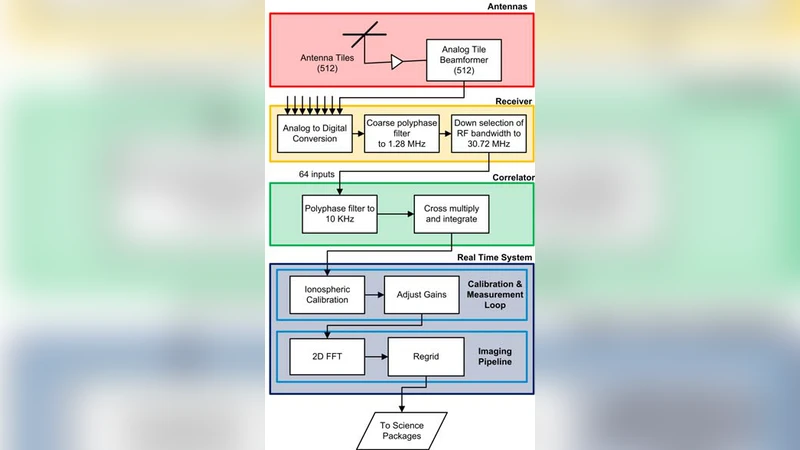
The Murchison Widefield Array (MWA) is a dipole-based aperture array synthesis telescope designed to operate in the 80-300 MHz frequency range. It is capable of a wide range of science investigations, but is initially focused on three key science projects. These are detection and characterization of 3-dimensional brightness temperature fluctuations in the 21cm line of neutral hydrogen during the Epoch of Reionization (EoR) at redshifts from 6 to 10, solar imaging and remote sensing of the inner heliosphere via propagation effects on signals from distant background sources,and high-sensitivity exploration of the variable radio sky. The array design features 8192 dual-polarization broad-band active dipoles, arranged into 512 tiles comprising 16 dipoles each. The tiles are quasi-randomly distributed over an aperture 1.5km in diameter, with a small number of outliers extending to 3km. All tile-tile baselines are correlated in custom FPGA-based hardware, yielding a Nyquist-sampled instantaneous monochromatic uv coverage and unprecedented point spread function (PSF) quality. The correlated data are calibrated in real time using novel position-dependent self-calibration algorithms. The array is located in the Murchison region of outback Western Australia. This region is characterized by extremely low population density and a superbly radio-quiet environment,allowing full exploitation of the instrumental capabilities.
💡 Research Summary
The Murchison Widefield Array (MWA) is a low‑frequency (80–300 MHz) aperture‑array radio telescope built around 8192 dual‑polarisation active dipoles grouped into 512 tiles of 16 dipoles each. Each tile incorporates an analogue beamformer that steers its collective response, and the tiles are distributed quasi‑randomly over a 1.5 km core with a handful of outliers extending to 3 km, providing a dense set of baselines (≈130 000) that sample the uv plane at Nyquist density for any single frequency. This results in an instantaneous point‑spread function with exceptionally low sidelobes and high symmetry, enabling high‑fidelity imaging of complex sky structures.
All tile‑to‑tile correlations are performed in custom FPGA‑based correlators, delivering data rates of several hundred gigabits per second. The raw visibilities are streamed in real time to a high‑performance computing cluster where they undergo compression, calibration, and imaging. A novel position‑dependent self‑calibration scheme is applied: each tile’s line of sight receives its own phase and amplitude solutions, mitigating direction‑dependent ionospheric refraction and instrumental non‑linearities. Because ionospheric distortions dominate at these frequencies, the MWA continuously models the ionosphere using the wide field of view and high temporal resolution, updating calibration parameters on sub‑second timescales.
The observatory is located in the Murchison region of Western Australia, an area with extremely low population density and an exceptionally radio‑quiet environment. Site selection minimizes anthropogenic radio‑frequency interference (RFI), and the on‑site power and communications infrastructure is engineered to avoid generating additional electromagnetic noise.
The scientific programme is centred on three key projects. First, the detection and statistical characterisation of three‑dimensional 21 cm brightness‑temperature fluctuations from neutral hydrogen during the Epoch of Reionisation (EoR) at redshifts 6–10. This requires thousands of hours of deep integration, precise spectral calibration, and robust foreground subtraction, all of which the MWA’s wide field, high spectral resolution, and stable instrumental response support. Second, solar imaging and remote sensing of the inner heliosphere. By measuring propagation effects on background radio sources, the array can reconstruct solar wind density structures and coronal magnetic fields with unprecedented angular and temporal resolution, providing valuable inputs for space‑weather forecasting. Third, a high‑sensitivity survey of the variable radio sky, targeting transients such as pulsars, fast radio bursts, and flare stars. The MWA’s rapid snapshot capability and large instantaneous sky coverage enable real‑time detection and triggering of follow‑up observations.
The design is deliberately modular and scalable. Both hardware (tiles, beamformers, correlators) and software (data pipelines, calibration algorithms) are built to allow future expansion—additional tiles, extended baselines, or broader frequency coverage—while maintaining compatibility with the upcoming Square Kilometre Array Low‑frequency instrument (SKA‑Low). Data handling leverages cloud‑based workflows and distributed storage to manage the petabyte‑scale data volumes generated over multi‑year campaigns.
In summary, the MWA combines an innovative aperture‑array architecture, real‑time direction‑dependent calibration, and a pristine radio‑quiet site to deliver unprecedented imaging performance at low radio frequencies. Its capabilities are already advancing our understanding of the early Universe, solar and heliospheric physics, and the dynamic radio sky, and its modular framework positions it as a pathfinder for the next generation of low‑frequency facilities such as SKA‑Low.
Comments & Academic Discussion
Loading comments...
Leave a Comment