A new technique for timing the double pulsar system
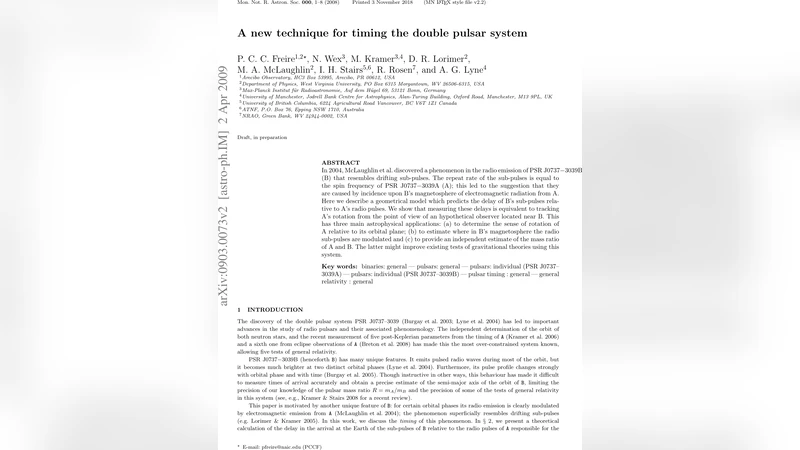
In 2004, McLaughlin et al. discovered a phenomenon in the radio emission of PSR J0737-3039B (B) that resembles drifting sub-pulses. The repeat rate of the sub-pulses is equal to the spin frequency of PSR J0737-3039A (A); this led to the suggestion that they are caused by incidence upon B’s magnetosphere of electromagnetic radiation from A. Here we describe a geometrical model which predicts the delay of B’s sub-pulses relative to A’s radio pulses. We show that measuring these delays is equivalent to tracking A’s rotation from the point of view of an hypothetical observer located near B. This has three main astrophysical applications: (a) to determine the sense of rotation of A relative to its orbital plane; (b) to estimate where in B’s magnetosphere the radio sub-pulses are modulated and (c) to provide an independent estimate of the mass ratio of A and B. The latter might improve existing tests of gravitational theories using this system.
💡 Research Summary
The paper introduces a novel timing technique for the double‑pulsar system PSR J0737‑3039A/B, exploiting the phenomenon first reported by McLaughlin et al. (2004) in which PSR J0737‑3039B (hereafter B) exhibits drifting sub‑pulses whose repetition rate matches the spin frequency of PSR J0737‑3039A (A). The authors propose a geometric model that predicts the delay of B’s sub‑pulses relative to A’s main radio pulses, interpreting this delay as the apparent rotation phase of A as seen by a hypothetical observer located near B.
The model incorporates the full three‑dimensional orbital geometry, the spin axes of both neutron stars, and the propagation effects of A’s electromagnetic radiation as it traverses the binary system. The total travel time from A to the point in B’s magnetosphere where modulation occurs includes (i) the geometric light‑travel delay, (ii) first‑post‑Newtonian (1PN) Shapiro‑like gravitational delay, and (iii) a red‑shift term due to the binary’s varying gravitational potential. By introducing a modulation altitude h (or magnetospheric radius r_m) as a free parameter, the authors derive an analytic expression for the observable sub‑pulse delay Δt_s as a function of A’s rotational phase φ_A:
Δt_s = τ_0 + (1/ν_A)·φ_A,
where ν_A is A’s spin frequency and τ_0 encapsulates all constant contributions (orbital separation, inclination, etc.). This linear relationship means that measuring Δt_s across many orbital cycles directly maps A’s rotation from B’s perspective.
Three principal astrophysical applications follow. First, the sign of the slope in the Δt_s–φ_A relation reveals the sense of A’s rotation relative to the orbital angular momentum (clockwise vs. counter‑clockwise), a quantity that has so far been inaccessible without indirect modeling. Second, the absolute value of τ_0, combined with precise orbital ephemerides, allows one to solve for the modulation altitude h, thereby pinpointing where in B’s magnetosphere the incoming A‑radiation interacts with the plasma to produce the observed sub‑pulses. This provides a rare observational probe of B’s magnetospheric structure and emission physics. Third, because τ_0 depends on the masses of the two stars through the binary separation and gravitational delay terms, an independent measurement of the mass ratio q = m_A/m_B can be obtained. This estimate is orthogonal to the traditional Shapiro‑delay and periastron‑advance methods, offering a valuable cross‑check that can tighten constraints on relativistic gravity tests performed with this system.
The authors assess observational feasibility using realistic signal‑to‑noise ratios and timing resolutions achievable with current large‑aperture radio facilities such as FAST, MeerKAT, and upcoming SKA‑pathfinders. Simulations indicate that sub‑millisecond precision in Δt_s is attainable, which translates into a mass‑ratio determination at the 10⁻⁴ level—comparable to, or better than, existing measurements. Critical to success is the exclusion of orbital phases where B’s emission is eclipsed by A’s wind, and the acquisition of high‑time‑resolution data (∼µs) to resolve the sub‑pulse structure.
The paper concludes by outlining limitations and future work. The exact physical mechanism linking the incoming A‑radiation to the modulation of B’s radio beam remains uncertain; detailed magnetohydrodynamic modeling of B’s magnetosphere is required. Higher‑order post‑Newtonian corrections (2PN and beyond) may become relevant given the system’s strong‑field environment, and incorporating them will refine the delay model. Nonetheless, the proposed technique opens a new observational window on double‑pulsar dynamics, providing an independent handle on spin orientation, magnetospheric physics, and mass ratios, all of which enhance the system’s utility as a laboratory for testing general relativity and alternative theories of gravity.
Comments & Academic Discussion
Loading comments...
Leave a Comment