The stellar population and complex structure of the bright-rimmed cloud IC 1396N
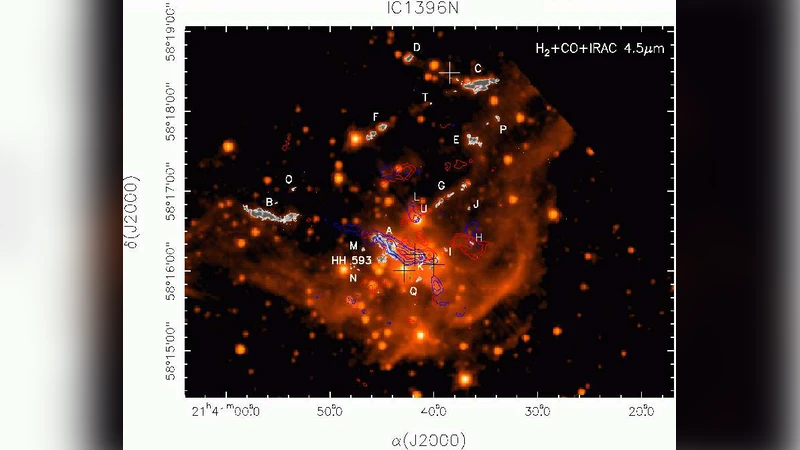
Context. IC 1396N is a bright-rimmed cloud associated with an intermediate-mass star-forming region, where a number of Herbig-Haro objects, H2 jet-like features, CO molecular outflows, and millimeter compact sources have been observed. Aims. To study in detail the complex structure of the IC 1396N core and the molecular outflows detected in the region and to reveal the presence of additional YSOs inside this globule. Methods. We carried out a deep survey of the IC 1396N region in the J, H, K’ broadband filters and deep high-angular resolution observations in the H2 narrowband filter with NICS at the TNG telescope. The completeness limits in the 2MASS standard are Ks17.5, H18.5 and J~19.5. Results. A total of 736 sources have been detected in all three bands within the area where the JHK’ images overlap. There are 128 sources detected only in HK’, 67 detected only in K’, and 79 detected only in H. We found only few objects exhibiting a Near-Infrared excess and no clear signs of clustering of sources towards the southern rim. In case of triggered star formation in the southern rim of the globule, this could be very recent, because it is not evidenced through Near-Infrared imaging alone. The H2 emission is complex and knotty and shows a large number of molecular hydrogen features spread over the region, testifying a recent star-formation activity throughout the whole globule. This emission is resolved into several chains or groups of knots that sometimes show a jet-like morphology. The shocked cloudlet model scenario previously proposed to explain the V-shaped morphology of the CO molecular outflow powered by the intermediate-mass YSO BIMA 2 seems to be confirmed by the presence of H2 emission at the position of the deflecting western clump. New possible flows have been discovered in the globule,
💡 Research Summary
The bright‑rimmed cloud IC 1396N, located in the Cepheus OB2 association, is a well‑studied intermediate‑mass star‑forming region that hosts a rich variety of phenomena: Herbig‑Haro objects, H₂ jet‑like features, CO molecular outflows, and compact millimetre sources (the BIMA objects). To obtain a more complete picture of its internal structure and to search for previously undetected young stellar objects (YSOs), the authors performed a deep near‑infrared (NIR) survey using the NICS instrument on the 3.58 m Telescopio Nazionale Galileo (TNG). Observations were carried out in the broadband J (1.25 µm), H (1.65 µm) and K′ (2.12 µm) filters, together with a narrow‑band filter centred on the H₂ v=1‑0 S(1) line at 2.12 µm. The data were calibrated onto the 2MASS system, achieving completeness limits of Kₛ≈17.5 mag, H≈18.5 mag and J≈19.5 mag—approximately two to three magnitudes deeper than previous surveys.
Within the region where the JHK′ images overlap, 736 sources are detected in all three bands. An additional 128 objects appear only in H and K′, 67 only in K′, and 79 only in H. Colour‑colour analysis reveals that only a small fraction (≲5 %) exhibit a near‑infrared excess indicative of circum‑stellar disks or envelopes. Consequently, the NIR data alone do not show a pronounced clustering of YSOs toward the bright southern rim of the globule. This lack of a clear NIR‑bright cluster suggests that any triggered star formation induced by the ionising radiation from the nearby O‑type star is either extremely recent (so that the youngest objects are still deeply embedded) or proceeding at a low efficiency that renders most protostars invisible at these wavelengths.
The H₂ narrow‑band image, however, tells a different story. It is filled with hundreds of compact knots and elongated chains, many of which display a jet‑like morphology. These features are distributed across the entire globule, indicating that recent star‑formation activity is not confined to the rim but is widespread. Several of the H₂ structures can be associated with previously identified Herbig‑Haro objects (e.g., HH 777, HH 593), while others appear to trace new outflows that have not been catalogued before. The authors note that the V‑shaped CO outflow previously mapped around the intermediate‑mass YSO BIMA 2 can be naturally explained by the “shocked cloudlet” model: a dense clump located to the west of BIMA 2 deflects the flow, producing the observed morphology. The detection of bright H₂ emission precisely at the position of this western clump provides direct observational support for the model.
Beyond BIMA 2, the H₂ data reveal additional candidate flows that may be driven by other millimetre sources (BIMA 3, BIMA 4) or by yet‑undetected protostars. The multiplicity of flows, together with the knotty, chaotic appearance of the H₂ emission, underscores the complexity of the star‑forming environment within IC 1396N. It suggests that the globule is undergoing a phase of simultaneous, multi‑directional outflow activity, likely reflecting a population of protostars at various evolutionary stages.
The paper also discusses the limitations of a purely NIR approach. High extinction and the presence of deeply embedded Class 0 objects can render many protostars invisible in JHK′ bands. Consequently, the authors advocate for complementary observations at longer wavelengths (mid‑infrared with Spitzer or Herschel, sub‑millimetre with ALMA) to uncover the hidden population and to map the full three‑dimensional structure of the outflows. Moreover, they propose that radiative‑transfer modelling and hydrodynamic simulations be combined with the observational data to quantify the impact of external ionising radiation on the globule’s dynamics and to test scenarios of radiation‑driven implosion versus collect‑and‑collapse triggered star formation.
In summary, this deep NIR and H₂ imaging study provides a nuanced view of IC 1396N: while the near‑infrared colour analysis shows only a modest number of excess sources and no strong rim‑side clustering, the rich H₂ knot network reveals ongoing, widespread star‑formation activity throughout the cloud. The confirmation of the shocked‑cloudlet interpretation for the BIMA 2 CO outflow and the identification of several new candidate flows highlight the intricate interplay between embedded protostars, their outflows, and the surrounding dense material. The work sets the stage for future multi‑wavelength investigations that will further unravel the star‑formation history and triggering mechanisms operating in bright‑rimmed clouds.
Comments & Academic Discussion
Loading comments...
Leave a Comment