Do high-velocity clouds form by thermal instability?
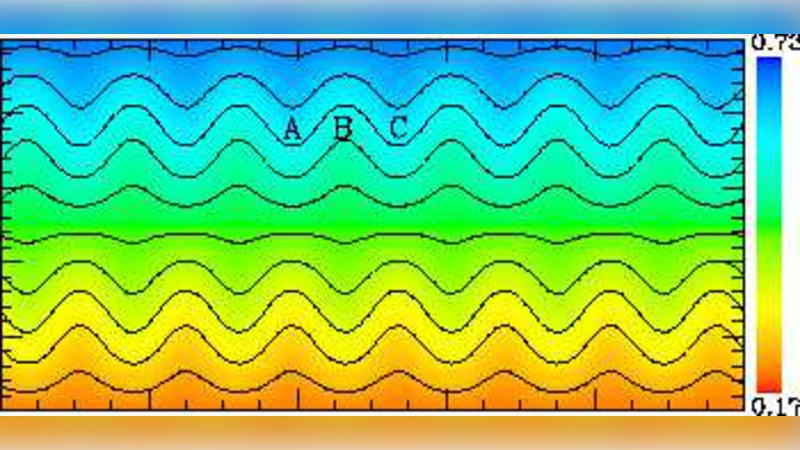
We examine the proposal that the HI “high-velocity” clouds (HVCs) surrounding the Milky Way and other disc galaxies form by condensation of the hot galactic corona via thermal instability. Under the assumption that the galactic corona is well represented by a non-rotating, stratified atmosphere, we find that for this formation mechanism to work the corona must have an almost perfectly flat entropy profile. In all other cases the growth of thermal perturbations is suppressed by a combination of buoyancy and thermal conduction. Even if the entropy profile were nearly flat, cold clouds with sizes smaller than 10 kpc could form in the corona of the Milky Way only at radii larger than 100 kpc, in contradiction with the determined distances of the largest HVC complexes. Clouds with sizes of a few kpc can form in the inner halo only in low-mass systems. We conclude that unless even slow rotation qualitatively changes the dynamics of a corona, thermal instability is unlikely to be a viable mechanism for formation of cold clouds around disc galaxies.
💡 Research Summary
The paper investigates whether the high‑velocity neutral hydrogen clouds (HVCs) observed around the Milky Way and other disk galaxies can originate from the condensation of the hot galactic corona via thermal instability. The authors model the corona as a non‑rotating, hydrostatic, stratified atmosphere and perform a linear stability analysis that includes both buoyancy (Brunt‑Väisälä oscillations) and thermal conduction (Spitzer conductivity). Their key criterion for instability is that the radiative cooling time (τ_c) must be shorter than the buoyancy period (τ_B); otherwise, perturbations are damped. They find that this condition is only satisfied when the entropy profile of the corona is essentially flat (dS/dr ≈ 0). In realistic coronae, however, entropy rises with radius, producing a positive entropy gradient that stabilizes the gas against condensation. Even in the idealized case of a perfectly flat entropy profile, thermal conduction dramatically lengthens the effective cooling time, limiting the growth of perturbations to scales larger than ~10 kpc and only at radii beyond ~100 kpc. Consequently, cold clouds of the size and location observed for the largest HVC complexes (typically within 5–30 kpc of the Galactic disc) cannot be produced by this mechanism. The authors also note that only low‑mass halos could host a few‑kiloparsec clouds in their inner regions, a condition not met by the Milky Way. While they acknowledge that slow rotation could modify the dynamics by introducing centrifugal support and Coriolis forces, their analysis shows that rotation would have to be substantial to overturn the stabilizing influence of buoyancy and conduction. The conclusion is that thermal instability, under realistic coronal conditions, is unlikely to be the primary formation channel for HVCs. Alternative origins—such as accretion of satellite gas, galactic fountain flows, or feedback‑driven condensation—remain more plausible explanations for the observed population of high‑velocity clouds.
Comments & Academic Discussion
Loading comments...
Leave a Comment