M31* and its circumnuclear environment
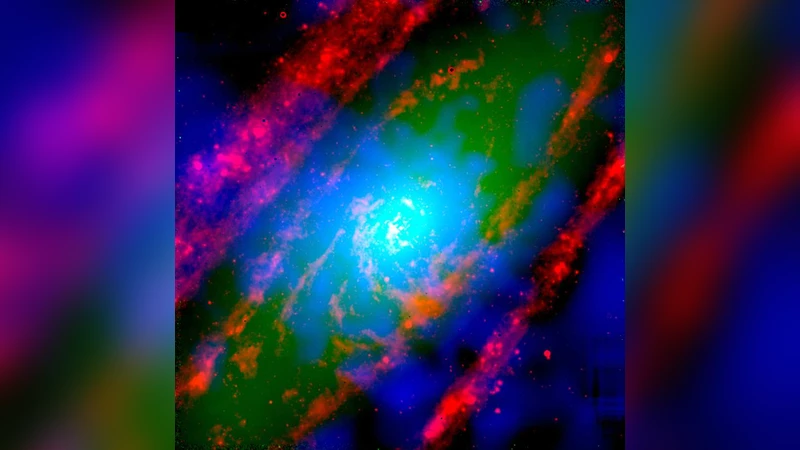
We present a multiwavelength investigation of the circumnuclear environment of M31. Based on Chandra/ACIS data, we tightly constrain the X-ray luminosity of M31*, the central supermassive black hole of the galaxy, to be L (0.3-7 keV)<= 1.2x10^{36}erg/s, approximately 10^{-10} of the Eddington luminosity. From the diffuse X-ray emission, we characterize the circumnuclear hot gas with a temperature of ~0.3 keV and a density of ~0.1 cm^{-3}. In the absence of an active SMBH and recent star formation, the most likely heating source for the hot gas is Type Ia SNe. The presence of cooler, dusty gas residing in a nuclear spiral has long been known in terms of optical line emission and extinction. We further reveal the infrared emission of the nuclear spiral and evaluate the relative importance of various possible ionizing sources. We show evidence for interaction between the nuclear spiral and the hot gas, probably via thermal evaporation. This mechanism lends natural understandings to 1) the inactivity of M31*, in spite of a probably continuous supply of gas from outer disk regions, and 2) the launch of a bulge outflow of hot gas, primarily mass-loaded from the circumnuclear regions. One particular prediction of such a scenario is the presence of gas with intermediate temperatures arising from the conductive interfaces. The FUSE observations do show strong OVI$\lambda$1032 and 1038 absorption lines against the bulge starlight, but the effective OVI column density (~4x10^{14} cm^{-2}), may be attributed to foreground gas located in the bulge and/or the highly inclined disk of M31. Our study strongly argues that stellar feedback, particularly in the form of energy release from SNe Ia, may play an important role in regulating the evolution of SMBHs and the interstellar medium in galactic bulges.
💡 Research Summary
This paper presents a comprehensive multi‑wavelength study of the circumnuclear region of the Andromeda galaxy (M31), focusing on the central supermassive black hole (M31*) and the surrounding interstellar medium (ISM). Using deep Chandra/ACIS observations, the authors place a stringent upper limit on the 0.3–7 keV X‑ray luminosity of M31*: L_X ≤ 1.2 × 10³⁶ erg s⁻¹, which corresponds to roughly 10⁻¹⁰ of the Eddington luminosity for a ~1.4 × 10⁸ M_⊙ black hole. This demonstrates that M31* is essentially quiescent, in stark contrast to many low‑luminosity active galactic nuclei.
The diffuse X‑ray emission after removal of point sources reveals a hot plasma with a temperature of ≈0.3 keV (≈3.5 × 10⁶ K) and an electron density of ≈0.1 cm⁻³. In the absence of recent star formation or AGN heating, the authors argue that Type Ia supernovae (SNe Ia) are the dominant energy source maintaining this hot phase. By adopting a SN Ia rate of ~0.03 yr⁻¹ and a canonical kinetic energy release of 10⁵¹ erg per event, they show that the cumulative heating can balance radiative cooling and sustain the observed temperature and density.
In parallel, the paper examines the well‑known nuclear spiral—a dusty, cold gas structure traced by optical emission lines (e.g., Hα,
Comments & Academic Discussion
Loading comments...
Leave a Comment