The gravitational wave background from star-massive black hole fly-bys
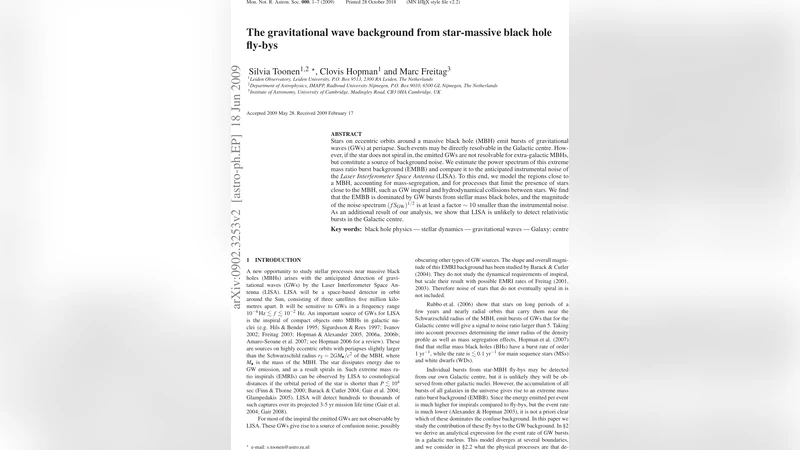
Stars on eccentric orbits around a massive black hole (MBH) emit bursts of gravitational waves (GWs) at periapse. Such events may be directly resolvable in the Galactic centre. However, if the star does not spiral in, the emitted GWs are not resolvable for extra-galactic MBHs, but constitute a source of background noise. We estimate the power spectrum of this extreme mass ratio burst background (EMBB) and compare it to the anticipated instrumental noise of the Laser Interferometer Space Antenna (LISA). To this end, we model the regions close to a MBH, accounting for mass-segregation, and for processes that limit the presence of stars close to the MBH, such as GW inspiral and hydrodynamical collisions between stars. We find that the EMBB is dominated by GW bursts from stellar mass black holes, and the magnitude of the noise spectrum (f S_GW)^{1/2} is at least a factor ~10 smaller than the instrumental noise. As an additional result of our analysis, we show that LISA is unlikely to detect relativistic bursts in the Galactic centre.
💡 Research Summary
The paper investigates a previously under‑explored source of low‑frequency gravitational‑wave (GW) noise: short, burst‑like GW emission from stars on highly eccentric orbits around massive black holes (MBHs). When a star passes through periapse it radiates a brief, intense GW burst. For a single galaxy such an event could be resolved (e.g., in the Galactic centre), but for the ensemble of distant MBHs the bursts overlap in time and frequency, forming a stochastic background dubbed the “extreme‑mass‑ratio burst background” (EMBB). The authors set out to quantify the EMBB’s power spectral density and to compare it with the anticipated instrumental noise of the Laser Interferometer Space Antenna (LISA).
Model of the nuclear star cluster
The authors adopt a standard cusp model for the stellar distribution around an MBH, with a power‑law density ρ∝r⁻ᵞ. Four stellar species are considered: main‑sequence stars (≈1 M⊙), white dwarfs (≈0.6 M⊙), neutron stars (≈1.4 M⊙), and stellar‑mass black holes (≈10 M⊙). Mass segregation is explicitly included: heavier objects sink deeper into the potential well, leading to a higher central concentration of stellar‑mass black holes. This segregation strongly influences the number of objects that can reach the small periapse distances required for strong GW bursts.
Physical limits on close orbits
Three processes are modeled to truncate the phase‑space of viable orbits:
-
Gravitational‑wave inspiral – Using the Peters‑Mathews formula the inspiral timescale τ_GW is computed for a given periapse. If τ_GW is shorter than the stellar lifetime (or the time a star spends on a given orbit), the object will quickly plunge into the MBH and will not contribute repeatedly to the background.
-
Hydrodynamical collisions – In the dense inner parsec, stars can physically collide. The mean collision time τ_coll is estimated from the stellar number density, relative velocity, and geometric cross‑section. Orbits for which τ_coll is less than the orbital period are deemed unpopulated.
-
Tidal disruption – The tidal radius r_t is calculated for each species; periapses smaller than r_t lead to complete disruption, removing the star from the population.
These limits carve out a “safe” region of orbital parameter space where stars can survive long enough to emit many bursts without being destroyed or swallowed.
Burst rate and spectral density
Within the allowed region, the authors integrate over semi‑major axis and eccentricity to obtain the differential burst rate dΓ/df for each species. A burst is treated as an impulsive GW signal of duration Δt≈(r_peri³/GM)¹ᐟ², and its Fourier amplitude scales as h̃(f)∝(G M_* /c² r_peri) f⁻¹. The single‑burst power spectrum therefore follows S_burst(f)∝(G² M_*² /c⁵) f⁻². Multiplying by the rate and summing over all species yields the total background spectral density S_GW(f).
The calculation shows that stellar‑mass black holes dominate the EMBB. Their larger mass and deeper penetration into the MBH potential produce stronger bursts, while mass segregation ensures a relatively high number density near the MBH. The contribution from lighter objects (main‑sequence stars, white dwarfs) is sub‑dominant by more than an order of magnitude.
Comparison with LISA sensitivity
LISA’s design sensitivity in the millihertz band is roughly (f S_n)¹ᐟ²≈10⁻²⁰ Hz⁻¹ᐟ². The EMBB spectrum computed by the authors lies at (f S_GW)¹ᐟ²≈10⁻²¹ Hz⁻¹ᐟ² across the most relevant frequencies (10⁻⁴–10⁻² Hz), i.e., at least a factor of ten below the instrumental noise floor. Consequently, the EMBB does not constitute a limiting confusion noise for LISA.
Detectability of individual Galactic‑centre bursts
The authors also estimate the rate of detectable bursts from the Milky Way’s central MBH (Sgr A*). Even under optimistic assumptions about the number of stellar‑mass black holes in the inner 0.01 pc, the expected signal‑to‑noise ratio for a single burst falls well below the detection threshold of LISA. Therefore, the prospect of observing a relativistic burst from our own Galactic centre with LISA is deemed unlikely.
Implications and future work
The study provides a comprehensive, physically motivated assessment of a potential stochastic GW background that could have interfered with LISA’s primary science goals. By demonstrating that the EMBB is comfortably below LISA’s noise floor, the authors reassure the community that the mission’s sensitivity to MBH mergers, extreme‑mass‑ratio inspirals, and cosmological backgrounds will not be compromised by this source. The methodology—combining mass segregation, tidal disruption, collisional destruction, and GW inspiral constraints—offers a template for future investigations of other exotic GW backgrounds (e.g., bursts from resonant scattering or from intermediate‑mass black holes). Extending the analysis to include non‑circular, resonant, or chaotic orbital dynamics, as well as applying it to next‑generation detectors such as TianQin or DECIGO, would further refine our understanding of low‑frequency GW confusion noise.
Comments & Academic Discussion
Loading comments...
Leave a Comment