Adaptive gene regulatory networks
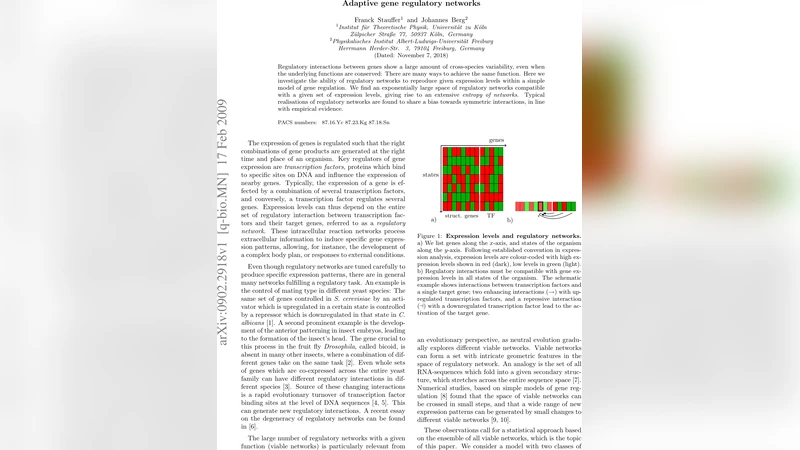
Regulatory interactions between genes show a large amount of cross-species variability, even when the underlying functions are conserved: There are many ways to achieve the same function. Here we investigate the ability of regulatory networks to reproduce given expression levels within a simple model of gene regulation. We find an exponentially large space of regulatory networks compatible with a given set of expression levels, giving rise to an extensive entropy of networks. Typical realisations of regulatory networks are found to share a bias towards symmetric interactions, in line with empirical evidence.
💡 Research Summary
The paper tackles a fundamental question in systems biology: how many distinct gene regulatory network (GRN) architectures can produce the same set of steady‑state expression levels? Using a minimalist model, each gene’s expression is governed by a monotonic activation function applied to a linear combination of the expression levels of all other genes plus an external bias. Formally, the steady‑state condition reads ( \mathbf{x}^{}=f(\mathbf{J}\mathbf{x}^{}+ \mathbf{h}) ), where ( \mathbf{x}^{} ) is the target expression vector, ( \mathbf{J} ) the interaction matrix, ( \mathbf{h} ) an external input, and ( f ) a sigmoidal (or otherwise monotonic) function. The authors treat ( \mathbf{x}^{} ) as given and ask what the space of admissible ( \mathbf{J} ) looks like.
By recasting the problem as a set of linear constraints on the entries of ( \mathbf{J} ) (once the non‑linear function is inverted at the target point) and applying tools from statistical mechanics—specifically, a replica‑type calculation of the volume of solutions—they derive an analytical expression for the number of compatible networks. The key result is that the solution space grows exponentially with the number of genes ( N ): ( \Omega \sim \exp(\alpha N) ), where ( \alpha>0 ) depends on the details of the activation function and the distribution of the external inputs. Consequently, the “network entropy” ( S = \ln \Omega ) scales linearly with ( N ), indicating a vast combinatorial freedom: many structurally different GRNs can implement the same functional output.
To explore the statistical properties of typical solutions, the authors generate random samples from the solution space using a Monte‑Carlo scheme that respects the constraints. Analysis of these sampled matrices reveals a pronounced bias toward symmetric interactions, i.e., a higher occurrence of pairs where ( J_{ij}=J_{ji} ) compared to antisymmetric or completely random couplings. This symmetry bias aligns with empirical observations in several model organisms where transcription factors often engage in mutually reinforcing or mutually inhibitory loops that are effectively symmetric at the level of interaction strength.
The paper interprets the symmetry bias as a “structural bias” that emerges even under entropy maximization. Symmetric couplings tend to flatten the effective energy landscape defined by the regulatory dynamics, thereby stabilizing fixed points and enhancing robustness against perturbations. In other words, among the astronomically many admissible networks, those that are more symmetric are statistically favored because they confer greater dynamical stability—a property that is likely selected for during evolution.
The authors acknowledge several limitations. The model’s linear‑plus‑nonlinear form abstracts away many biologically relevant features such as multi‑layered feedback loops, post‑transcriptional regulation, chromatin remodeling, and cell‑type specific epigenetic marks. Moreover, the analysis is confined to static steady‑state solutions; temporal dynamics, oscillatory behavior, and response to time‑varying signals are not addressed. Finally, the work does not directly validate the theoretical predictions against high‑throughput gene‑expression or ChIP‑seq datasets, leaving an empirical gap.
Future directions proposed include extending the framework to incorporate stochastic gene expression, multi‑scale regulatory layers, and explicit evolutionary dynamics that could explain how natural selection navigates the high‑entropy solution space toward biologically viable networks. The authors also suggest applying Bayesian inference techniques to infer the most probable network structures from noisy data, using the derived entropy as a prior that penalizes overly complex solutions.
In summary, the study provides a rigorous quantitative foundation for the intuition that many different GRN topologies can realize the same functional phenotype. By demonstrating an exponential proliferation of compatible networks and a statistically significant tilt toward symmetric interactions, the paper bridges concepts from statistical physics, information theory, and evolutionary biology. Its insights have practical implications for synthetic biology—where designing robust circuits often requires navigating a vast design space—and for disease genomics, where pathological rewiring of regulatory networks might be understood as a shift within this high‑entropy landscape rather than a singular catastrophic failure.
Comments & Academic Discussion
Loading comments...
Leave a Comment