Cosmology: small scale issues
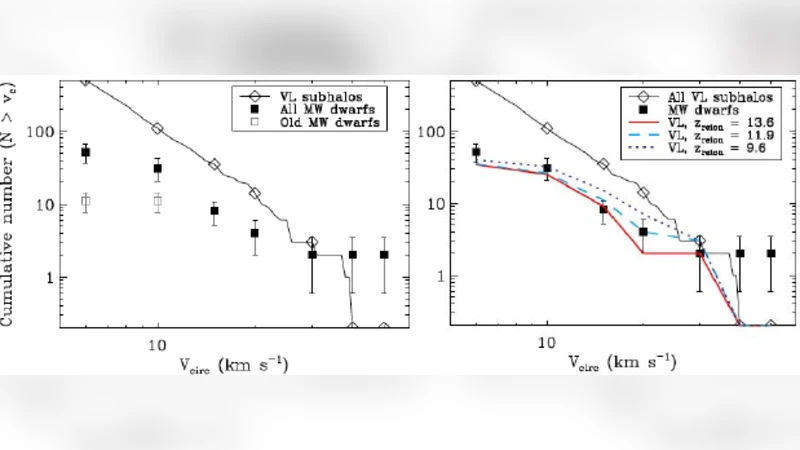
The abundance of dark matter satellites and subhalos, the existence of density cusps at the centers of dark matter halos, and problems producing realistic disk galaxies in simulations are issues that have raised concerns about the viability of the standard cold dark matter (LambdaCDM) scenario for galaxy formation. This talk reviews these issues, and considers the implications for cold vs. various varieties of warm dark matter (WDM). The current evidence appears to be consistent with standard LambdaCDM, although improving data may point toward a rather tepid version of LambdaWDM - tepid since the dark matter cannot be very warm without violating observational constraints.
💡 Research Summary
The paper reviews three long‑standing small‑scale challenges to the standard cold dark matter cosmology (ΛCDM): the “missing satellites” problem, the core‑cusp discrepancy, and the difficulty of forming realistic thin disk galaxies in simulations. In the missing‑satellites issue, high‑resolution N‑body simulations predict hundreds of subhalos around a Milky Way‑mass halo, yet only a few dozen luminous dwarf satellites are observed. The author discusses possible resolutions, including observational incompleteness, suppression of star formation by reionization and supernova feedback, and the notion that many subhalos remain dark. Recent simulations that incorporate strong feedback and a realistic reionization history reduce the predicted subhalo mass function, bringing theory into better agreement with data.
The core‑cusp problem concerns the inner density profile of dark‑matter halos. ΛCDM predicts a steep ρ∝r⁻¹ “cusp” while rotation curves of low‑mass galaxies often show a flat “core”. Two broad classes of solutions are examined. First, baryonic processes—especially energetic feedback from supernovae, gas outflows, and dynamical heating—can redistribute dark matter and flatten the central profile. State‑of‑the‑art hydrodynamic simulations demonstrate that repeated bursty feedback can generate cores even in dwarf halos. Second, modifications to the dark‑matter particle itself, such as self‑interacting dark matter (SIDM) or warm dark matter (WDM), naturally produce shallower inner slopes because the particles have non‑negligible thermal velocities that erase the smallest structures.
The third challenge is the formation of realistic disk galaxies. Early ΛCDM simulations produced overly thick, bulge‑dominated systems due to excessive early merging and inefficient angular‑momentum retention. Modern simulations that include refined treatments of gas cooling, star‑formation efficiency, and feedback have succeeded in producing thin, rotationally supported disks that resemble observed spirals. Nevertheless, these successes are sensitive to sub‑grid parameter choices, and the problem of overly massive central concentrations remains an active area of research.
To assess whether a warm component could alleviate all three problems simultaneously, the author compares ΛCDM with several WDM scenarios. Warm dark matter, characterized by a free‑streaming length of order a few hundred kiloparsecs, suppresses the formation of low‑mass subhalos, thereby addressing the missing‑satellites issue. The same thermal motion also smooths the inner density profile, offering a natural route to core formation. However, if the particles are too warm, they conflict with Lyman‑α forest measurements and the observed high‑redshift galaxy population, which require sufficient small‑scale power. Consequently, the paper argues that a “tepid” WDM model—one with a modest free‑streaming scale that barely satisfies Lyman‑α constraints—offers the best compromise.
Overall, the current observational evidence does not decisively rule out ΛCDM; rather, the small‑scale tensions appear to be mitigated by a combination of improved baryonic physics, better observational completeness, and perhaps a slight warm component. Future high‑precision surveys (e.g., JWST, LSST) and next‑generation hydrodynamic simulations will sharpen these constraints, potentially confirming whether a tepid ΛWDM scenario is required or whether ΛCDM with refined baryonic feedback suffices to explain the universe on all scales.
Comments & Academic Discussion
Loading comments...
Leave a Comment